On this page
GetSales' Q2 2026 data puts the median sender at 21% connection acceptance and 22% replies after acceptance. These measure different stages: a connection accepted, a prospect who replied, and a meeting booked are separate outcomes.
For B2B founders and sales teams, the useful question is where your own prospects drop off. Fix list quality and the sender profile when acceptance is weak. Examine the offer, first message and follow-up when accepted connections stay quiet. Extrovert supports the work around those stages: tracking prospect posts, preparing relevant comments and suggesting contextual DMs.
Petr Kaliuzhny and Oleg Sobolev presented the figures in the GetSales × Extrovert webinar on July 9, 2026. GetSales covered more than 6 million invitations across 20,000-plus accounts in Q2 2026. Extrovert's July 2026 analysis covered roughly 153,000 requests, 836,000 DMs and 857,000 posted comments across about 1,100 senders, mostly B2B founders and salespeople. Each finding below uses its own eligible cohort, not that entire inventory.
Start with the right benchmarks
In GetSales' Q2 2026 network data, the median sender had a 21% connection acceptance rate and a 22% reply rate after acceptance. The top 10% of senders reached 42% acceptance and 38.5% replies.
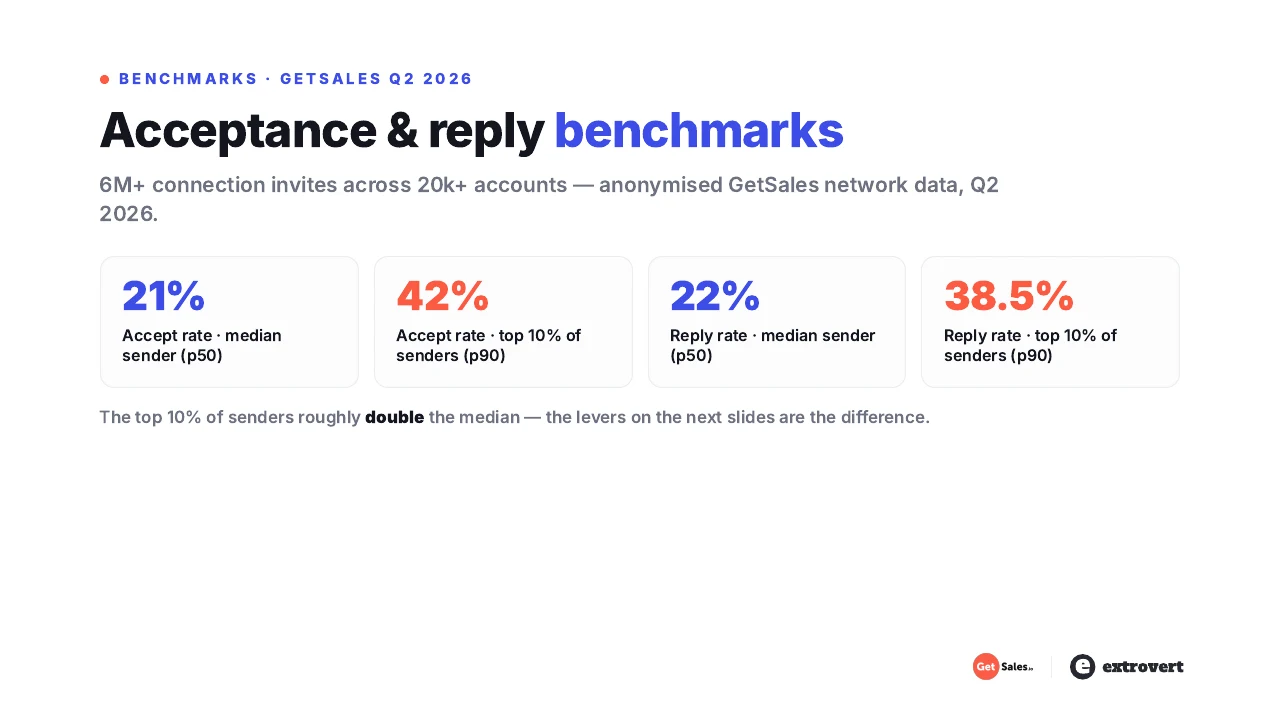
GetSales Q2 2026 anonymized network data. The 42% and 38.5% figures describe the top 10% of senders, not a guaranteed before-and-after lift.
Define your denominator before comparing results
Track each metric separately:
- Acceptance rate: accepted invitations divided by invitations successfully sent in the same cohort. Give pending requests the same observation time before comparing lists.
- First-DM reply rate: conversations with a prospect reply divided by eligible conversations that received a first DM. Count people or conversations once, not every message.
- Per-step reply rate: replies among leads who reached that specific sequence step. It has a different denominator from the campaign's overall reply rate.
- Meeting rate: meetings booked divided by the prospect cohort you name. A reply can be negative, and acceptance does not establish interest in buying.
Keep connection-note replies, post-acceptance DMs and InMail separate. Compare like audiences, channels and observation windows; a cold invitation benchmark cannot tell you your warm-DM reply rate.
GetSales reports sender-level median and top-decile benchmarks, not a pooled conversion rate for all 6 million invitations. Its slides do not specify a reply observation window, so do not treat the 22% figure as directly equivalent to Extrovert's 14-day first-DM measurement.
Treat these as diagnostic references, not universal promises. Petr noted that crowded categories such as custom software development can have lower acceptance rates because prospects see similar offers all day.
If acceptance is weak relative to comparable campaigns, inspect the list and sender profile before rewriting every message. If people accept but do not reply, inspect the offer, delivery and follow-ups. The gap shows how widely results vary among senders.
Give people a reason to answer
A generic description of your service is not an offer. “We offer LinkedIn automation at a good price” gives the prospect nothing concrete to grab.
Petr recommends building a no-brainer offer: specific value for a specific audience, with enough substance that the person can make a quick decision. Petr described an experiment from roughly one or two years before the July 2026 webinar: a single email offering unlimited LinkedIn and email automation went to 2,000 people in Smartlead and Instantly audiences and booked 40 meetings in the same week. That is a speaker-reported email campaign outcome, not a LinkedIn reply benchmark. The takeaway is to make the value obvious before adding personalization.
Value-first openers can also lower the effort needed to reply:
- “I put together a guide on how to double your LinkedIn acceptance rate. Want me to share it?”
- “We audited how often GPT and Claude surface your brand versus competitors. Want to see it?”
- “A client wants experts in your domain. Some make $10,000 a month on the side. Want an invite?”
These webinar examples make “yes” easy and the promised value clear; they are not a guarantee of replies. The asset or opportunity still has to be real. A dressed-up pitch with no useful give will not become better because it asks permission.
Once the prospect says yes, deliver what you offered and continue with a relevant question. That creates a conversation before you ask for a meeting.
Follow up, but know when the cold sequence is over
GetSales found that the first message received about a 15% reply rate among leads who reached it. The second produced about 7.5%, the third 4.5% and the fourth 1.7%. These rates are per message, not numbers you should add together.
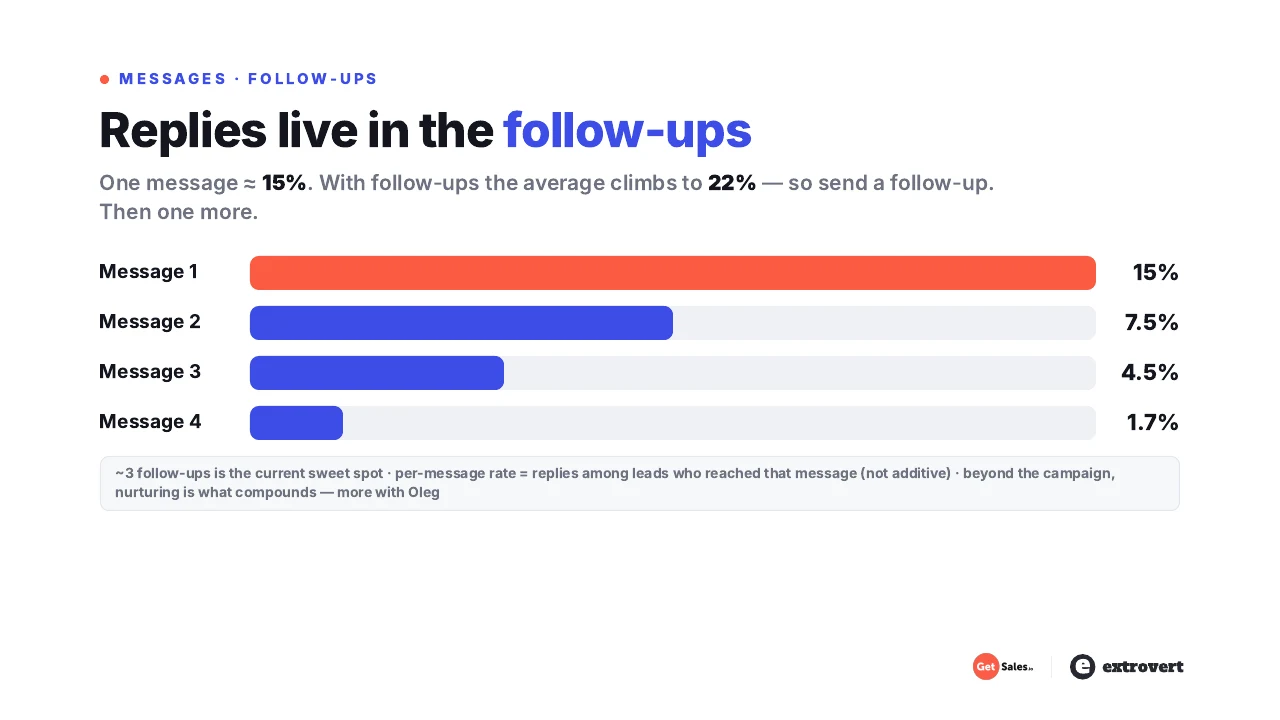
GetSales per-message reply rates among leads who reached each step. The percentages are not additive.
Petr's practical recommendation is around three follow-ups in a cold sequence. One message leaves replies behind. Stop immediately after an opt-out or negative response. Do not treat a follow-up count as a safe activity quota. After the cold sequence, move the prospect into a slower nurture motion rather than continuing the same chase.
Delivery matters too. Petr advises against putting a link or Loom video in the first LinkedIn message before a reply. He reported warnings or filters around links in his outreach experience; that does not mean every first-message link is blocked. Oleg added that a truly personalized video may make sense for some mid-market or enterprise accounts, but his team found the effort hard to justify for routine outreach.
A better workflow is to ask whether the person wants a short personalized video. Record it only after they answer. You get consent, avoid spending time on people who are not interested and remove the link from the cold opener.
The same human-delivery rule applies to the sequence itself:
- clean company names, job titles and other imported fields before they enter a message;
- avoid obvious placeholder sentences such as “I came across your profile and saw you work at {company}”;
- do not visit, like several posts, connect and message within minutes;
- vary messages instead of sending one identical block at scale;
- monitor open rates where available, since a sudden drop may mean messages are landing outside the primary inbox.
Use automation for repetitive steps, but clean the variables, pacing and copy before anything reaches the prospect.
Use signals only after you qualify the list
Petr described auditing a campaign aimed at plumbers and local businesses that included tech CEOs and unrelated roles. The campaign had a 2% acceptance rate. Better copy would not repair the list.
Before launch, check:
- Buying role: Does this person own or influence the problem?
- Company fit: Is the company relevant even if the title looks right?
- Current employment: Does the person still work there?
- Geography and language: Can you communicate naturally in the market you selected?
- Reachability: Does the profile have a photo, a credible network and signs of real activity?
- Platform activity: Do they post, comment or react often enough to see your outreach?
Petr recommends testing native-language greetings or sequences and warned that teams may have to explain the switch if the sales rep cannot continue in that language. For practical use, treat language as a market and staffing choice.
In Extrovert's July analysis, profiles posting two to five times weekly had 42.8% acceptance (7,857 requests), versus 24.6% for the zero-post-frequency cohort (71,182 requests). This measures observed posting frequency, not every form of LinkedIn activity. This overlaps with the warm-up effect, so do not multiply the lifts. Use activity as a list-quality filter.
Signals can improve timing, but relevance still comes first. “Attended a webinar about LinkedIn conversions” can explain why a related playbook is useful now. “Liked a post” is not a reason to buy. Petr's framework is to use timely signals to strengthen a relevant offer, not replace one. A signal can explain timing; it does not prove purchase intent.
Use more than one route to the account
If a relevant prospect does not accept your connection request, the account does not have to disappear.
Petr recommends trying InMail, especially for open profiles where it is free, and using paid InMail selectively behind a strong offer. For prospects you cannot reach on LinkedIn, find and verify a work email, then send the same value-first offer at low volume.
Existing first-degree connections deserve their own path. They already know you or have seen your content, so do not automatically end a campaign when your system detects an existing connection. Review the conversation history and send a relevant message when there is a real reason to restart it.
Your profile is part of the message
Prospects often inspect the sender before accepting. A confusing headline, missing photo or generic banner can sink a strong campaign.
Petr's profile checklist is straightforward:
- use a clear, open photo, ideally with a visible face and natural smile;
- write a headline that communicates one understandable offer, achievement or point of view;
- avoid piling GTM, RevOps, AI and every tool you use into one line;
- use the banner to support what you do and why it matters;
- publish useful posts so new connections keep seeing evidence after they accept.
A blank connection request is a sensible default when you have no meaningful note. Petr found the acceptance rates for notes and blank requests were similar after recalculating his data, so he chose not to publish a hard comparison. A real referral or specific reason to connect can make a note useful. Generic filler adds risk without adding context.
Warm the request while your name is still fresh
In Extrovert's July 2026 analysis of 127,725 successfully sent requests with at least 21 days to mature, the no-prior-comment cohort had 27.4% acceptance (96,188 requests). One prior comment was associated with 38.6% (15,660 requests), and two with 41.1% (10,186 requests). Five or more comments had 35.8% acceptance (1,966 requests); four comments had 40.5%. These are different observed groups, not the same prospects before and after an intervention.
Among 31,538 requests with prior comments, the under-one-day gap cohort had 44.1% acceptance (12,381 requests), versus 32.5% for gaps of 30 days or more (4,555 requests). These groups can differ in targeting and sender behavior. Use recency as a reason to consider connecting, not a guaranteed lift or instruction to force comments.
The practical play is small:
- Choose an active, well-qualified prospect.
- Leave one or two useful comments on posts where you have something real to add.
- Send the connection request while your name is still familiar.
- Stop commenting if you are forcing it. Familiarity helps; a sudden wall of attention feels strange.
If prospects rarely publish, Oleg suggests engaging in their orbit: comment on posts from colleagues or industry voices they already follow and engage with. The July trigger-based analysis found 40.6% acceptance for indirect-comment requests (1,541), 43.5% for direct-comment requests (22,936) and 27.3% for no-comment requests (103,319), all matured at least 21 days. This trigger-based cut is separate from the comment-count cohorts above. Since there is no guarantee the prospect sees an indirect comment, use it as a visibility tactic rather than pretending it is a direct interaction.
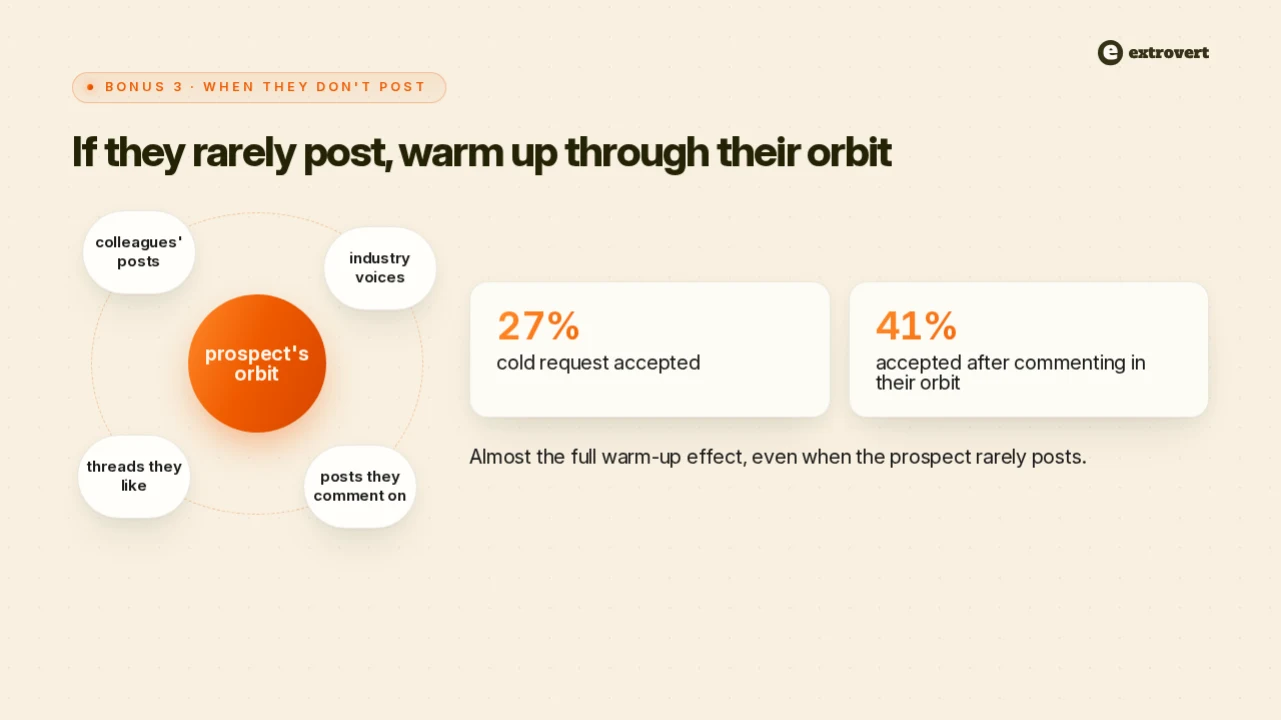
The orbit model means contributing to posts the prospect may already see. The rounded 41% figure represents 40.6% acceptance in the 1,541-request indirect-comment cohort and does not guarantee that any individual prospect saw the comment.
Keep the first message useful and easy to answer
Extrovert measured 15,533 first Extrovert-sent DMs per conversation, each given at least 14 days to mature, with a prospect reply counted within 14 days. Messages of 50–100 characters had 15.9% replies (554 DMs). The 150–300-character buckets ranged from 27.4% to 31.2%, while 800-plus characters had 21.5% (1,223 DMs). Message length is associated with replies in this population; it is not an experimentally proven optimum for every audience.
The middle range gives you room for two or three sentences: one specific observation about the prospect, one useful idea and one easy question. It is long enough to create a reason to answer but short enough to avoid a full pitch.
The subject matters more than polishing the sentence. Within the same first-DM analysis, post-triggered messages had higher replies than generic post-connect timeout messages. The gap was about 5–8 percentage points in the 150–700-character buckets; the under-150-character gap was 2.8 points. The comparison groups also differ in timing and context, so it does not isolate a causal effect of wording. The same approach becomes even more useful in follow-ups. A product launch, new hire, conference, post or other current event gives you a natural reason to restart the conversation.
For example, ask how a recent launch went rather than sending a third version of your value proposition. Once they answer, you can continue the conversation and introduce the commercial angle when it fits.
Stay visible after the cold sequence
Cold sequences usually end before many prospects are ready to buy.
Extrovert tracked 968 first-DM conversations with no reply in the first 14 days and at least 90 days of observation. Late replies in days 14–90 occurred in 2.3% of the went-dark group (528 conversations), versus 18.6% of the group that continued commenting and sent follow-up DMs (129 conversations). This is a modest, self-selected observational comparison, not proof that nurture creates that uplift. Stay present with relevant touches rather than extending the same cold sequence.
Comments, DMs and your own posts work together here. A comment keeps your name visible. A contextual DM reopens the thread. Useful content gives the prospect something to learn from between direct conversations.
Speed matters once they do reply. Across 155,364 exchanges in Extrovert's July data, a prospect replied again in 83.2% of cases when the sender answered within an hour (84,322 exchanges). The rate was 66.8% for a 4–24-hour delay (23,513 exchanges), and 63.1–65.0% for longer delays. These are repeat-reply rates within existing conversations, not first-DM replies or meetings. Some of that spread may reflect naturally active conversations, but the operational lesson is sound: route prospect replies into an inbox someone checks and respond while the exchange is live.
Keep a human between AI and the prospect
AI can help clean variables, summarize a post, find a useful angle and draft comments or DMs. It cannot reliably judge every social context.
At the July webinar, Oleg described his own workflow: he approves about 70% of his suggested comments as written and edits roughly 30%. The edits may be small: remove a phrase, change the rhythm or add a line break. Sometimes the right decision is not to comment, especially on illness, grief, personal news or an inside joke the model does not understand.
Extrovert uses prospect context and your Voice to prepare comments and DMs. Manual review lets you edit, approve or skip drafts. Comment campaigns also support bulk approval and optional automatic mode; an MCP assistant can approve or send the actions you allow. Choose permissions deliberately rather than assuming every action requires a fresh human click. That boundary matters because a slightly wrong public comment can damage the sender's reputation in front of the prospect's whole network.
See how B2B sales teams use Extrovert to warm and nurture prospects and set the review and automation choices for the work you delegate.
Turn a relevant post into a conversation restarter
Extrovert's Conversation Restarters connect a concrete prospect post to a suggested DM. The illustration shows that source-to-draft step, so you can judge whether the reason to reconnect is useful before sending. It supports contextual follow-up; it does not predict a reply or book a meeting.
Illustration: Extrovert reads the prospect's posts. hot take, thought leadership, motivation, promotion are skipped. One post, went to sf tech week, is a Restarter signal. Extrovert suggests the DM "Seen you went to SF Tech Week. How did it go?", and the prospect replies.


Use AI to reduce effort per prospect. Keep the sender responsible for relevance, taste and timing.
A practical LinkedIn workflow
Put the pieces together in this order:
- Benchmark the current motion. Separate low acceptance from low post-acceptance replies.
- Fix the offer. Give a narrow audience a concrete reason to answer.
- Clean the list. Verify role, company, employment, geography, reachability and LinkedIn activity.
- Check the sender. Make the photo, headline, banner and recent content support the offer.
- Warm priority prospects. Leave one or two good comments and connect while your name is fresh.
- Write a concise contextual opener. Mention something specific about them and ask one easy question.
- Run a short cold sequence. Use around three follow-ups, then stop pushing.
- Add other channels. Try relevant InMail or a low-volume value-first email when LinkedIn does not connect.
- Move quiet prospects into nurture. Comment lightly and follow up when there is actual news.
- Reply promptly and choose review permissions. The system can suggest; the sender owns what goes out.
FAQ
Should I add a note to a LinkedIn connection request?
Use a note when you have a real referral, shared context or specific reason to connect. Otherwise, a blank request is a reasonable default. Petr recalculated GetSales data and found notes and blank requests had similar acceptance rates overall, so there was not enough evidence for a universal winner.
How many LinkedIn follow-ups should I send?
Petr recommends around three follow-ups in the cold sequence. GetSales' per-message reply curve declines from about 15% on message one to 7.5%, 4.5% and 1.7% on the next messages. After the cold sequence, switch to slower, contextual nurture rather than continuing to push the same offer.
Should I send a Loom or another link in the first message?
Petr advises against links before the first reply based on warnings or filters he reported in his outreach experience. Ask whether the prospect wants the resource or personalized video, then send it after they answer. Oleg noted that personalized Loom videos may still make sense for selected mid-market or enterprise accounts when the potential value justifies the manual work.
How can I tell whether a prospect is active on LinkedIn?
Check when they last published an original post and how often they post, comment or react. Oleg cautioned that Sales Navigator's “posted on LinkedIn” filter can include reposts or old posts. Use the prospect's recent posts and interactions to judge whether there is enough context for a useful approach.
Can AI comments run fully automatically?
Extrovert now supports optional automatic comment campaigns as well as manual review and bulk approval. Oleg's July advice was to keep a person checking social context, especially sensitive posts. If that matters for your campaign, choose manual review rather than assuming automation will understand every situation.
Does the day of the week matter for connection requests?
In the July analysis of 127,725 matured requests, acceptance ranged from 30.1% to 30.6% across all seven days. That small spread does not establish that send day never matters in another audience. Separately, among 33,807 acceptances with precise dates, 89% arrived within 14 days. That is a share of eventual acceptances, not an 89% chance that any pending request will be accepted, and it does not make two-week withdrawal a universal rule.