On this page
By June 18, 2026, HeyReach had reached $15M ARR in about three years, according to its CMO, Vukašin “Vuk” Vukosavljević. He attributed 90% of HeyReach’s growth to inbound and word of mouth, supported by inbound-led outbound.
HeyReach connects customer wins, integration launches, creator content, paid distribution, and lead qualification in a series of growth loops. Marketing passes sales the reason an account is worth contacting; sales keeps the conversation going when the account is not ready to buy.
Start with a user win you can measure
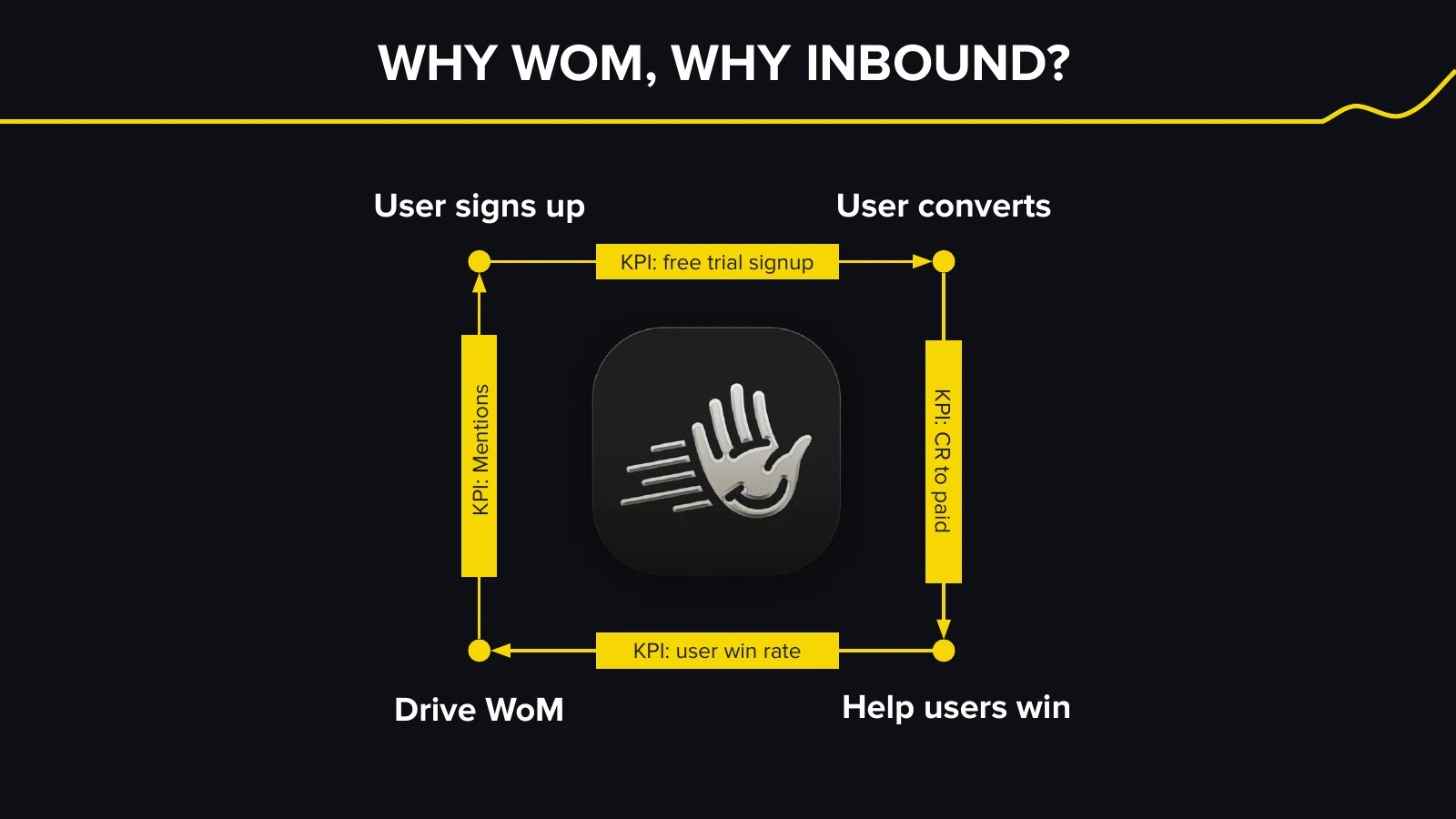
HeyReach’s funnel tracks the usual conversion steps: a visitor starts a free trial, activates, and becomes a paid user. But Vuk puts another metric at the center of the system: user win rate.
For HeyReach, a win can be measured through positive replies, accepted connections, or meetings booked. Those outcomes give customers something worth talking about. Vuk uses user win rate to connect acquisition with retention: customers need a reason both to stay and to recommend the product.
Vuk’s June 18 operating snapshot reported:
- 6,500+ companies using HeyReach
- 5,000+ free trials per month
- about 60% average profitability in 2026 to that point
- 90% of growth coming from inbound and word of mouth
To build the user-win loop:
- Help customers get a result they care about.
- Measure that result.
- Turn strong results into stories or shareable assets.
- Give customers a reason to distribute those stories.
- Feed the new attention back into acquisition.
This only works when the customer result is real. A referral program cannot rescue a product that does not help users win.
Treat integrations as distribution channels
HeyReach decided to focus on LinkedIn outreach rather than build every adjacent feature. Customers can connect it to enrichment, workflow, and multichannel tools that already fit their stack.
That product decision created a marketing opportunity. HeyReach prioritizes integrations using two checks:
- Do users want it because it helps them get better results?
- Does the partner have a relevant audience HeyReach can reach?
Clay passed both checks. Agencies were a core HeyReach audience, Clay already sat at the center of many agency workflows, and Vuk described HeyReach’s Clay launch as a first-mover opportunity. He said its integration advantage lasted more than a year.
The launch combined product adoption with a partner event and customer distribution.
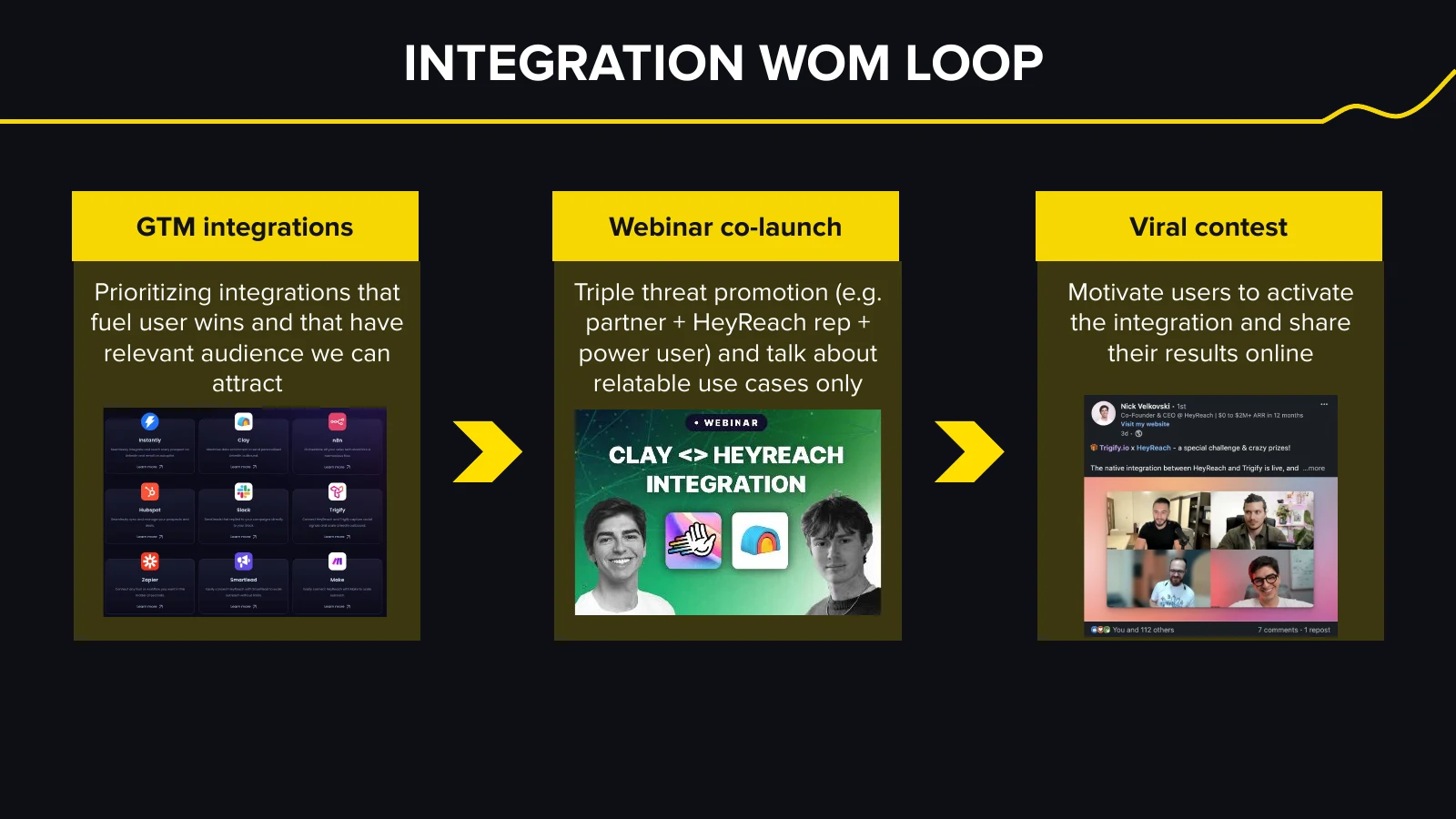
HeyReach used three steps:
- Build an integration with clear ICP fit. The product has to solve a real workflow problem.
- Co-launch with three perspectives. A partner representative, a HeyReach representative, and a power user show practical use cases together.
- Give users a reason to try and share it. A contest rewarded customers for putting the integration to work and publishing their results.
Vuk reported hundreds of posts from the Clay contest. He attributed the response to agency workflow fit, first-mover timing, Clay’s customer advocates, and users building their own authority by sharing what they built.
Vuk was clear that the same tactic did not work equally well with every partner. Distribution follows audience fit. Choose a partner whose users have a reason to build and share the workflow before committing to a contest.
Make the customer the main character
HeyReach’s early content loop started with people already sharing outreach workflows and mentioning the product. The team invited them to explain how they worked, then turned those explanations into stories for Outbound Outliers and other formats.
Vuk’s rule is memorable: the user is Batman; HeyReach is the Batmobile.
That changes how a case study is written. The story is about the customer’s skill, workflow, problem, and result. The product has a clear role, but it does not steal the spotlight or turn every paragraph into a feature pitch.
A useful customer story should answer:
- What was the customer trying to do?
- What was getting in the way?
- What workflow did they build?
- Where did the product help?
- What changed for the customer?
- Why would the customer want to share the story?
HeyReach treats the customer’s distribution as an outcome it must earn. The company promotes the customer, sends attention or leads their way, and gives them an asset that supports their own positioning.
Build collaborations where both sides get distribution
A collaboration needs a useful asset, an overlapping audience, and a distribution benefit for each participant.
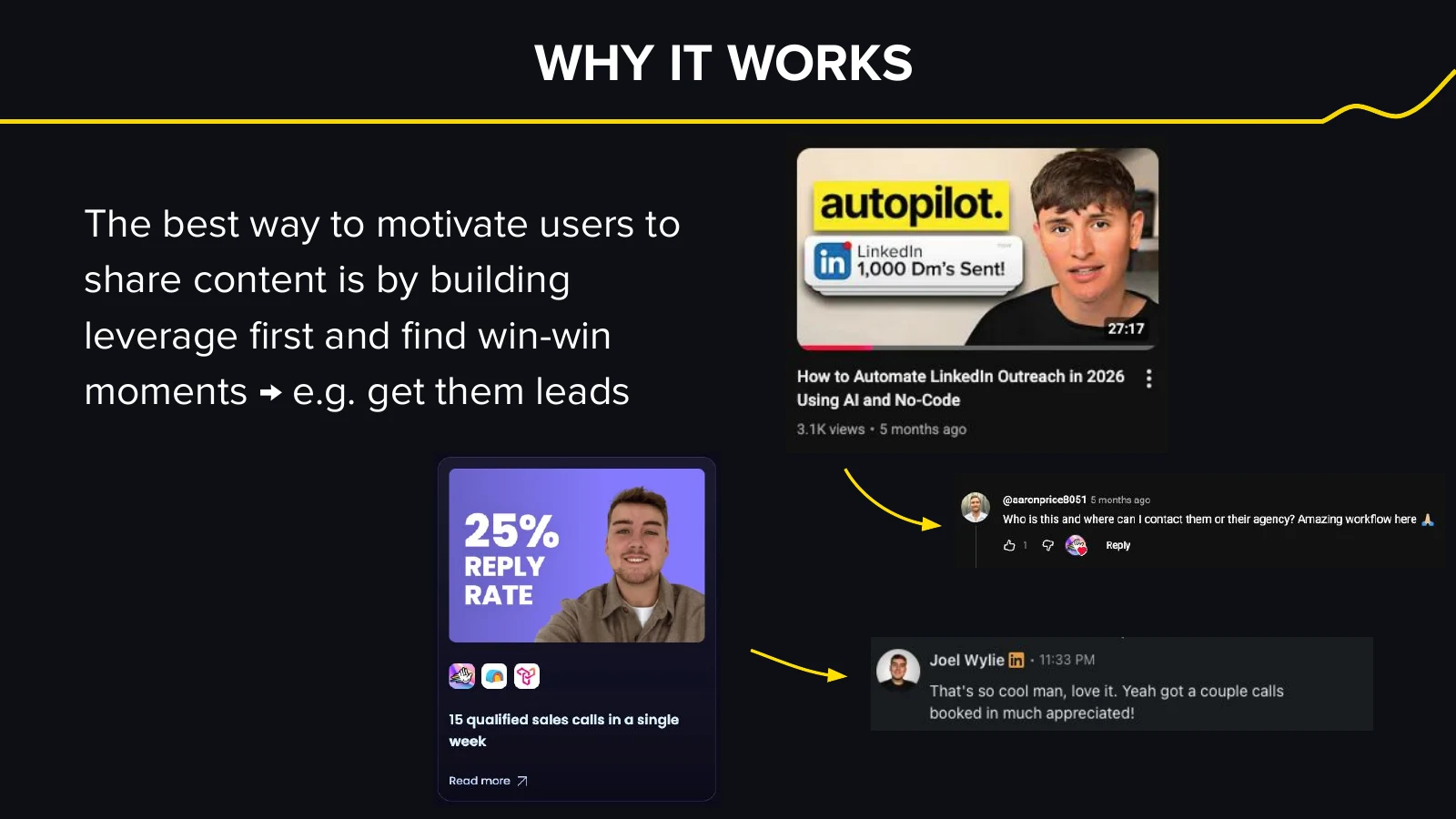
HeyReach’s collaboration loop has three parts:
- Choose a partner for audience and content fit. A large following is not enough. The audience needs to overlap with the people you want to reach.
- Create something useful to both audiences. Templates, tutorials, events, and workflow breakdowns work when each party has a credible contribution.
- Distribute together. Both sides use their newsletter, social profiles, community, product, or event channels to extend the asset’s reach.
As HeyReach’s owned distribution grew, collaboration became more valuable to creators and customers. Vuk said the company’s expert and creator programs generated 1,000 posts in 285 days.
Those programs were built as ongoing relationships. Participants received roadmap input, leads, reach, event opportunities, and other support. In return, they made content with HeyReach under their own voice and rules.
HeyReach’s programs gave creators reasons to collaborate repeatedly, beyond payment for an individual post.
The examples extended beyond webinars. Vuk described promoting agency owners’ Clay templates through HeyReach’s audience, co-distributing YouTube content, and a Belgrade event with Mina from Instantly and Tan, a power user of both tools. Each gave the collaborator something useful to show their own audience.
Turn proven organic posts into paid distribution
HeyReach also used paid distribution to extend posts that had already earned attention from the right audience. The team reviewed customer, creator, and ambassador posts, chose those with strong organic engagement and relevant commenters, then boosted the winners as LinkedIn thought leader ads.
This kept the creator in the spotlight while giving HeyReach wider distribution. Vuk reported roughly 20x return on ad spend for HeyReach’s LinkedIn ads as of the June session. That was a company-specific result from its existing inbound and creator network.
Paid distribution also showed HeyReach which user stories and workflows attracted qualified interest. The team shared those patterns with its creator network, used them to choose the next posts to boost, and repurposed strong ideas in retargeting and other ads.
Package user wins so they are easy to share
A customer may get a strong result and still never talk about it. HeyReach closes that gap by turning results into simple, branded assets.
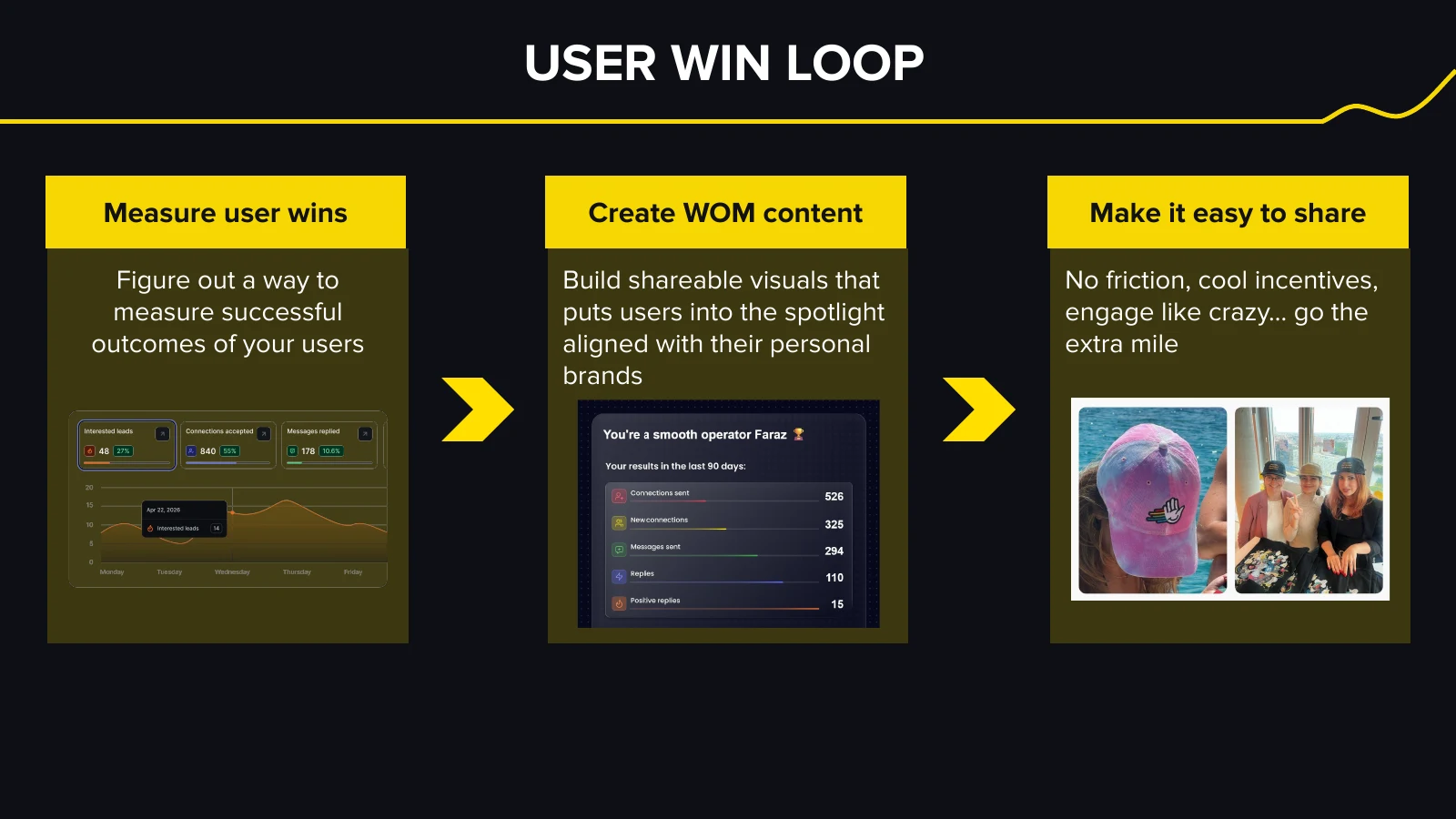
HeyReach Wrapped showed customers their activity and outcomes in a recognizable annual format. The Pipeline Queen campaign highlighted women building GTM workflows and offered limited-edition caps. A separate positive-reply-rate launch packaged users’ quarterly results. A share button and small incentives reduced the work required to publish.
To package user wins:
- Pick an outcome the product can measure honestly.
- Present the customer’s result in a format they would be proud to share.
- Keep the product’s role visible without making the asset an ad.
- Remove publishing friction.
- Support the customer’s post once it goes live.
The visual should protect the customer’s privacy and make them look good.
Turn engagement into qualified warm leads
Word of mouth and content create attention. A signal-based GTM workflow still has to qualify that attention before it becomes pipeline.
HeyReach captures people engaging with posts from employees, creators, experts, ambassadors, launches, and campaigns. The team enriches those contacts, checks ICP fit, then decides whether outreach makes sense.
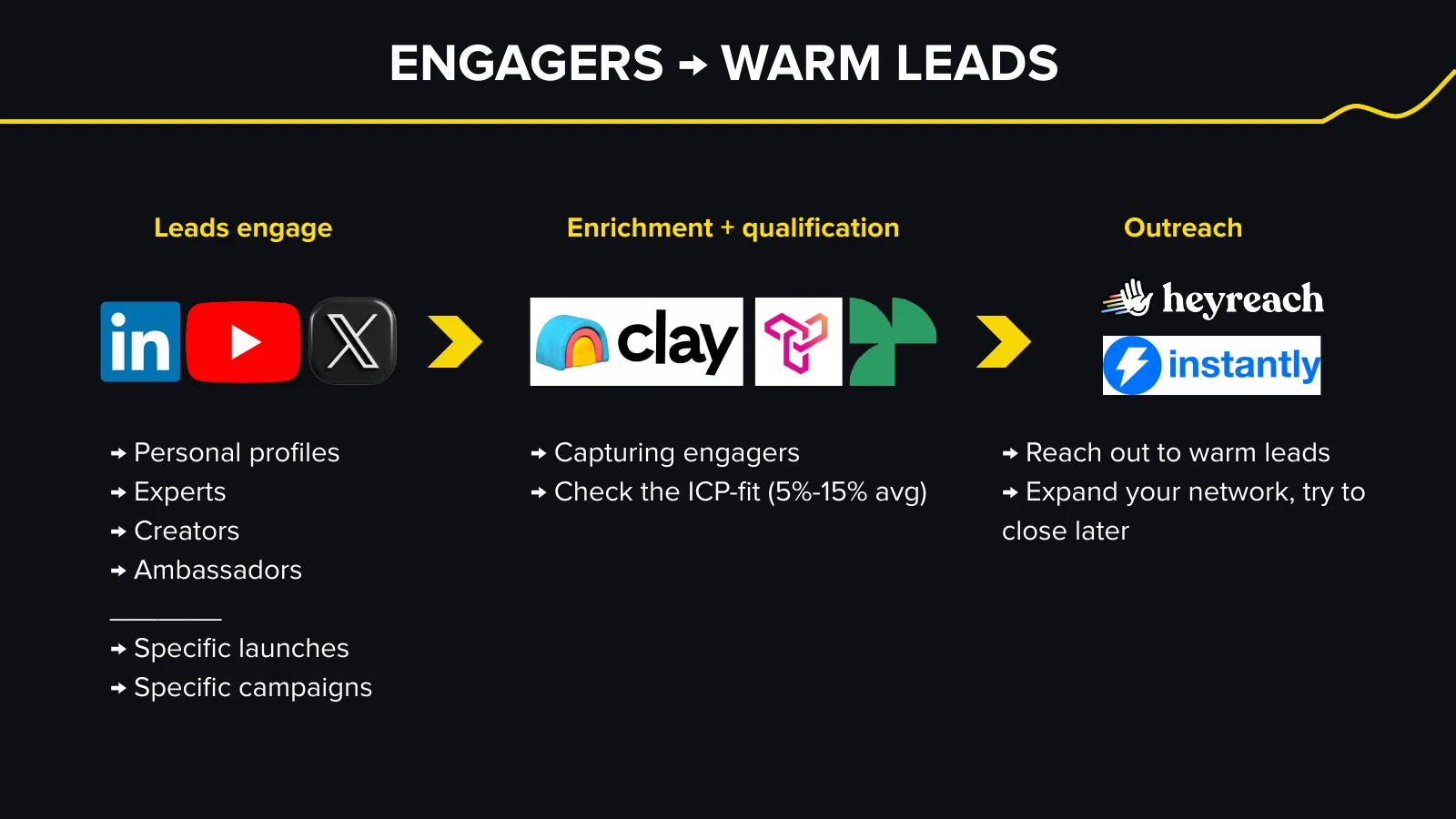
HeyReach’s June 18 slides put average ICP fit among captured social engagers at about 5% to 15%. That qualification step prevents a popular post from becoming a giant, poorly targeted sequence.
The workflow looks like this:
| Stage | Decision and next action |
|---|---|
| Capture | Collect the people or companies behind relevant content, ad, event, or website signals. |
| Qualify | Check account and person fit; enrich the record and exclude weak fits. |
| Add context | Record the topic they engaged with and relevant account history. |
| Route | Choose self-serve, success-led, sales-led, or a nurture path. |
| Reach out | Start with a timely reason to talk; engagement alone does not establish buying intent. |
HeyReach applies the same logic to free trials. Vuk said trial-to-paid conversion improved from 9% to 17% after marketing and sales worked together to qualify trials and route higher-value accounts into human onboarding.
One concrete campaign came from Nadja, HeyReach’s head of sales. In summer 2025, she selected outbound agencies with high annual contract value potential that had visited the website in the previous 30 days. The outreach connected that audience to new agency features, including workspaces and the n8n integration.
HeyReach’s June 18 slides reported 60% LinkedIn connection acceptance and 43% LinkedIn replies for that campaign. These figures apply to that selected agency audience, not to all HeyReach users or all warm outreach.
For trial routing, Vuk’s example was equally specific: a prospect had sent a campaign and received replies but failed to connect Clay. Sales could help resolve that setup problem rather than open with a generic demo request.
Give marketing and sales one shared scoreboard
Vuk argues against making marketing and sales fight over who “created” the revenue. A buyer may see a creator post, click an ad, receive an outbound message, visit the site, and talk to sales before buying.
The better questions are:
- Which touchpoints helped the account move?
- Which messages or posts created useful signals?
- Which accounts became qualified opportunities?
- Which activities should the team repeat?
HeyReach tracks qualified free trials and warm leads as primary marketing KPIs. It also sends marketing-influenced pipeline to sales with the context behind each account.
Attribution should help the team decide what to do next.
Keep good accounts warm after the first touch
Warm outreach can start a conversation without making a prospect ready to buy. Many good accounts need more time after the first touch.
For high-value accounts, the next step is to keep the interaction window long while keeping manual effort per prospect low.
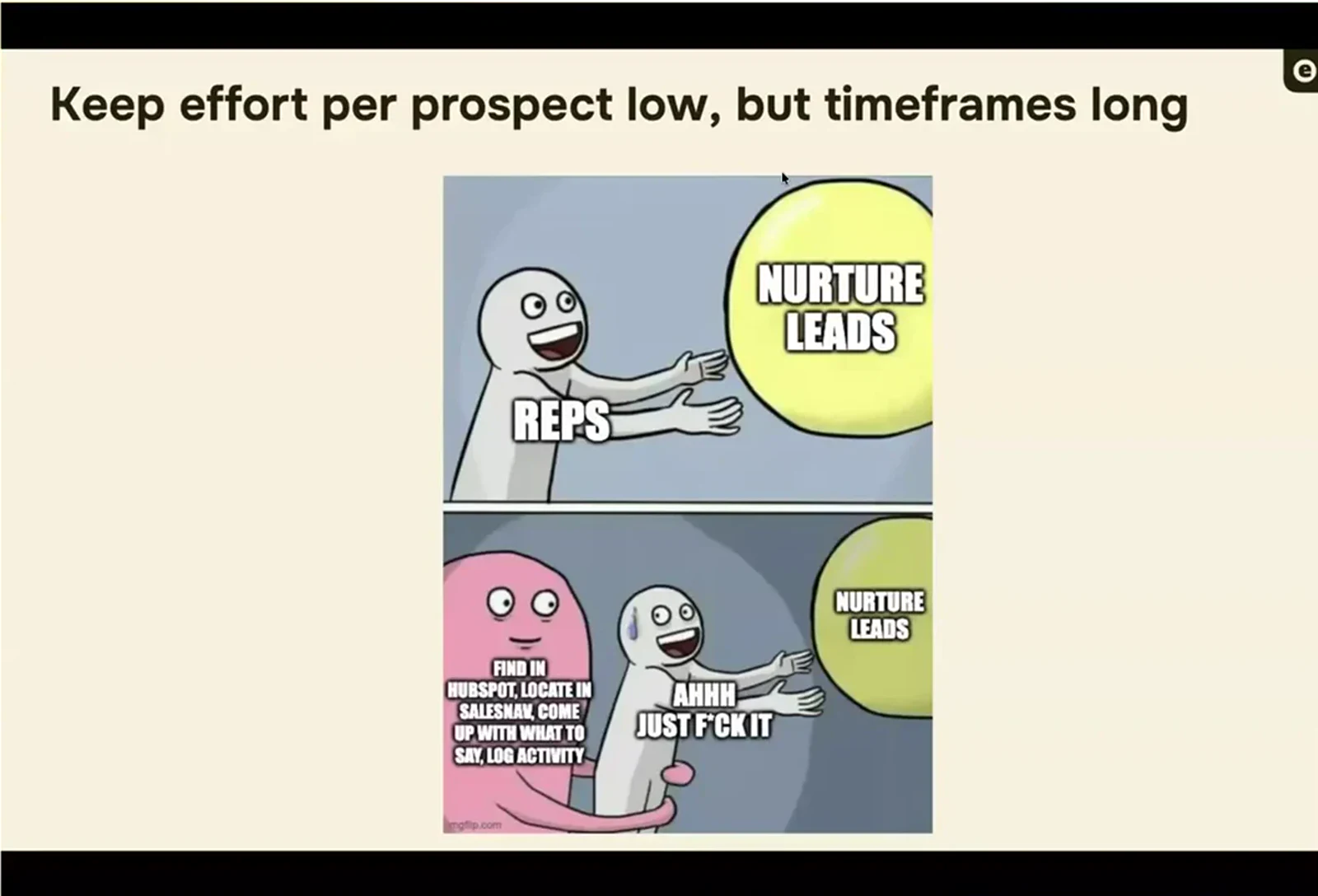
The workflow uses three kinds of touchpoint:
- Comments create familiarity before a connection request and help a salesperson stay visible.
- Nurturing DMs reopen a conversation around a real event, post, launch, or shared context instead of restarting the pitch.
- Posts keep teaching and reminding the prospect between direct conversations.
Extrovert founder Oleg Sobolev reported roughly double the connection acceptance among prospects with prior comments in an analysis of 30,000 connection requests sent through Extrovert. This was an observed association in Extrovert’s data, not a promised effect for every campaign.
For prospects who rarely post, Oleg suggested joining relevant discussions around people they follow. That gives the rep another place to contribute without relying on the prospect publishing regularly.
Extrovert helps B2B sales teams track chosen prospects, filter the content worth seeing, and draft comments or nurturing DMs based on the user’s instructions and voice. In the June demonstration, Oleg reviewed, edited, approved, skipped, or regenerated suggestions. Current Extrovert workflows also offer optional Automatic Comments and delegated agent actions. A rep can keep a review-led workflow for selected accounts without rebuilding the broader campaign motion.
Hand qualified accounts into a longer nurture workflow
Stefan Repin described using HeyReach for campaigns and Extrovert for ongoing prospect nurturing, including combining their MCP tools. That was his workflow example, not a claim that every account needs both products.
The handoff needs three things: the account’s ICP fit, the signal that prompted outreach, and the history of the conversation. A salesperson can then decide whether to follow up, contribute to a relevant post, help with a problem, or wait for a better moment.
Oleg’s example was a prospect’s Launchpad announcement. Extrovert surfaced the post and drafted a congratulatory DM around it, giving him a concrete reason to reconnect. For a long sales cycle, that kind of relevant touchpoint is more useful than restarting the same pitch.
For the original examples, watch the June 18 HeyReach and Extrovert replay and use the accompanying slides. The guest was HeyReach CMO Vuk Vukosavljević; HeyReach co-hosted the session with Extrovert.
FAQ
Does word of mouth mean the product grows by itself?
No. HeyReach treats word of mouth as a designed system. The product must create a measurable user win, and the company still packages customer stories, supports collaborators, distributes content, and routes the resulting attention into sales.
How should you choose an integration partner?
Start with user demand and workflow fit. Then check whether the partner has a relevant audience and whether both companies can show a real use case together. HeyReach’s Clay launch worked because those conditions lined up; Vuk said the same play worked less well with some other integrations.
Should every social engager enter an outreach campaign?
No. HeyReach’s June 18 slides put average ICP fit among captured social engagers at about 5% to 15%. Enrich and qualify the account and person before outreach. Engagement alone does not establish buying intent.
How do HeyReach and Extrovert fit together?
Stefan’s example used HeyReach for campaigns and Extrovert for prospect nurturing. Extrovert surfaces relevant posts and follow-ups and prepares comments and DMs; the team chooses its review and execution settings. Preserve the outreach context when handing an account into nurture.
What should marketing measure in this system?
Track the customer outcome that creates advocacy, qualified free trials, qualified warm leads, conversion by route, and the touchpoints that influenced pipeline. Use attribution to improve the system rather than assign all credit to one team.
Can this work with a long sales cycle?
Yes. Separate interaction length from manual effort. Keep good accounts visible, surface meaningful moments, and ask the salesperson to act when there is a useful reason to talk. The goal is a longer relationship without turning every account into daily busywork.