On this page
Signal-based GTM starts with a change around a good-fit account, connects it to a problem you solve, and uses that context to start a useful conversation. The work continues after the first reply: stay familiar, learn what changes, and return when you have a reason worth answering.
In Extrovert's July 15, 2026 webinar, Georgi Furnadzhiev, founder of Signalbase, explained how he sources accounts and stacks context for outreach. Oleg Sobolev, founder of Extrovert, covered familiarity before the ask and nurturing afterward. Watch their full replay for the examples behind this playbook.
For a founder or sales team, the practical split is straightforward: use account signals to decide where to investigate, then use comments and DMs to build the relationship. Extrovert helps with prospect discovery, relevant LinkedIn activity, comment drafts and follow-up suggestions. You choose what to review or automate.
1. Qualify the account before acting on a signal
A reaction to a relevant post can be a poor targeting shortcut. Oleg said that in Extrovert's own outreach, only about eight of every 100 people reacting to relevant posts matched its ICP. That 8% describes that outreach experience, not every LinkedIn audience.
Funding, an acquisition or a new executive can also produce a large list with little relevance. Ask what the change means for the person and the problem you solve.
Before an account enters outreach, check:
- Account fit. Does the company match the market, size, business setup or technical environment you serve?
- Person fit. Does this person own, influence or experience the problem?
- Situation. What changed, and why might it affect the work your offer supports?
- Relationship history. Is this an existing customer, open opportunity, previous conversation or person who declined contact?
- Next action. Do you have enough context to research, contribute to a discussion or ask a useful question?
If the situation is hard to explain, keep researching. The ICP and Jobs-to-be-Done playbook goes deeper into the buyer's desired progress and reasons to change.
2. Separate external signals from direct intent
Georgi uses “signals” for external movements around an account and “intent” for touchpoints with your company. This distinction helps you choose the response without assuming every event opens a buying window.
| Evidence type | What to look for and how to use it |
|---|---|
| External signal | Funding, an acquisition, a new hire, a leader leaving, an office opening or a certification. Investigate what it changes for your use case. |
| Direct interaction or intent | A pricing-page visit, product signup, event registration, engagement with key content or a support conversation. Read the interaction and check the account's existing relationship with you. |
| Proof from an active account | CRM history, sales conversations, product usage and customer-success evidence. Use these to confirm or challenge your first interpretation. |
Someone can visit a pricing page while planning a project three months away. A company can raise money without needing your product. Keep the observation separate from the conclusion.
Georgi also groups signals by how they support a repeatable motion:
- Occasional: a market or vendor event creates a timely reason to discuss a problem. His post about Clay's pricing drew a relevant discussion.
- Evergreen: expertise, certifications, industry-event participation or recurring account characteristics help narrow the market over time.
- Custom: an offer-specific clue makes the account more relevant. Georgi used office count in an acquisition workflow and the need to integrate live signals into a product in Signalbase's own sales.
For a broader definition and qualification checklist, see what buying signals can and cannot tell you.
Where Extrovert's Intent Signals fits
Extrovert's product uses “Intent Signals” for finding people behind configured LinkedIn activity: engagement with a chosen post, person or company; topic activity; and relevant activity around a competitor's team. These sources can surface interest beyond direct interactions with your own company. They do not confirm a purchase.
The radar below shows people found with the activity behind each match. Check role and account fit before adding them to a campaign. Lead Finder is a separate database search for people matching your criteria; a matching profile is not an observed buying signal. Neither workflow should be confused with a general funding or acquisition feed.
Illustration: a radar sweeping LinkedIn activity. Most of it is passed over; three people are found by what they did: commented on a post about your topic; engaged with a competitor's post; connected with a competitor's sales team.


3. Turn an account event into a research hypothesis
Georgi's sourcing loop has three stages: discover an account in motion, create or observe an interaction, and validate the situation through CRM, product and customer-success evidence.
His acquisition example makes the handoff concrete. He started with financial movement, then used multiple office locations as a custom signal. His hypothesis was that a company might revisit its SEO strategy after an acquisition. The event justified research; it did not prove the company had an SEO project.
Work through the same sequence:
- Capture the event and its source.
- Check the account against your ICP.
- Add the clue tied to your offer, such as office count in Georgi's SEO example.
- Identify the person responsible for the work.
- Compare the hypothesis with existing account history.
- Give the sender the useful situation, supporting evidence and a question to explore.
Three sourcing paths, one qualification step
Georgi's webinar slide distinguishes signal infrastructure, database enrichment and community monitoring. Each supplies a different starting point. All still need account qualification and a relevant next action.
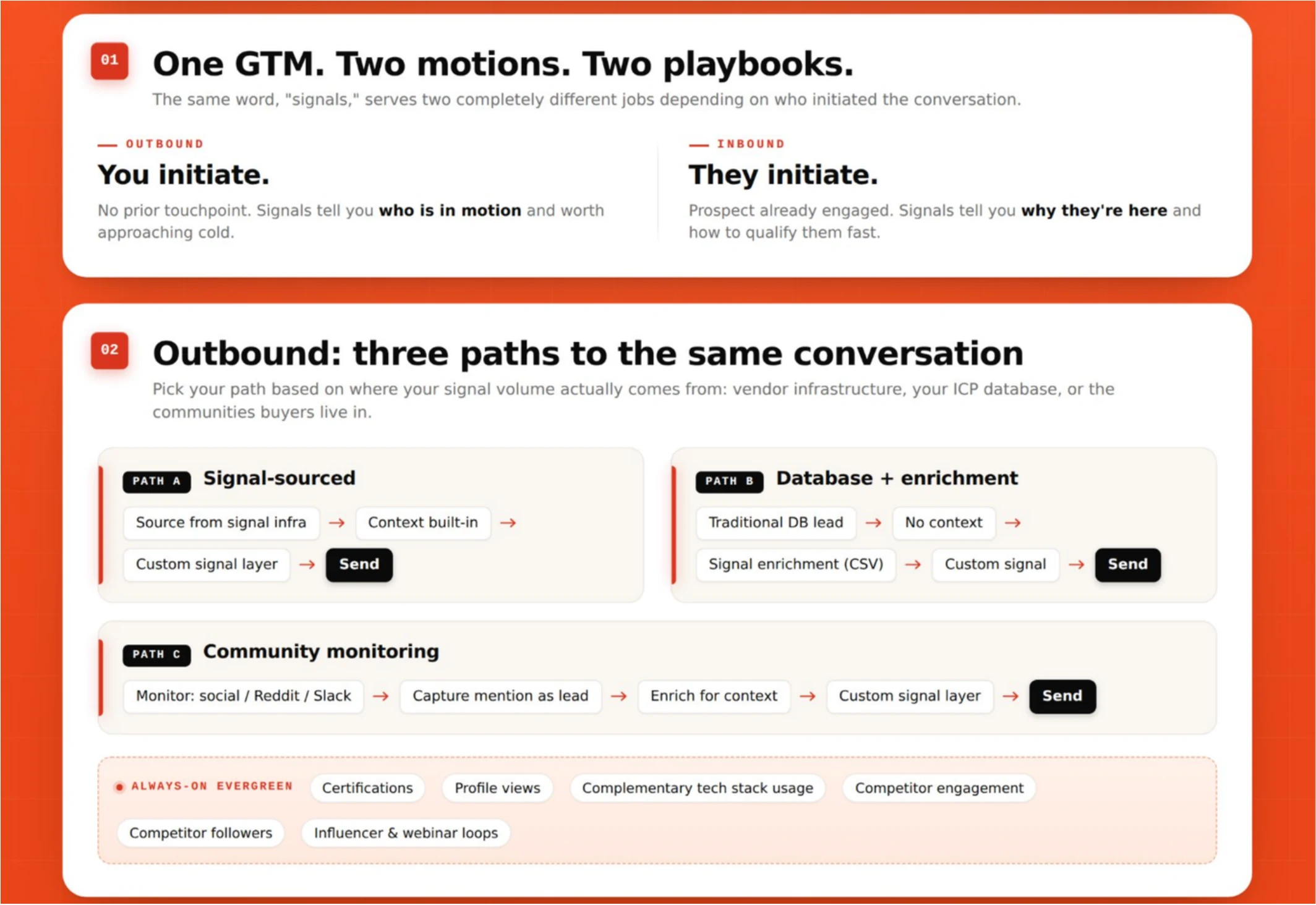
In the session, Georgi showed how Signalbase data could enter Clay or an agent workflow through MCP. Clay and Claude Code were orchestration choices, not substitutes for good data or a clear ICP. Choose the workflow that lets your team inspect and act on the context it collects.
4. Write from the prospect's situation
Georgi's rule was to keep most of the context for yourself. The research should improve what you say, rather than turn the opening into a list of tracked events.
He critiqued messages such as “I noticed that you're active on LinkedIn” and “Your thoughts on context engineering resonated.” Neither explains the problem, adds insight or gives the recipient a useful reason to respond.
In the context-engineering example, Oleg suggested asking, “Have you had success with it?” Georgi wanted the sender to understand how the person was using context engineering. A public post can support a question about their work without becoming a trial pitch.
Two of Georgi's own examples show how this changes the message:
Live data for a research layer
Georgi knew the prospect used LLMs for research, depended on stale data and had a knowledge graph operating on a two-week window. He connected live external context to that setup. CRM data reflected what had been entered; it missed changes outside the CRM. The message addressed that specific limitation rather than adding a generic compliment.
A rebrand before the buying window
Another account had lost product and marketing executives, hired new management and publicly rebranded. Georgi combined those changes with a post and a light offer to help if the product moved toward signals. A personal reference to the recipient's Juventus interest made the exchange recognizably his.
Georgi said the conversation booked a call six months before the buying window opened. He followed the account through summer product updates; the deal was still active when he gave the webinar. A call was an early relationship milestone, not a closed-won result.
Before sending, ask whether the message:
- makes the reason for choosing this person understandable;
- addresses a current problem, constraint or plan;
- adds something beyond repeating a public fact;
- still works without the vague compliment;
- invites an answer without requiring the recipient to sit through a pitch.
Mention a shared interaction when it helps: a real event registration, product use, support conversation or reply. Do not claim a project or budget you have not established.
5. Become familiar before the connection request
Oleg's addition was to become a familiar name before reaching out, then stay familiar until the buyer is ready. A thoughtful comment gives someone a chance to recognize you, inspect your profile or start the DM themselves.
He presented these figures from Extrovert's platform data:
| Measure | Result shown in Oleg's webinar slides |
|---|---|
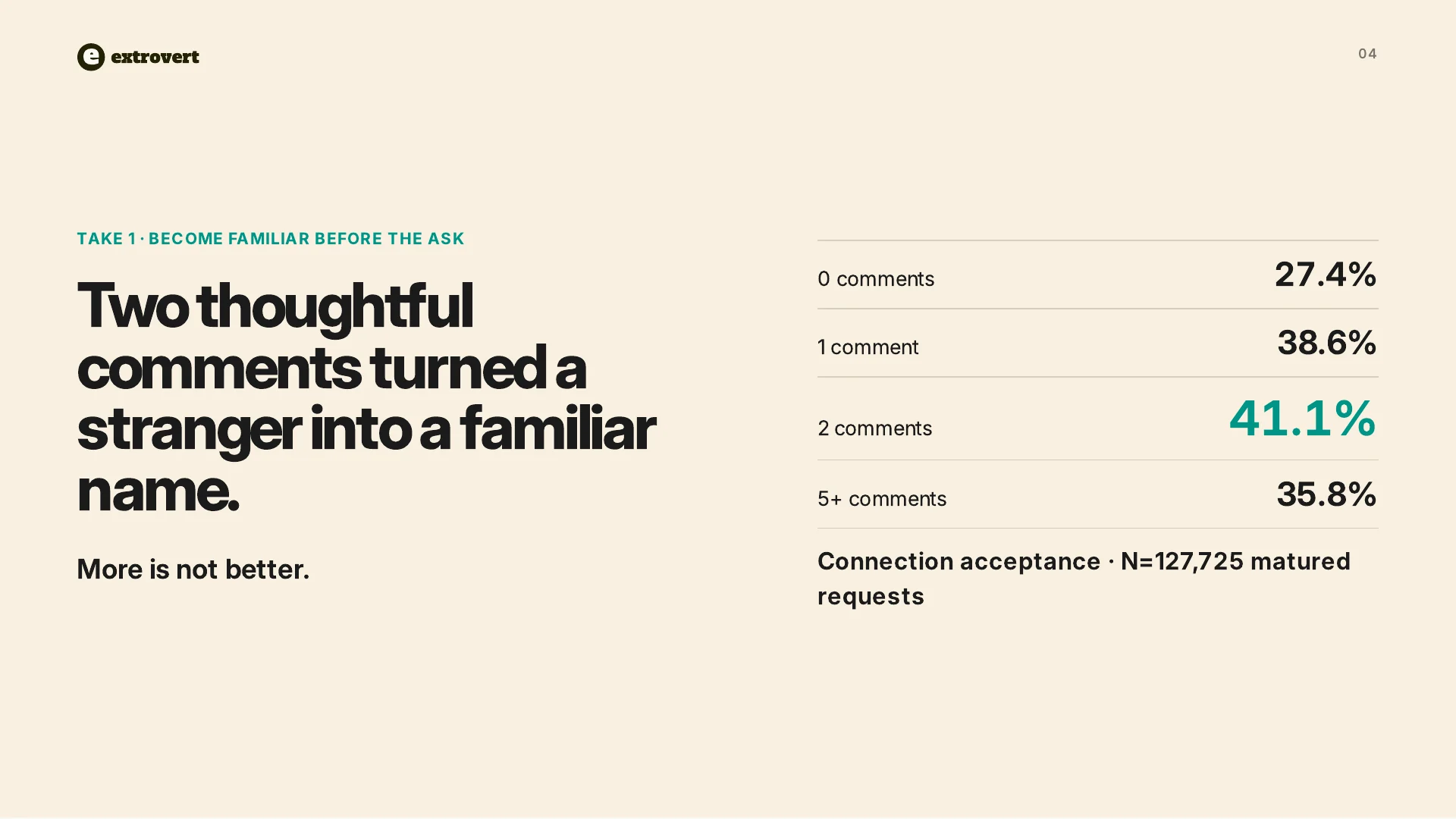
| Connection acceptance by prior comments | 27.4% with zero comments; 38.6% after one; 41.1% after two; 35.8% after five or more. Acceptance sample: 127,725 matured requests. |
| First-DM reply rate | 23.4% with zero comments and 31.3% after two. |
| Prospect sends the first DM | The warmed prospect was 2.4 times as likely to DM first. |
| Warm-up around a quiet prospect's network | About 27% acceptance for cold requests versus 41% after commenting in their orbit. |
| Late replies after silence | 18.6% when the sender stayed present and followed up, versus 2.3% without the extra follow-up. |
These are the platform aggregates Oleg presented, not promised results for an individual campaign. He also noted that the analysis did not track how often senders posted. Two comments should be useful, spaced interactions, not a mechanical requirement before every request.
What the acceptance curve shows
The source chart below plots the matured-request sample. Acceptance peaked after two comments and was lower after five or more. Oleg's practical takeaway was to become familiar without crowding the prospect.
If the prospect rarely posts, look at industry voices, colleagues, threads they like and discussions they join. Oleg described this as warming up through their orbit. Choose discussions they are likely to see and contribute something relevant. Random comments on large creator posts repeat the targeting problem.
Warm outreach explains how comments, connection requests and DMs fit together. A direct demo request does not need to wait for a warm-up sequence.
6. Reactivate a deal when something has changed
Georgi's largest integration opportunity had gone quiet in February. He later met one of the vendor's users at an event and learned about a weak point. Other users raised the same issue, and the vendor's own team added supporting evidence. He combined that proof and demand into a new message and booked another call. The deal was still unfolding at the time of the session.
That is a stronger reason to return than another “checking in” message. Use fresh evidence to explain why the conversation is worth reopening now.
Georgi also shared relevant posts, sent relationship-appropriate memes and met prospects in person. He described catching four funding leaks from four companies in one month as a useful conversation starter. These were his follow-up examples, not a requirement to use every channel.
His preferred order was LinkedIn first, WhatsApp second and email third. He asked for a WhatsApp number after a real conversation and an agreement to try the product, then managed it manually. Oleg pointed out the team-management and CRM-recording difficulty of that channel. Obtain permission instead of finding a private number and pitching there.
Georgi said in-person invitations increased conversion probability by 80% in his experience. Treat that as his session claim about his sales motion, not a benchmark for every enterprise deal.
He also described burning prospects through aggressive follow-up early in Signalbase's life. His advice was to stop when follow-up became spammy, give people time and revisit two or three months later when there was a new reason.
7. Use a Conversation Restarter to make the next reply easy
A buying signal helps answer why an account deserves attention now. A Conversation Restarter answers why it is natural to talk to the person again. The second can be useful even when it says nothing about buying intent.
Oleg used two examples:
- A Product Hunt launch. Congratulate the person and ask how it went. A reply can reopen the relationship without a pitch.
- A framework launch from a potential webinar partner. A prospect had posted about a framework nine days earlier. Oleg connected the post to her GTM goal and the possibility of showcasing it in a joint webinar.
From a real post to a suggested DM
Extrovert's Conversation Restarters use activity around saved prospects to suggest a reason to reconnect and a possible DM. The illustration shows the post context beside the draft. Read the context, check the relationship and edit or skip the message before taking action.
Illustration: Extrovert reads the prospect's posts. hot take, thought leadership, motivation, promotion are skipped. One post, went to sf tech week, is a Restarter signal. Extrovert suggests the DM "Seen you went to SF Tech Week. How did it go?", and the prospect replies.

This is an application of Oleg's webinar workflow using Extrovert's current product. The July demonstration focused on review before posting. Today, Extrovert offers manual review, optional automation and MCP-connected assistants that can act within the permissions you give them. Decide which actions you want to keep under direct review; automation does not remove the need for relevant context or respect for a request to stop.
8. Keep a long interaction window without constant chasing
Oleg separated effort per prospect from the length of the relationship. A two-to-four-week sequence can end long before a buyer finishes evaluating. Monitoring and a queue of useful moments let you stay present without sending repeated pitches.
Start with warm connections already in your network. Filter for ICP fit, review old conversations and watch for a reason to reconnect. Oleg said reactivation campaigns for Extrovert and its users had produced 30–40% reply rates. Those were the campaigns he described, not a guaranteed rate for every existing connection.
For your next account batch, keep a short handoff for each person:
- the observed event and source;
- why the account and person fit;
- the situation you want to understand;
- what the previous conversation established;
- the next useful interaction and its owner;
- what would make you pause, stop or revisit later.
A teammate can handle monitoring and routine follow-up while the founder or salesperson owns important sales conversations. Oleg emphasized balancing quality with consistency. If your market uses several languages, set language instructions for drafts or match the language of the post. He encouraged posting as well as commenting, while noting that posting frequency was outside the commenting analysis.
Pick one good-fit account, check the event, and write down the question the event helps you ask. If there is no useful next interaction, leave the account out of today's outreach queue.