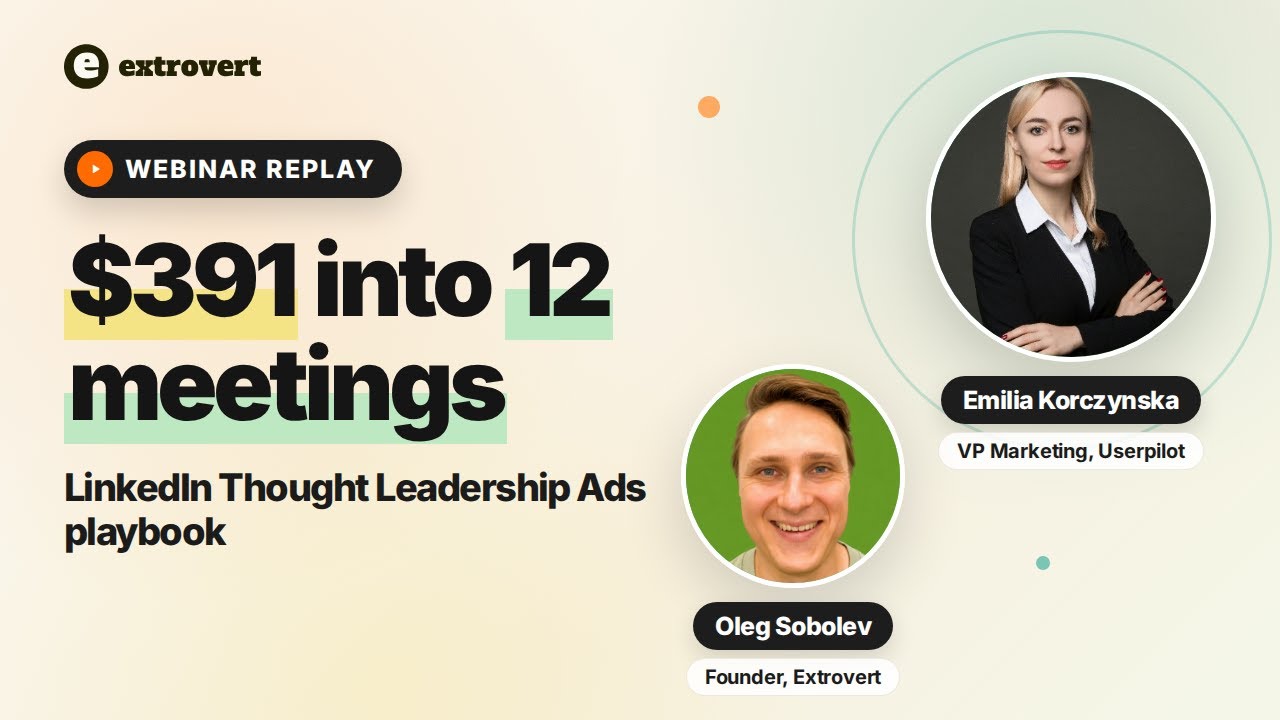
Valueships, a pricing consultancy for SaaS companies targeting CFOs and CEOs, spent about $6,204 on a three-format LinkedIn ads pilot. Only $391 went to thought leadership ads. The Valueships case study Emilia presented attributes 12 qualified meetings and more than €40,000 in closed-won deals to the TLA activity.
Emilia Korczyńska, VP of Marketing at Userpilot, had been running ABM programs for over two years, generating more than $8M in influenced pipeline for her company. She had been trying to convince Kris to run thought leadership ads. The Valueships result shows what the format can do when credible content, a defined account list, and the offer line up.
What happened at Valueships
Valueships launched a pilot ABM campaign with three ad formats: thought leadership ads (TLAs), image ads, and carousel ads. The targeting was expensive: CFOs, CEOs, and senior SaaS executives in Western Europe, the US, UK, and the DACH region.
TLAs accounted for 6% of the total ad spend.
| Format | Spend | Impressions | Landing-page clicks | Cost per landing-page click | CPM | eCTR |
|---|---|---|---|---|---|---|
| Thought leadership ads | $391 | 169,571 | 2,669 | $0.15 | $2.31 | 1.57% |
| Single image ads | $3,076 | 63,669 | 307 | $10.02 | $48.31 | 0.48% |
| Carousel ads | $2,736 | 49,412 | 234 | $11.69 | $55.38 | 0.47% |
Across the three formats, TLAs produced 83% of all landing-page clicks while using 6% of the budget. A landing-page click cost $0.15 from a TLA, compared with $10.02 from an image ad and $11.69 from a carousel. The full Valueships case study includes the individual ads and campaign data.
After the pilot, Valueships shut down the image ads and carousels and shifted the campaign budget to TLAs.
The reason is straightforward. LinkedIn is a social network. People come to follow specific people—practitioners, experts, and voices they trust—rather than company pages. Emilia argued that this is why personal posts often outperform company-page content on organic reach. TLAs let you combine the engagement dynamics of a personal post with the precision of paid targeting. You don't need the audience already in your network. You just need a post worth reading and a well-defined account list.
The metric LinkedIn doesn't show you
LinkedIn reports CTR as all clicks divided by impressions. Likes, "see more" clicks, shares, and comments all count. A post that goes viral but sends nobody to your landing page will show a strong CTR number.
When the goal is landing-page traffic, watch eCTR: clicks to the landing page divided by total impressions.
LinkedIn doesn't surface this metric. You calculate it manually: pull landing page clicks from the engagement report, divide by total impressions in the same time window.
Two Valueships TLAs reached about 21% CTR, with eCTRs of 4.69% and 3.02%.
The engagement rate also feeds back into cost. LinkedIn uses CTR as a quality signal for ad rank. Higher engagement means lower CPMs. Valueships' posts engaged strongly enough to partially go viral within their target audience, which drove CPMs to levels Emilia described as "unheard of for LinkedIn."
When optimizing: run five to six ads at a time. Aim to keep the ads hitting 10%+ engagement. Replace the ones below that threshold with posts closer in style or content to what is performing.
A larger-budget check at Userpilot
The $0.15 landing-page click was an exceptional result, not a benchmark every campaign should expect. Emilia also shared Userpilot's May 2026 results, where the gap between formats was much narrower:
| Format | Spend | Landing-page clicks | Cost per landing-page click | eCTR |
|---|---|---|---|---|
| Thought leadership ads | $27,302 | 1,747 | $15.63 | 0.57% |
| Single image ads | $33,818 | 2,314 | $14.61 | 0.46% |
| Video ads | $10,805 | 779 | $13.87 | 0.42% |
| Carousel ads | $8,013 | 596 | $13.45 | 0.37% |
At Userpilot, TLAs had the highest eCTR but also the highest cost per landing-page click. The Valueships result is useful as a creative and audience-fit case, not a cost promise. Evaluate eCTR, landing-page click cost, and pipeline influence separately.
What a winning TLA looks like
The highest-performing posts at Valueships shared a set of characteristics, and none of them looked like ads.
First-person and imperfect. The partners at Valueships wrote in their own voice: contrarian takes, funny memes, and real case studies. Emilia also advised teams not to over-polish posts or worry about occasional typos. She cited Jason Lemkin and Alina Vandenberghe as examples worth studying: they don't worry about capitalization, which helps their posts feel real.
Analogy or humor in the hook. The best-performing posts opened with something unexpected, not the product. Give the reader a reason to stay past the first line before mentioning a solution.
Real numbers. Named clients, results, and concrete benchmarks give executives something they can evaluate. Vague claims don't.
CTA low in the post. The link to your landing page belongs near the bottom, after the reader has followed the problem and the proposed solution. Don't put the link in the comments. You can't calculate eCTR from a comment click, and TLAs don't optimize for organic reach anyway.
One practical note on timing: post organically first. Wait a few days to see if it gets traction. If it performs well, edit the post to add the link in the body, then add it to Campaign Manager as a TLA. Posts with organic engagement signal quality to the algorithm and tend to get cheaper CPMs when promoted.
Five ways to source TLAs
For most teams the bottleneck is content, not budget.
Internal stakeholder interviews. Record conversations with your founders, sales leaders, or subject-matter experts. Feed the transcript into an AI writing system trained on your best-performing posts. The raw voice is already there.
Influencer sponsorships. Platforms like Passionfroot let you find niche influencers and pay them to write posts for you. More expensive, but influencers bring an audience that trusts them. Emilia sees influencer TLAs among the highest-performing sources by eCTR.
Existing brand mentions. Search LinkedIn for your company name. Find people who already post about you. Offer a small incentive (Emilia mentioned a $50 voucher), ask if you can sponsor the post. LinkedIn lets you run any post as a TLA as long as the author gives permission. They don't have to be your employee.
Customer advocacy programs. Build a system where customers earn rewards for posting about your product. Results vary: some posts are great, some are unusable, and eCTRs from customer posts tend to be the lowest of the TLA sources Emilia compared. Worth running, but don't rely on it as your primary source.
Ghostwriters. A professional writer interviews your internal team, builds a writing system, and produces posts on an ongoing basis.
From engagements to pipeline
Running TLAs without tracking what happens next leaves most of the value on the table.
Stefan warned against sending company-level engagement lists straight to SDRs. An engagement signal at the company level does not mean a specific person is ready for a sales call.
What works instead:
Tag campaigns by topic. If you run multiple TLA campaigns on different problems, label each one with an intent tag. Which problem did this account engage with? That's a signal about where they are in their thinking.
Push data to your CRM. Tools like Zen ABM surface company-level engagement and job titles from TLA interactions. Set a threshold, such as five or more engagements in a defined timeframe, mark that company as active, and push the intent tag via webhook to your sequencing tool or CRM. Valueships ran this: Zen ABM to Clay via webhook to outreach.
Measure with view-through attribution. Look at the companies you opened deals with in the past 30 to 90 days. Which ad formats did they engage with before the deal opened? If TLAs show up consistently, they may be influencing pipeline even when "direct traffic" takes last-touch credit. This shows a pattern, not proof that an ad caused the deal.
Feed warm signals into organic nurture. In the second half of the session, Oleg showed how Extrovert fits after the account-level signal. ZenABM identifies engaged companies and job titles; Clay can find relevant contacts at those accounts. After qualification, add those contacts to Extrovert and stay present over the long game: comment on their posts, send context-relevant DMs based on what they publish, and build the relationship before the pitch. The signal does not prove that a specific contact engaged or is ready to buy.
How to set up TLAs in Campaign Manager
Don't use the native boost button on LinkedIn posts. You lose targeting options.
The correct setup:
- Open Campaign Manager and create a new campaign.
- Set the objective to Engagement. (Website visits won't work here: LinkedIn won't allow you to promote personal posts under that objective.)
- Set the ad format to Single Image Ad.
- When creating ads, skip "create new." Click Browse existing content, then open the LinkedIn members tab.
- Search for the post author by name. Find the specific post.
- Send the author a permission request through Campaign Manager.
- After they approve, go back to the campaign and manually add the post. Approval doesn't auto-add it.
LinkedIn's Campaign Manager is confusing here. It doesn't guide you through the TLA flow. This setup gives you account targeting; use the engagement report to calculate eCTR.
FAQ
What is a LinkedIn thought leadership ad (TLA)?
A TLA is a personal LinkedIn post, from an employee, customer, or outside voice, that a company sponsors as a paid ad while keeping the original author's name and profile attached. It runs through Campaign Manager, not the company page, and needs the author's permission before it can go live.
How is a TLA different from just boosting a post?
LinkedIn's native boost button skips the targeting options TLAs need. Setting one up correctly means building the ad in Campaign Manager under the Engagement objective, finding the post under the LinkedIn Members tab, and requesting the author's permission first.
What is eCTR, and why track it instead of LinkedIn's reported CTR?
LinkedIn's CTR counts every click on a post, including likes, shares, comments, and "see more," not just clicks to your landing page. eCTR (landing-page clicks divided by total impressions) isolates the number tied to pipeline. LinkedIn doesn't calculate it for you; pull landing-page clicks from the engagement report and divide manually.
Will TLAs get me the same cost-per-click Valueships saw?
No. Valueships' $0.15 cost per landing-page click reflects strong creative and account-list fit for that campaign, not a general benchmark. At a larger budget, Userpilot's cost gap between TLAs and other formats narrowed well below that number. Judge a campaign on its own eCTR and cost per click.
Do I need permission to run someone else's post as a TLA?
Yes. LinkedIn requires the original author's consent, whether that person is an employee, a customer, or an outside influencer. Campaign Manager sends the permission request, and once it's approved you still have to add the post to the campaign manually.
Where should the CTA link go in a thought leadership post?
Near the bottom of the post body, not in the comments. A link in the comments can't be counted toward eCTR, and TLAs aren't optimized for organic reach the way a comment-driven post might be.
Where does TLA content come from if I don't already have a large following?
Common sources include internal stakeholder interviews turned into posts, paid influencer sponsorships, existing brand mentions found by searching LinkedIn for your company name, customer advocacy programs, and ghostwriters who interview your team directly. Content tends to be the actual bottleneck, not budget.
How do TLA engagement signals turn into pipeline?
Track engagement at the company level and tag campaigns by topic so you know which problem an account responded to. Avoid routing raw engagement lists straight to SDRs: a company-level signal doesn't mean one specific person is ready for a call. Feeding qualified contacts into ongoing LinkedIn engagement, rather than an immediate pitch, tends to work better than acting on the signal alone.