LinkedIn automation tools promise the same thing: fewer hours spent clicking connect, more meetings on the calendar. Most deliver on the first half. Push connection requests and follow-ups on a schedule and LinkedIn eventually notices the pattern, and so do the prospects who get the same templated message as everyone else.
The tools that actually build pipeline are the ones that match their automation to how much ban risk and personalization your team can live with. Some run full sequences from the cloud with no human touch. Others assist a rep who still reviews and sends every message.
This guide compares the 10 best LinkedIn automation tools in 2026, covering what each does, current pricing, platform, and an honest limitation, plus a framework for matching a tool to your team's risk tolerance and workflow.
See how SDRs use Extrovert to warm up accounts and show up on prospects' posts before the first touch.
Extrovert for SDRsBest LinkedIn automation tools: a brief overview
If unattended sending is the part that worries you, Extrovert is the best pick in this category because it automates the finding and drafting but leaves every send to a human. Here's how it stacks up against the automation platforms it's built as an alternative to.
Warm, engagement-led
- Extrovert: Best for automation-fatigued teams that want warm outreach with every comment and DM human-reviewed before it sends. Track prospects and topics, then review AI-suggested comments and DMs from your own playbook instead of firing off unattended sequences.
Multi-account and agency scale
- HeyReach: Best for agencies running outreach across many LinkedIn accounts: trades Extrovert's human-reviewed single account for sender rotation and a unified inbox across many.
Full sequence automation (LinkedIn plus email)
- Skylead: Best for branching, if/else automation sequences: trades Extrovert's reviewed sending for unlimited cold email accounts under one flat price.
- We-Connect: Best for straightforward cloud-based multichannel campaigns: trades Extrovert's human review for no-extension, always-on sending.
- Closely: Best for teams that want a dedicated residential IP per account: trades Extrovert's reviewed workflow for a unified inbox and infrastructure-based risk reduction.
- Meet Alfred: Best for scaling outreach across LinkedIn, X, and email: trades Extrovert's single-channel, reviewed approach for broad, unattended multichannel volume.
Budget and Chrome-extension automation
- Dux-Soup: Best for the lowest-cost entry point: trades Extrovert's reviewed workflow for the cheapest unattended automation in the category.
- Octopus CRM: Best for solo reps who want simple connection automation: trades Extrovert's playbook-based review for basic, unreviewed browser automation.
- Linked Helper: Best for teams that want desktop-level control over automation pacing: trades Extrovert's human review for locally-run, unattended sequences.
Cross-platform scraping and automation
- PhantomBuster: Best for teams that need LinkedIn automation alongside data extraction from other platforms: trades Extrovert's reviewed, LinkedIn-only workflow for unattended, cross-platform scraping.
| Tool | Key strength | Pricing | Platforms |
|---|---|---|---|
| Extrovert | Warm, AI-suggested comments and DMs from your playbook | Free trial; from $29/seat/month | Web, Chrome extension |
| HeyReach | Multi-account outreach with sender rotation | From $79/sender/month | Web |
| Skylead | Branching sequences with unlimited cold email accounts | From $100/month flat | Web |
| We-Connect | Cloud multichannel campaigns, no extension required | From $49/month | Web |
| Closely | Dedicated IP per account plus unified inbox | From $49/month | Web |
| Meet Alfred | LinkedIn, X, and email automation in one dashboard | From $59/user/month | Web |
| Dux-Soup | Low-cost connection and messaging automation | From $14.99/month | Chrome extension, Cloud Dux |
| Octopus CRM | Simple browser-based connection automation | From $9.99/month | Chrome extension |
| Linked Helper | Desktop-run automation with cloud-backed data storage | From $29.90/month | Desktop app (Windows, macOS, Ubuntu) |
| PhantomBuster | LinkedIn automation plus multi-platform scraping | From $69/month | Web |
Warm, engagement-led automation
1. Extrovert, best for human-reviewed warm outreach
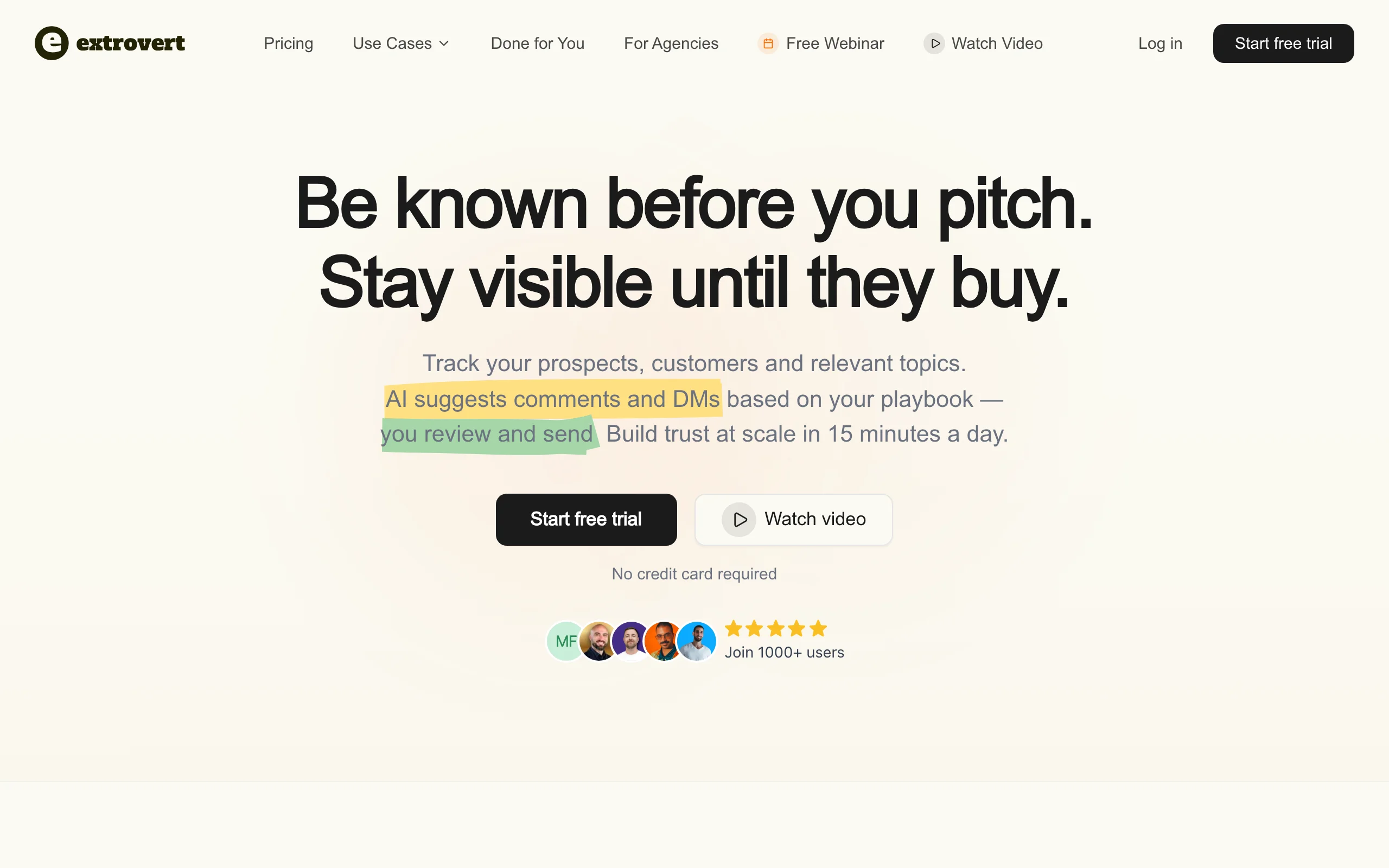
Every other tool on this list automates the sending. Extrovert automates the finding and the drafting instead, and leaves sending to you. You track prospects, customers, and relevant topics on LinkedIn, and Extrovert's AI suggests on-brand comments and DMs built from your own playbook. You review each draft, edit or approve it, and post it yourself, so nothing goes out unattended.
The pitch is that familiarity beats volume. Commenting genuinely on a prospect's posts before you ever message them means the outreach lands warm instead of cold, and over what Extrovert calls the 90-day loop those touches compound into relationships that convert like referrals. It's a deliberate contrast to the rest of this list: no connection-request blasts, no scheduled sequences running while you sleep, about 15 minutes a day of hands-on review.
Key features:
- Prospect, customer, and topic tracking on LinkedIn
- AI-suggested comments and DMs tuned to your playbook and voice
- Buying-signal and champion-change tracking
- Human-in-the-loop review on every comment and DM before it sends
- Connection requests to prospects and ways to reach prospects who don't post
Best for:
- SDRs and AEs doing LinkedIn for SDRs who've had accounts flagged by automation before
- Teams that want the 90-day loop instead of a 2-week automated sequence
Pricing:
- 10-day free trial, no card required
- Light from $29/month ($21.75/month billed annually), Business from $49/month ($36.75/month billed annually), Pro from $75/month ($56.25/month billed annually) (see Extrovert pricing for current tiers)
Pros:
- No unattended sending: every comment and DM is reviewed before it sends
- Builds compounding familiarity instead of one-off blasts
Cons:
- LinkedIn-focused, not a multichannel cold-email automation platform
- Built for a steady daily rep, not a one-time mass send
Multi-account and agency-scale automation
2. HeyReach, best for agencies and multi-account rotation
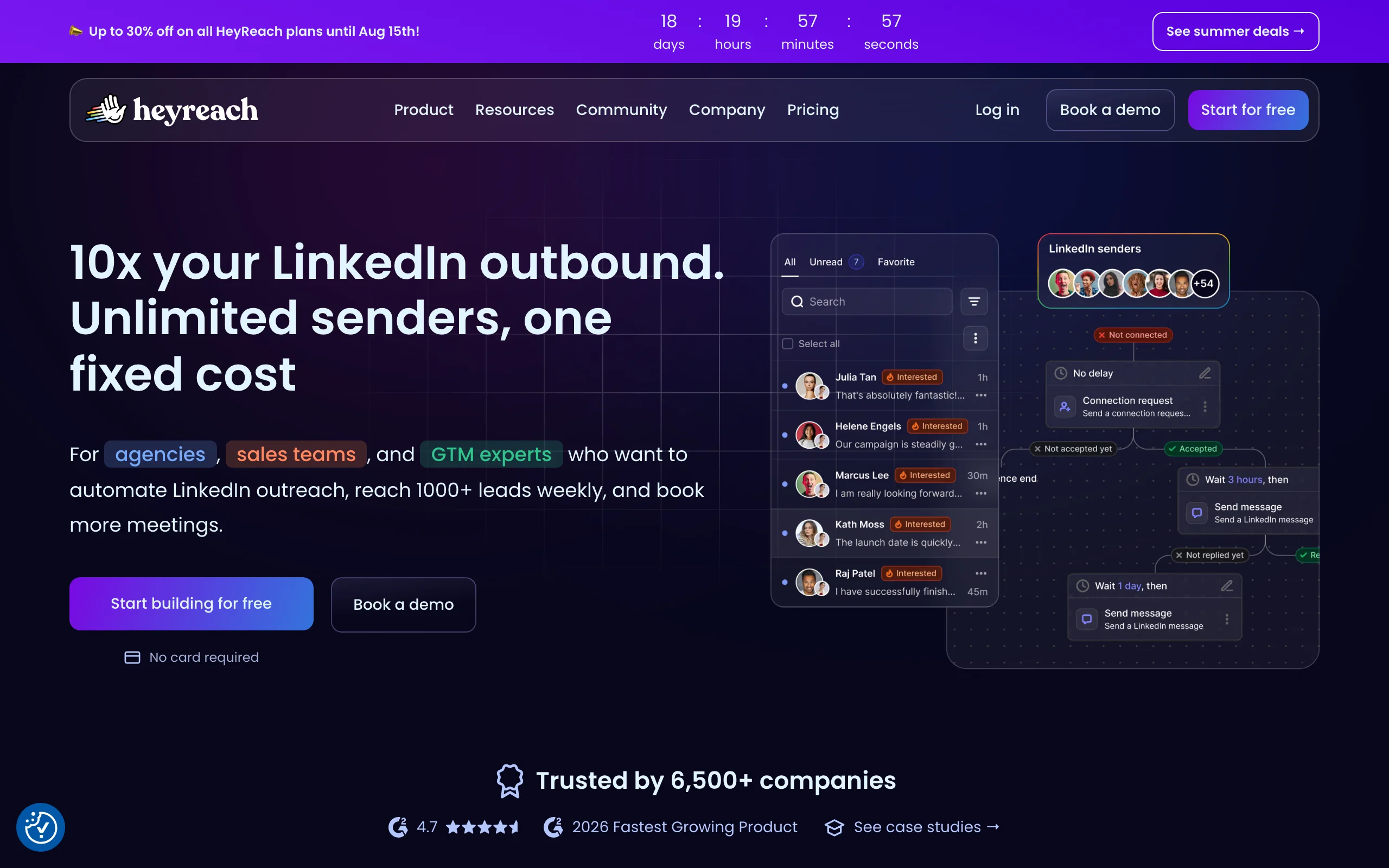
HeyReach trades Extrovert's human-reviewed, single-account approach for sender rotation at scale. It's built to run outreach across dozens of LinkedIn accounts without babysitting each one individually. Its core mechanic is sender rotation: campaigns spread activity across every connected account instead of pushing one account to its daily limits, which is why it's become a default pick for agencies managing outreach on behalf of multiple clients. A unified inbox pulls every account's replies into a single view so nobody has to log into ten separate LinkedIn profiles.
It runs entirely from the cloud with no Chrome extension, and its enrichment credits and integrations (including MCP server access for AI-agent workflows) make it easy to plug into a bigger outbound stack. The trade-off is that it's still unattended automated sending, so every account carries some restriction exposure, and the dashboard reportedly gets harder to manage past roughly 20 connected senders.
Key features:
- Multi-account sending with automatic sender rotation
- Unified inbox across every connected LinkedIn account
- API, webhook, and MCP server access
- Native integrations with Instantly and Smartlead for multichannel stacks
- Workspace and permission controls for agencies managing clients
Best for:
- Agencies running outreach for multiple clients from one workspace
- Teams scaling volume across many seats without one account absorbing all the risk
Pricing:
- Growth: 14-day free trial, no card required. Agency and Unlimited: 30-day trial available on request
- Growth from $79/sender/month ($63/sender/month billed annually); Agency from $999/month flat for 25 senders; Unlimited from $2,999/month flat for unlimited senders
Pros:
- Spreading activity across many connected accounts lowers per-account risk versus single-account tools
- Strong fit for agencies managing many client accounts at once
Cons:
- Still unattended automated sending with real ban exposure
- Dashboard performance reportedly degrades with a high sender count
Full sequence automation (LinkedIn plus email)
3. Skylead, best for branching automation with unlimited email
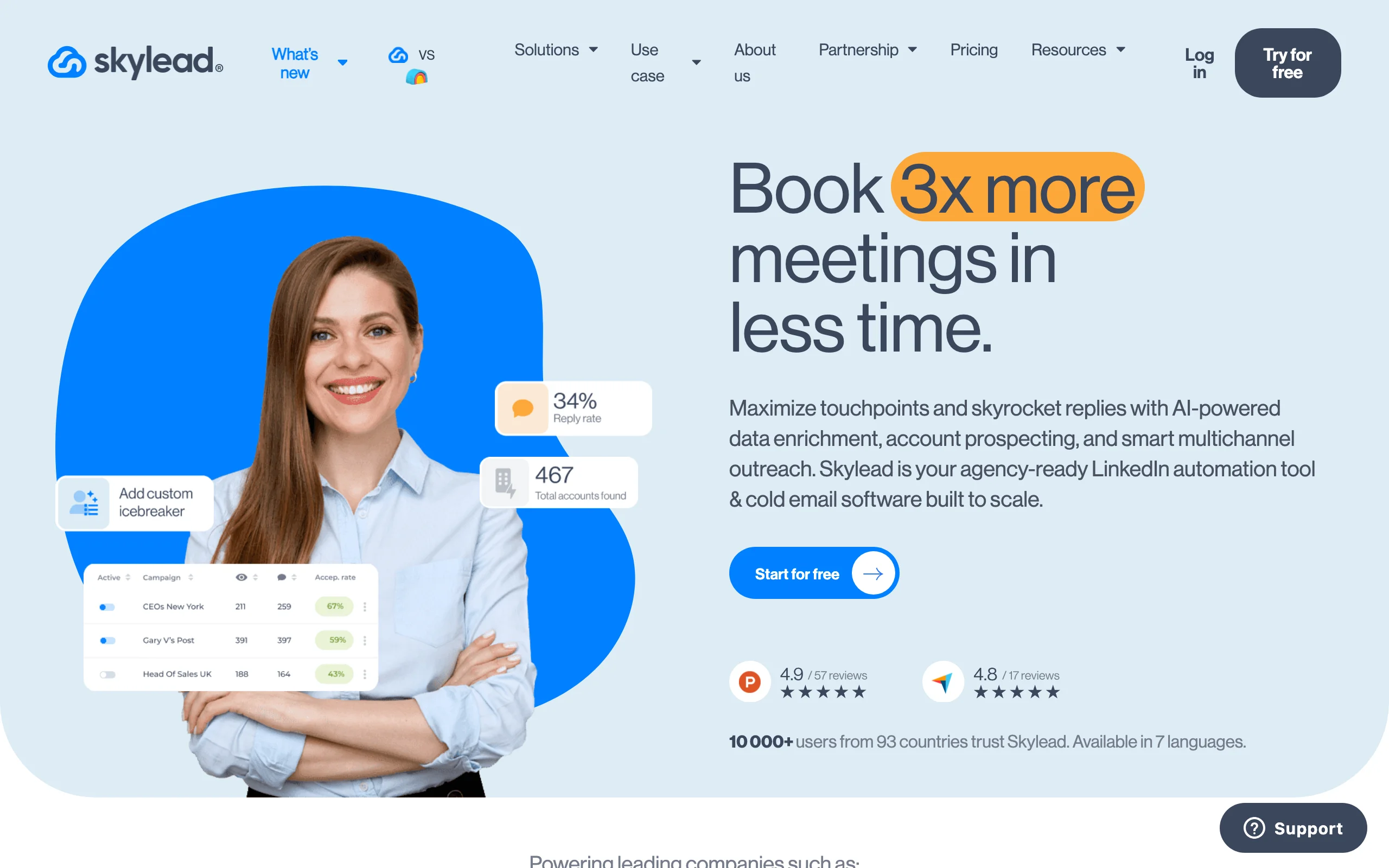
Skylead trades Extrovert's reviewed, LinkedIn-only sending for unattended automation across two channels. It bundles LinkedIn automation with cold email into one flat monthly price, which is the pitch against tools that upcharge for every additional channel. Its Smart Sequences support if/else branching logic, so a campaign can route a prospect down a different path depending on whether they accepted a connection request or opened an email, and unlimited email accounts with built-in inbox warm-up come included rather than as an add-on.
A built-in email finder and verifier plus a unified Smart Inbox round out the platform, and native sync with HubSpot, Pipedrive, and Salesforce covers most CRM setups out of the box. The email-finder credit limits aren't clearly disclosed upfront, and reviewers describe a steep learning curve for a first-time user setting up branching logic.
Key features:
- Smart Sequences with if/else branching logic
- Unlimited email accounts with inbox warm-up
- Built-in email finder and verifier
- Image, GIF, and spintax personalization
- Native real-time sync with HubSpot, Pipedrive, and Salesforce
Best for:
- Teams that want LinkedIn and cold email under one flat price
- Campaigns that need conditional logic based on prospect behavior
Pricing:
- 7-day free trial
- All-in-One from $100/month flat, one seat included, no monthly/annual discount toggle; a separate custom-quote annual tier exists for teams and agencies
Pros:
- Unlimited email sending included instead of priced per inbox
- Branching logic supports genuinely conditional sequences
Cons:
- Undisclosed caps on email-finder credits catch some users off guard
- Steeper learning curve than single-purpose tools
4. We-Connect, best for simple cloud multichannel campaigns
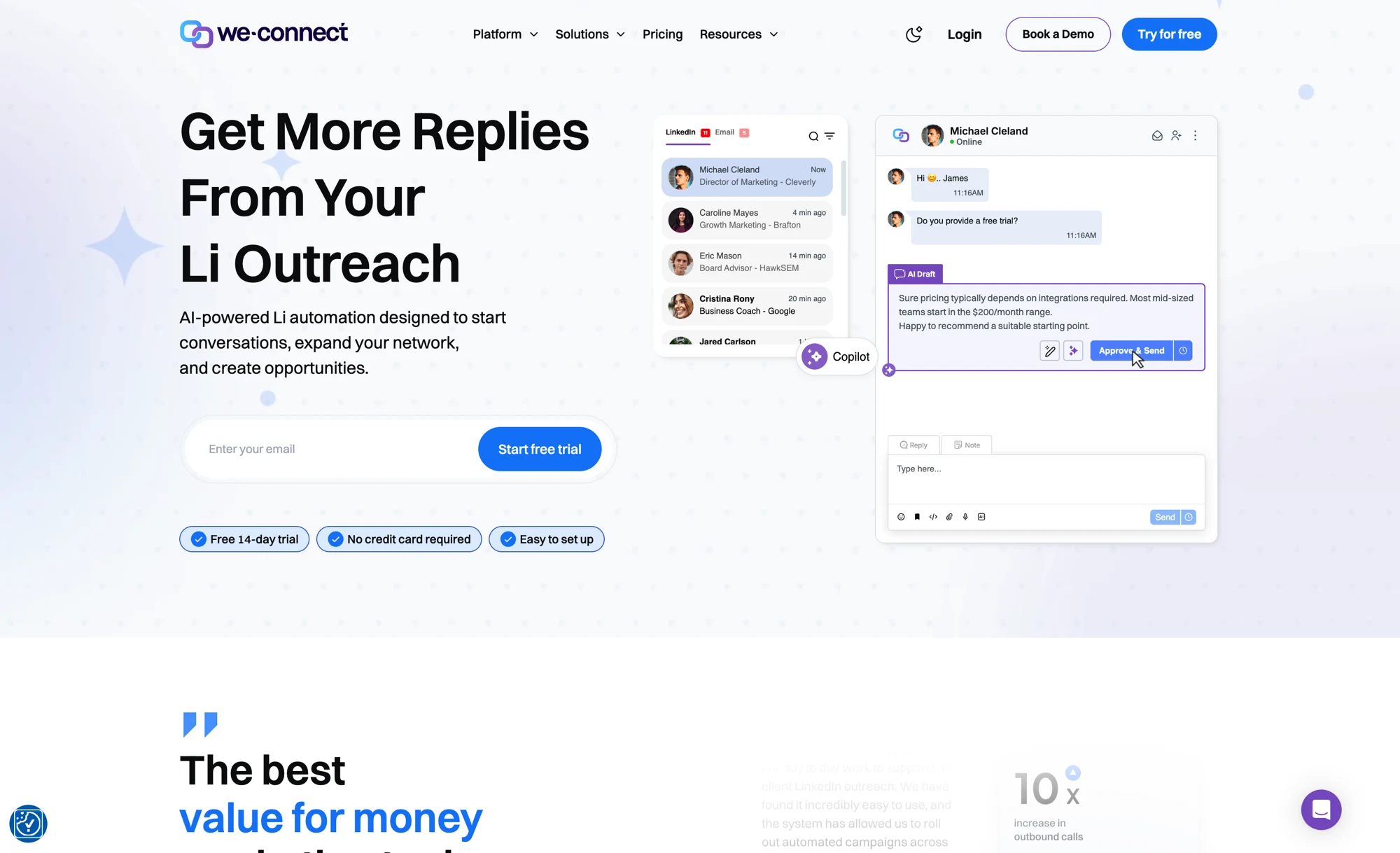
We-Connect trades Extrovert's human review for always-on cloud sending. It runs LinkedIn and email sequences entirely from the cloud, so there's no browser extension or desktop app to keep open for a campaign to keep firing. Its visual, conditional-branching campaign builder covers standard multi-step automation, and AI Assist can draft icebreakers or run auto-replies in either a co-pilot or fully autonomous mode. Each seat gets a dedicated country-based IP as a baseline safety measure.
It's a straightforward pick for a team that wants cloud reliability without Skylead's or Closely's added complexity. Reviewers note a buggier interface than category leaders, with campaigns occasionally failing to execute, and support is limited to weekday hours.
Key features:
- Visual, conditional-branching campaign builder
- AI Assist for icebreakers, spintax, and auto-reply
- Multichannel sequencing across LinkedIn and email with A/B testing
- Contact enrichment and name cleanup
- Native HubSpot, Salesforce, Pipedrive, and Zoho integrations
Best for:
- Teams that want cloud automation without installing a browser extension
- Campaigns that combine LinkedIn steps with email follow-up
Pricing:
- 14-day free trial, no credit card required
- Growth at $49/seat/month billed annually ($69/month billed monthly); Professional at $59/seat/month annually ($79/month monthly); announced-but-not-live Scale tier at $79/seat/month annually ($99/month monthly)
Pros:
- No extension or desktop app dependency
- Dedicated per-seat IP as a baseline account-safety measure
Cons:
- Reviewers report occasional campaign-execution bugs
- Support hours are limited to weekdays
5. Closely, best for dedicated-IP safety and a unified inbox
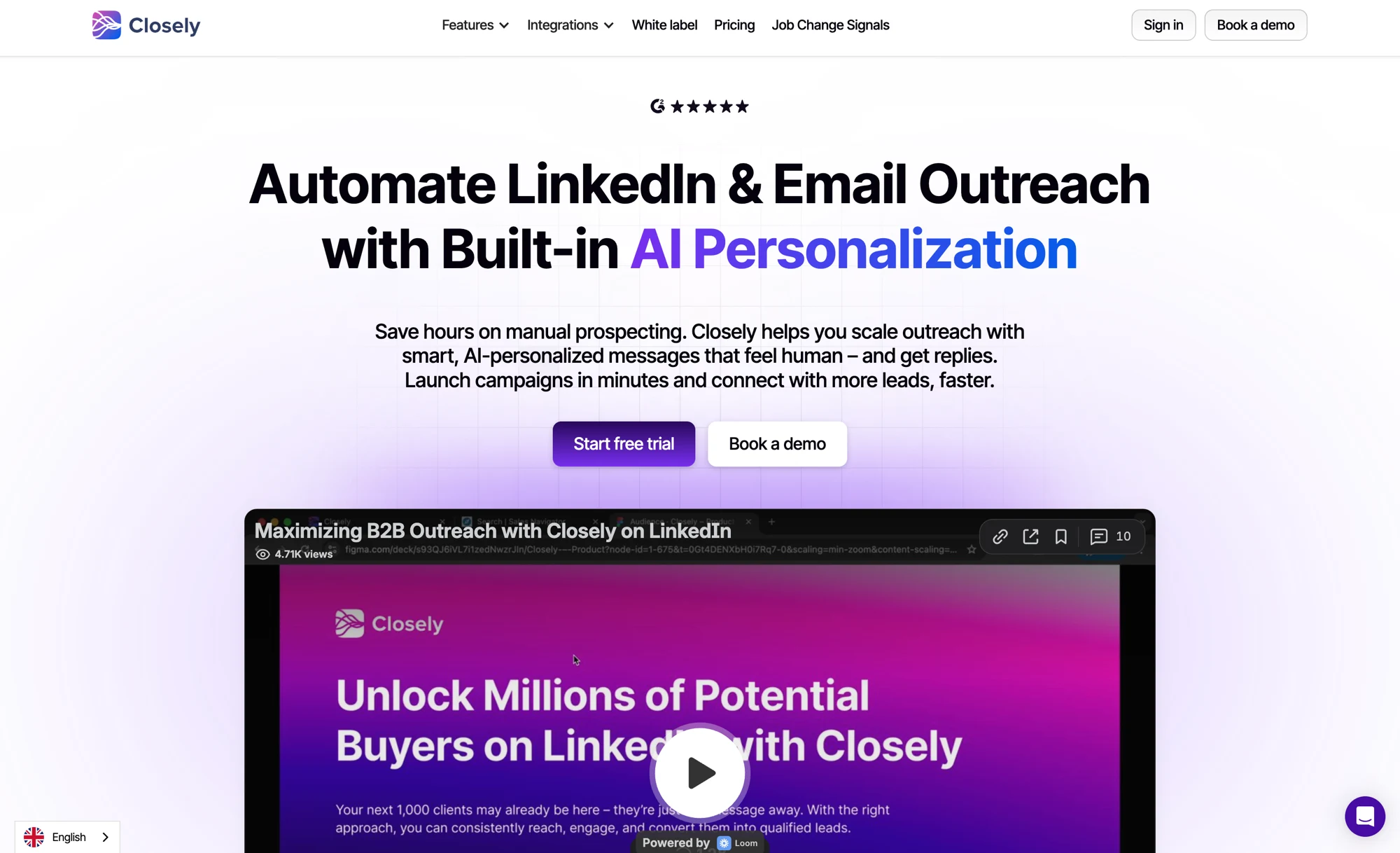
Closely trades Extrovert's human-reviewed sending for infrastructure-based risk reduction. It automates LinkedIn and email outreach from the cloud with a dedicated residential IP assigned to each connected LinkedIn account, aimed at reducing the footprint that gets accounts flagged. Its Smart Inbox merges LinkedIn DMs, InMail, and email replies into one thread per lead, and a conditional sequence builder handles multichannel campaigns with AI-personalized messaging and lead scoring layered on top.
A white-label option and deep CRM integrations make it usable for agencies as well as internal teams. Because LinkedIn session custody sits in Closely's cloud rather than your own browser, some reviewers flag that as a trade-off rather than a pure safety win, and G2 reviews cite stalled support responsiveness and occasional HubSpot sync issues.
Key features:
- Unified Smart Inbox across LinkedIn DMs, InMail, and email
- Conditional sequence builder for multichannel campaigns
- Data enrichment with email and phone finder
- AI-personalized messaging and lead scoring
- Dedicated residential IP per LinkedIn account
Best for:
- Teams that want LinkedIn and email replies unified in a single inbox
- Agencies that want a white-label option for client-facing outreach
Pricing:
- Free trial available
- Starter from $49/month ($29/month billed annually), includes the dedicated IP, Smart Inbox, and white-label; Growth from $127/month ($87/month billed annually) adds AI-personalized messaging, lead scoring, and email/phone enrichment
Pros:
- Dedicated IP per account is a genuine safety measure most budget tools skip
- Unified inbox keeps multichannel replies from getting scattered
Cons:
- Cloud-held LinkedIn sessions are a trade-off, not a guarantee against bans
- Support responsiveness is a recurring complaint
6. Meet Alfred, best for LinkedIn, X, and email in one dashboard
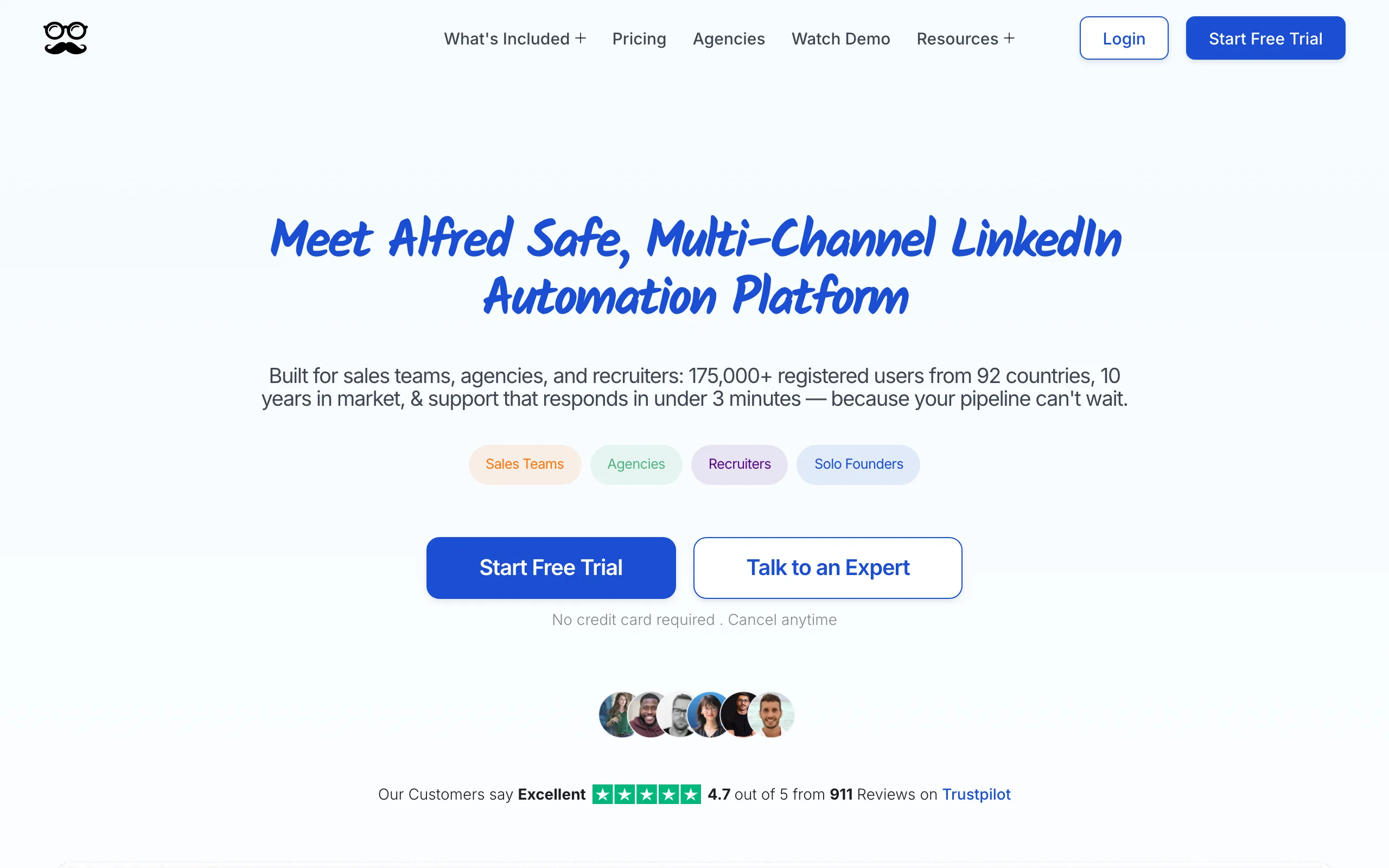
Meet Alfred trades Extrovert's single-channel, reviewed approach for broad unattended volume. It runs campaigns across LinkedIn, X, and email from a single cloud dashboard, covering connection requests, InMail, group and event automation, and even social post scheduling in one subscription. Unlimited campaigns on its higher tiers make it a reasonable pick for a team that wants one platform instead of stitching together separate channel tools.
The trade-off is aggressiveness: reviewers on SalesRobot and HeyReach's own comparison pages describe a pattern of account restrictions tied to how hard Meet Alfred pushes automation, and support response times of three to four days show up repeatedly in complaints.
Key features:
- Multichannel automation across LinkedIn, X, and email
- InMail automation alongside standard connection sequences
- LinkedIn Groups and Events automation
- Smart inbox with built-in CRM
- Social media post scheduling
Best for:
- Teams that want LinkedIn, X, and email campaigns under one login
- Users who need Groups and Events automation specifically
Pricing:
- Free trial at signup
- Pro (multichannel, InMail, Groups/Events, scheduling) from $99/month ($49/month billed annually); a cheaper LinkedIn-only Basic tier starts at $59/month ($29/month billed annually)
Pros:
- Genuinely broad channel coverage in a single tool
- Unlimited campaigns available on higher tiers
Cons:
- Reviewers report a higher rate of account restrictions than more conservative competitors
- Customer support response times run several days
Budget and Chrome-extension automation
7. Dux-Soup, best for the lowest-cost entry point
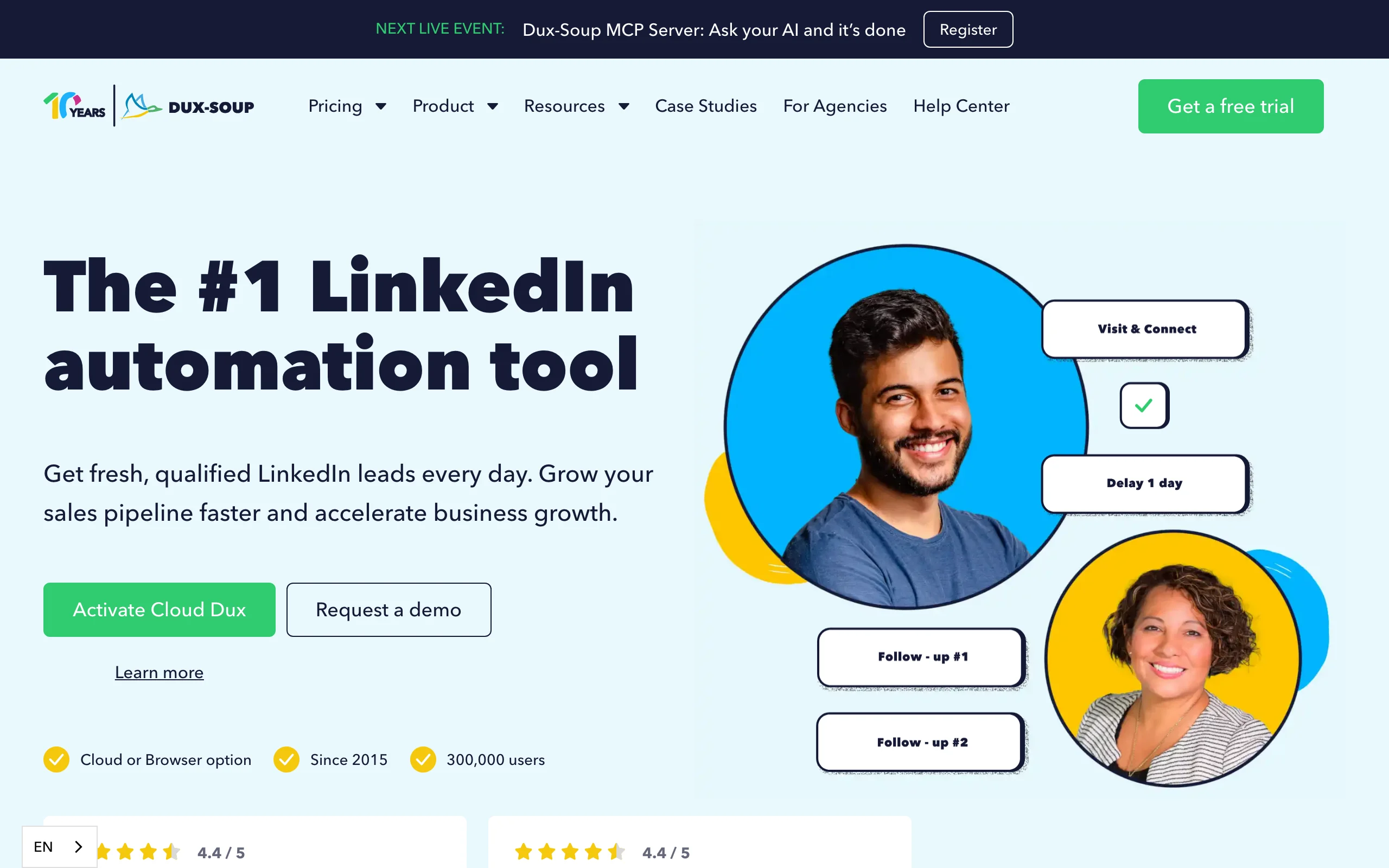
Dux-Soup trades Extrovert's reviewed workflow for the cheapest unattended automation in the category. It has been running LinkedIn automation longer than almost anything else here, and its pricing still reflects a budget-first position. As a Chrome extension it handles personalized connection requests, first-degree messaging, and profile auto-liking directly inside your browser session, with an optional Cloud Dux tier that keeps campaigns running independent of your laptop.
Its longevity is also its ceiling: the interface is widely described as dated next to newer cloud-native tools, and the Chrome-extension tiers stop working the moment the browser closes or the laptop sleeps, which is a common complaint from users on the Pro and Turbo plans.
Key features:
- Personalized connection invites and first-degree messaging
- Profile auto-liking and contact tagging
- Drip campaigns and a lead-management dashboard (Turbo and above)
- Cloud Dux tier for browser-independent execution
- Activity logging and CRM integrations on higher tiers
Best for:
- Solo reps and small teams on a tight tool budget
- Anyone wanting the most established option in the category
Pricing:
- 14-day free trial plus a limited free version
- Pro Dux from $14.99/month ($11.25/month billed annually)
Pros:
- Lowest cost of entry in this list by a wide margin
- Cloud Dux tier removes the "keep your laptop open" dependency
Cons:
- Extension-based tiers stop running if the browser or laptop isn't active
- Interface feels dated next to cloud-native competitors
8. Octopus CRM, best for simple browser-based automation
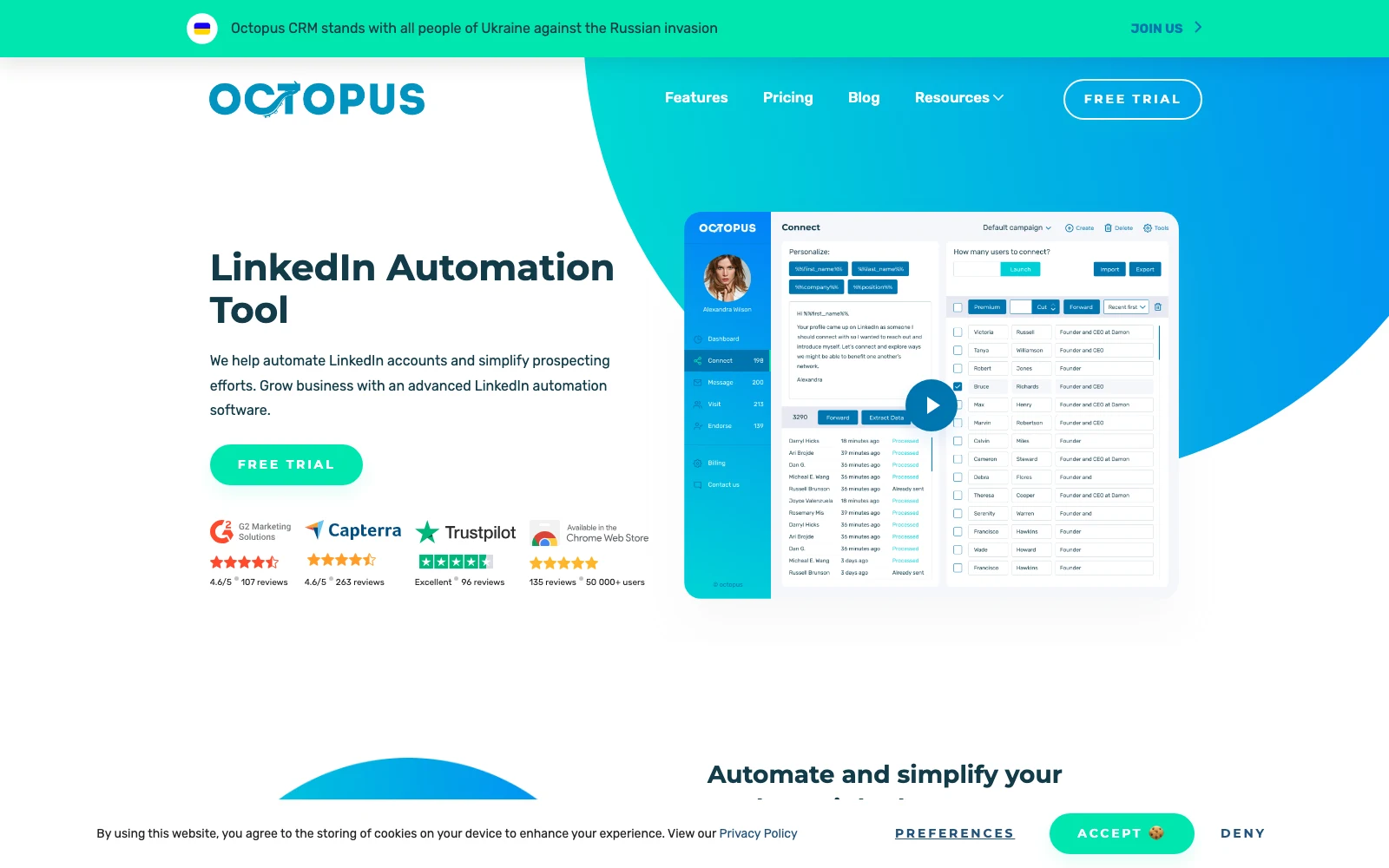
Octopus CRM trades Extrovert's playbook-based review for basic, unreviewed browser automation, keeping things narrow on purpose: it's a Chrome extension focused on automated connection requests, bulk messaging to first-degree connections, and a light personal CRM to track leads, positioned as an affordable entry point for solo reps, recruiters, and small teams. Auto skill-endorsement and profile-visit automation round out a feature set that stays close to LinkedIn's native actions rather than layering on multichannel complexity.
Because it runs purely in-browser, both your laptop and Chrome need to stay open for campaigns to execute, and there's no multi-step conditional sequence logic beyond a linear campaign builder. Support is email-only with a reported slow turnaround.
Key features:
- Automated personalized connection requests
- Bulk messaging to first-degree connections
- Auto skill endorsements and profile-visit automation
- Personal CRM with lead storage and a campaign builder
- Zapier and HubSpot integrations
Best for:
- Solo reps, recruiters, and small teams wanting a low-cost Chrome extension
- Simple, linear campaigns without branching logic
Pricing:
- 7-day free trial, no card required
- Starter from $9.99/month ($6.99/month billed annually)
Pros:
- Among the cheapest paid options in the category
- Simple enough to set up without a learning curve
Cons:
- Browser-dependent execution, no cloud option
- No conditional branching for multi-step sequences
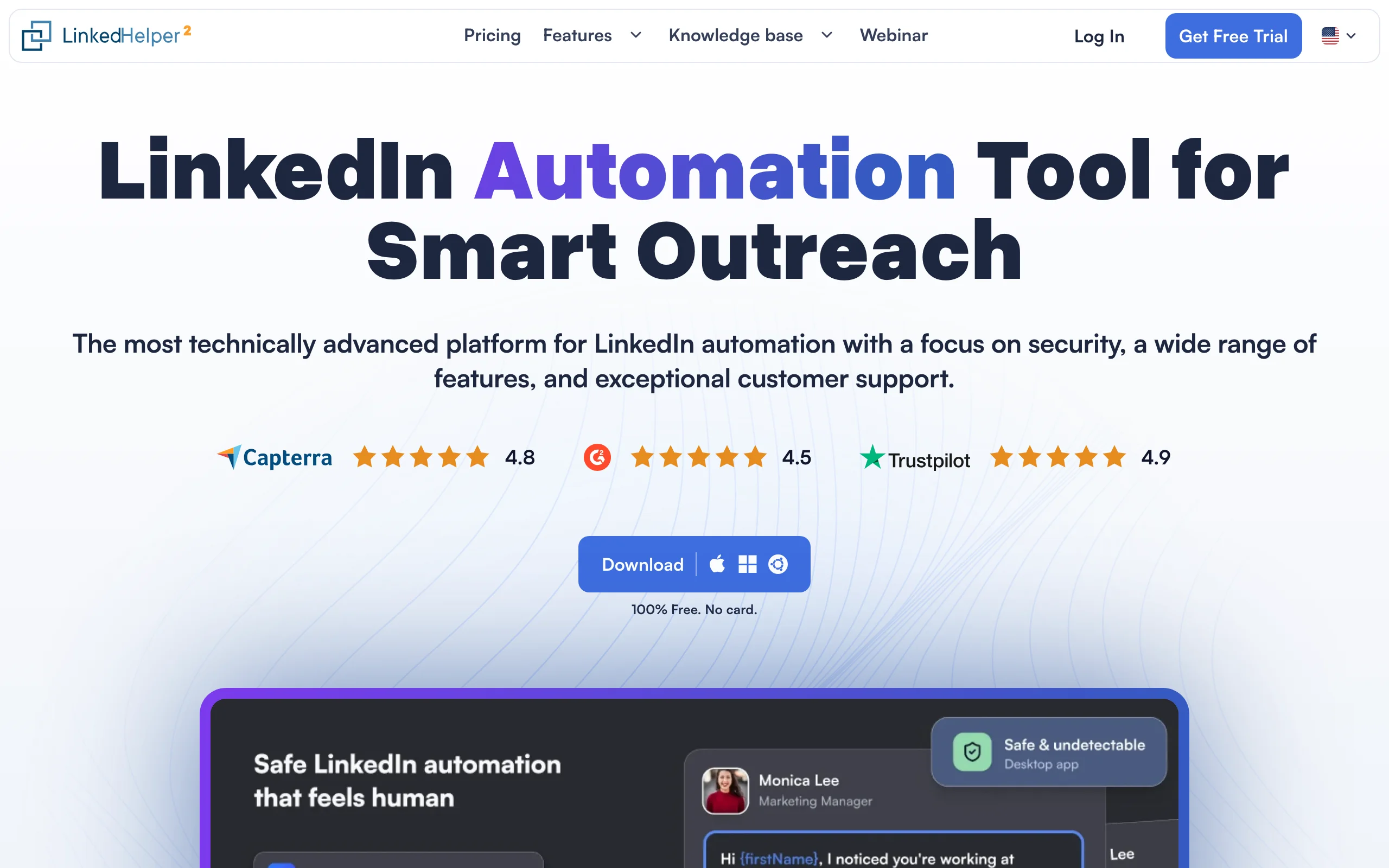
9. Linked Helper, best for desktop-level pacing control
Linked Helper trades Extrovert's human review for locally-run, unattended sequences. It runs as a desktop application rather than a pure cloud tool, which gives you direct control over automation pacing instead of handing session custody to a third-party server. A pricier tier swaps local data storage for cloud-backed storage and sync, but automation still executes on your machine either way. Multi-step campaigns support chained conditions and personalization, a built-in CRM handles tags and notes, and data credits cover lead enrichment on top of the base automation.
That local-first design is also the catch: campaigns only run while your computer is powered on, and reviewers consistently describe a three-to-five-hour setup time for a first multi-step campaign with chained logic.
Key features:
- Desktop app for Windows, macOS, and Ubuntu
- Chained, conditional multi-step campaigns
- Built-in CRM with tags and notes
- Data credits for lead enrichment
- Webhook integrations and image-attached messaging (Pro)
Best for:
- Teams that want automation pacing controlled locally, not by a cloud vendor
- Users comfortable with a steeper setup in exchange for more control
Pricing:
- 14-day free trial with full feature access
- Cloud Standard from $29.90/month, Cloud Pro from $59.90/month
Pros:
- Local execution gives direct control over timing and pacing
- Deep conditional logic once configured
Cons:
- Campaigns stop if the computer is off or asleep
- Notably steep setup time for chained, multi-step campaigns
Cross-platform scraping and automation
10. PhantomBuster, best for automation beyond LinkedIn
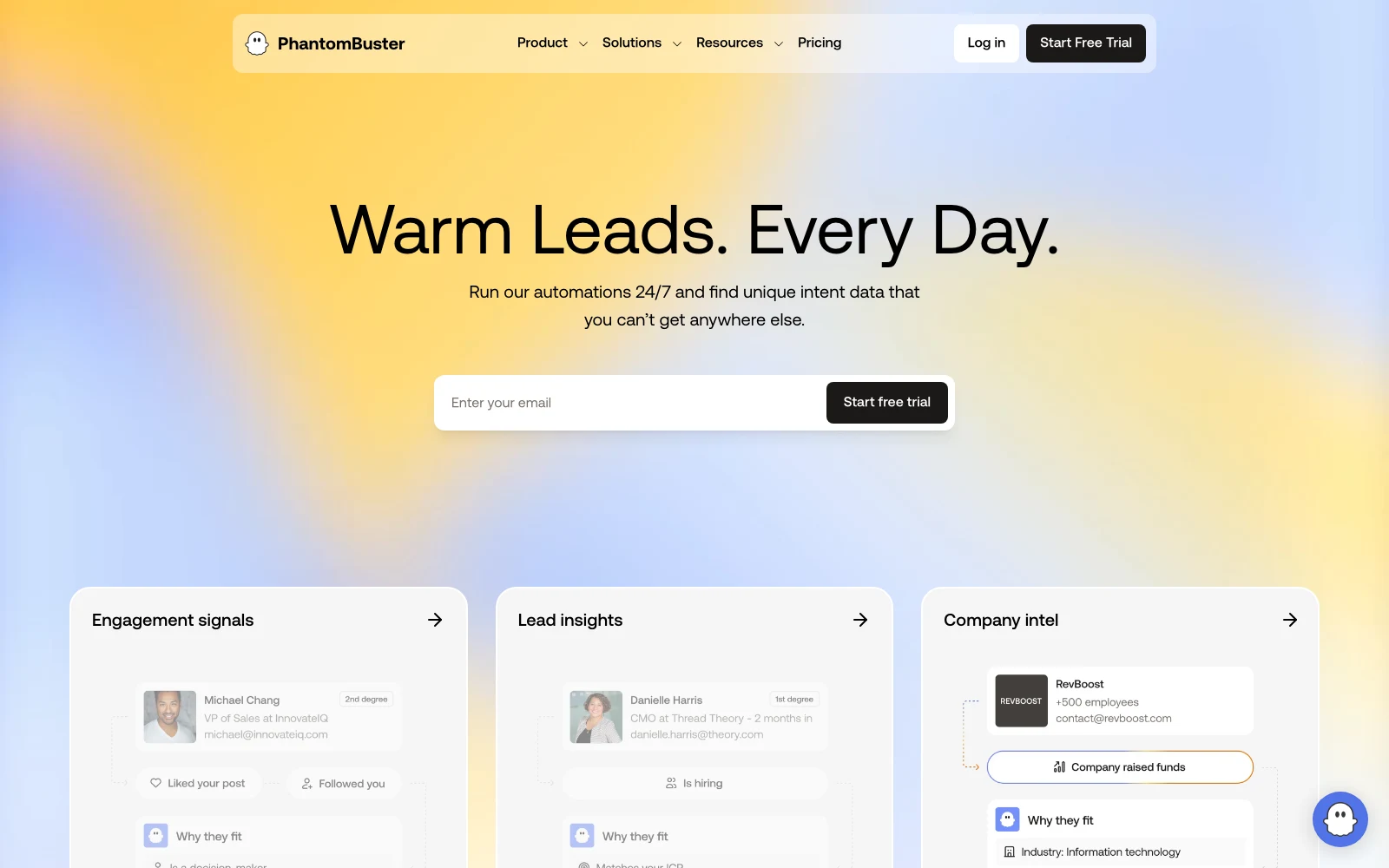
PhantomBuster trades Extrovert's reviewed, LinkedIn-only workflow for unattended, cross-platform scraping. It's broader than a LinkedIn-only tool: its no-code "Phantoms" automate data extraction and outreach across LinkedIn and Sales Navigator as well as Instagram, X, and Google Maps, priced by execution hours rather than by seat. For a team that needs LinkedIn automation as one piece of a wider scraping and enrichment workflow, that range is the draw, and API and webhook access make it easy to wire into custom pipelines.
The execution-hour and credit model means campaigns hard-stop when the monthly allowance runs out with no rollover, and its LinkedIn phantoms operate through stored session cookies, a method that carries real restriction risk since safety features like randomized delays aren't enabled by default.
Key features:
- No-code "Phantoms" for LinkedIn, Sales Navigator, Instagram, X, and Google Maps
- Lead enrichment for emails and job data
- CRM sync and API/webhook access
- AI credits for message generation
- Cross-platform automation beyond LinkedIn alone
Best for:
- Teams that need LinkedIn automation alongside multi-platform data extraction
- Technical users building custom workflows on top of an API
Pricing:
- 14-day free trial, no card required (limited execution hours and credits)
- Starter from $69/month ($56/month billed annually)
Pros:
- Genuinely useful outside LinkedIn for scraping and enrichment
- API access supports custom, technical workflows
Cons:
- Execution hours and credits expire monthly with no rollover
- Safety features aren't on by default, and restrictions still occur
Manage warm-outreach campaigns across all of your clients without spreadsheets or logins juggling.
Extrovert for agenciesHow to choose the best LinkedIn automation tool for your needs
Warm engagement vs automated volume
Decide first whether you want a tool that sends on a schedule or one that keeps a human reviewing every action. Full automation platforms like HeyReach, Skylead, We-Connect, Closely, and Meet Alfred can run a sequence with no daily input, but every unattended action adds to your account's restriction exposure. Extrovert takes the opposite approach: it surfaces prospects and drafts the comment or DM, but you approve and send it yourself, so nothing goes out unreviewed.
How much ban risk your team can absorb
No LinkedIn automation tool is risk-free, but the risk profile varies. Dedicated-IP tools like Expandi-style safety features (seen here in Closely and We-Connect) and cloud-native platforms with built-in warm-up tend to fare better than pure Chrome-extension tools like Dux-Soup and Octopus CRM, which stop the moment your browser closes but also carry the most direct exposure since they act through your own logged-in session. If a senior rep's account going dark for two weeks would hurt pipeline, weight that risk heavily.
Solo rep vs full team vs agency
Octopus CRM, Dux-Soup, and Linked Helper are priced and built for a single user getting started cheaply. Skylead, We-Connect, and Closely scale reasonably to a small team. HeyReach and Meet Alfred are built around multi-account management, which matters most for LinkedIn for account executives and agencies running campaigns for several clients from one workspace.
Cloud vs Chrome extension vs desktop
Cloud-based tools (HeyReach, Skylead, We-Connect, Closely, Meet Alfred, PhantomBuster) keep running whether or not your laptop is on. Chrome-extension tools (Dux-Soup, Octopus CRM) need an active browser session. Linked Helper is the outlier, running locally as a desktop app that trades cloud convenience for direct control over pacing: its pricier tier adds cloud-backed data storage, but execution still happens on your machine. Pick based on whether "always-on" or "under my direct control" matters more for your LinkedIn for B2B sales motion.
Total cost, not sticker price
Compare the real monthly cost, not just the advertised entry price. Skylead's flat rate includes unlimited email that would otherwise cost extra elsewhere, HeyReach's agency tiers get expensive fast per client, and PhantomBuster's execution-hour model can force an upgrade well before the sticker price suggests. Run a two-week pilot on a real (not primary) account before committing to an annual plan, and if you're evaluating a warm alternative alongside these, see how Extrovert's pricing compares.
If you've been burned by an automation tool restricting an account, or you'd rather build pipeline through warm, engagement-led touches than scheduled sends, Extrovert is worth a look before you commit to another automated sequencer. It's built specifically for teams that want LinkedIn to compound trust, not just volume.
FAQ
Are LinkedIn automation tools against LinkedIn's terms of service?
Yes. LinkedIn's user agreement prohibits automated data collection and unauthorized automated actions, which technically covers every tool on this list. In practice, enforcement varies: LinkedIn tends to flag accounts that spike activity far past normal human patterns, which is why safety features like daily limits, randomized delays, and dedicated IPs exist. No automation tool, regardless of marketing, eliminates that risk entirely.
What's the safest LinkedIn automation tool?
There's no fully risk-free option, but tools with dedicated per-account IPs and built-in warm-up (Closely, We-Connect, Expandi-style platforms) generally carry lower restriction rates than Chrome-extension tools acting through your own logged-in session. Extrovert's model works differently: a human reviews and sends every comment and DM, so there's no unattended sequence for LinkedIn to flag as abnormal.
Can I use a free LinkedIn automation tool?
Several tools here offer a genuine free tier or trial: Dux-Soup has a limited free version, and Octopus CRM, Extrovert, and most others offer a free trial (typically 7 to 14 days) rather than an ongoing free plan. Budget-friendly paid entry points like Octopus CRM ($9.99/month) and Dux-Soup ($14.99/month) are the closest thing to free for ongoing use.
Do I need Sales Navigator to use these tools?
Most tools on this list work with a standard LinkedIn account, though several (including HeyReach, Skylead, and Meet Alfred) support Sales Navigator imports and targeting for teams that already pay for it. None of these tools require Sales Navigator to function, though the extra filtering it offers pairs well with any of them for building a target list.
What's the difference between a LinkedIn automation tool and a LinkedIn engagement tool?
An automation tool, like HeyReach, Skylead, or Dux-Soup, sends connection requests and messages on a schedule without a human reviewing each one. An engagement tool, like Extrovert, suggests comments and DMs that you review and send yourself. The trade-off is speed: automation runs unattended, engagement tools put a person in the loop on every send. Teams that have had accounts restricted by automation often move toward the engagement-led model.
Can agencies use these tools for multiple clients?
Yes, several are built specifically for that. HeyReach and Closely both offer agency and white-label tiers for managing outreach across client accounts from one dashboard, and Extrovert for agencies supports running warm-outreach campaigns for multiple clients without juggling separate logins.
How much does LinkedIn automation cost per month?
Entry-level tools like Octopus CRM and Dux-Soup start under $15/month per seat. Mid-tier multichannel platforms like We-Connect, Closely, and Meet Alfred run $49 to $99/month. Full-featured platforms like Skylead and HeyReach start closer to $80 to $130/month, and agency tiers on any of these can run into the hundreds or thousands per month depending on seat or sender count.
Do these tools integrate with a CRM?
Most do on their paid tiers. Skylead, We-Connect, and Closely all offer native HubSpot, Salesforce, or Pipedrive sync, while Dux-Soup, Octopus CRM, and Linked Helper typically require Zapier or Make to connect to a CRM. Extrovert supports done-for-you setup and API integrations on its Business and Pro tiers for teams that want prospect and campaign data flowing into an existing stack.
What happens if LinkedIn restricts my account while using one of these tools?
Policies vary by vendor. Some offer limited support or guidance for recovering a restricted account, but none can guarantee reinstatement since that decision sits entirely with LinkedIn. This is the core argument for lower-volume, human-reviewed approaches: the fewer unattended automated actions on an account, the less likely it triggers LinkedIn's restriction patterns in the first place.
Is a Chrome extension or cloud-based tool safer for LinkedIn automation?
Neither is inherently safer in every case. Chrome extensions act through your own logged-in browser session, which some see as more "native" but stops working the moment the browser closes. Cloud-based tools keep running independent of your machine but require handing LinkedIn session custody to a third-party server. The bigger safety factor in either case is the daily volume and pacing the tool applies, not the delivery method itself.