Most LinkedIn outreach treats engagement as optional. Build a list, send a connection request, fire off a DM, follow up twice, move on. Oleg, founder of Extrovert, ran that exact comparison at scale. The results surprised even him.
In an A/B test across 10,000 leads (same audience, same message, same sequence), the only variable was whether prospects were warmed up with comments before outreach began. Results across three ICP segments:
- CEOs: 8% cold vs. 50% social-first
- Sales leaders: 26% cold vs. 57% social-first
- Agency owners: 11% cold vs. 53% social-first
The lift ranged from roughly 2.2× to 6.25×. Watch the full replay.
The core idea
By the time you send a connection request, the prospect should already recognize your face. Everything in this playbook is designed to build that recognition before you ask for anything.
Why social-first works
Three things explain the lift.
When you engage with someone's content before reaching out, you arrive as a recognized face. People are more likely to read and reply to someone they've already noticed in their feed.
When you comment on a prospect's posts, your own posts may also become more likely to appear in their feed. That can warm them up through both direct engagement and your content.
In a standard sequence, if they ignore your connection request or don't reply to your DMs, you've lost them. Comments and content give you a second and third and fourth touchpoint, completely separate from the DM sequence.
The five-step system
The playbook runs five stages in order:
- Comment → 2. Connect → 3. Wait → 4. Message → 5. Nurture
That middle step, wait, is the most underrated. More on that below.
Step 0: List prep
Before warming anyone up, build the right list.
Work in small batches: 100 to 200 prospects per batch. A monthly cadence is one option. Smaller batches keep you within LinkedIn's connection limits and let you run real experiments instead of one long slow campaign.
Prioritize active LinkedIn users. If your ICP doesn't post or engage, the warm-up phase loses most of its force.
Add co-workers to the nurture stage too. You may only pitch direct decision-makers, but having their colleagues see your comments and content creates ambient familiarity inside the account.
Pull from intent signals where you can. LGM lets you import leads from people who commented on a post, registered for an event, liked a post, or followed a company. People who've already expressed interest in a topic outperform cold firmographic lists.
The warm-up phase
Once your list is ready, spend one to six weeks commenting on prospects' content before you connect. The length depends on your market:
- Transactional / large TAM: one to two weeks, two to three comments per prospect
- Enterprise / limited TAM: two to three weeks, four to five comments (sometimes longer)
Space comments two to seven days apart. If you hit the same prospect's post daily, they see through it. The spacing is what makes the warmth feel genuine.
| Result | What it represents |
|---|---|
| 2.2–6.25× | Reply-rate lift across the three segments |
| 51% | Headline reply rate highlighted in the webinar |
| 20% | Prospects who DM you first when you wait after connecting |
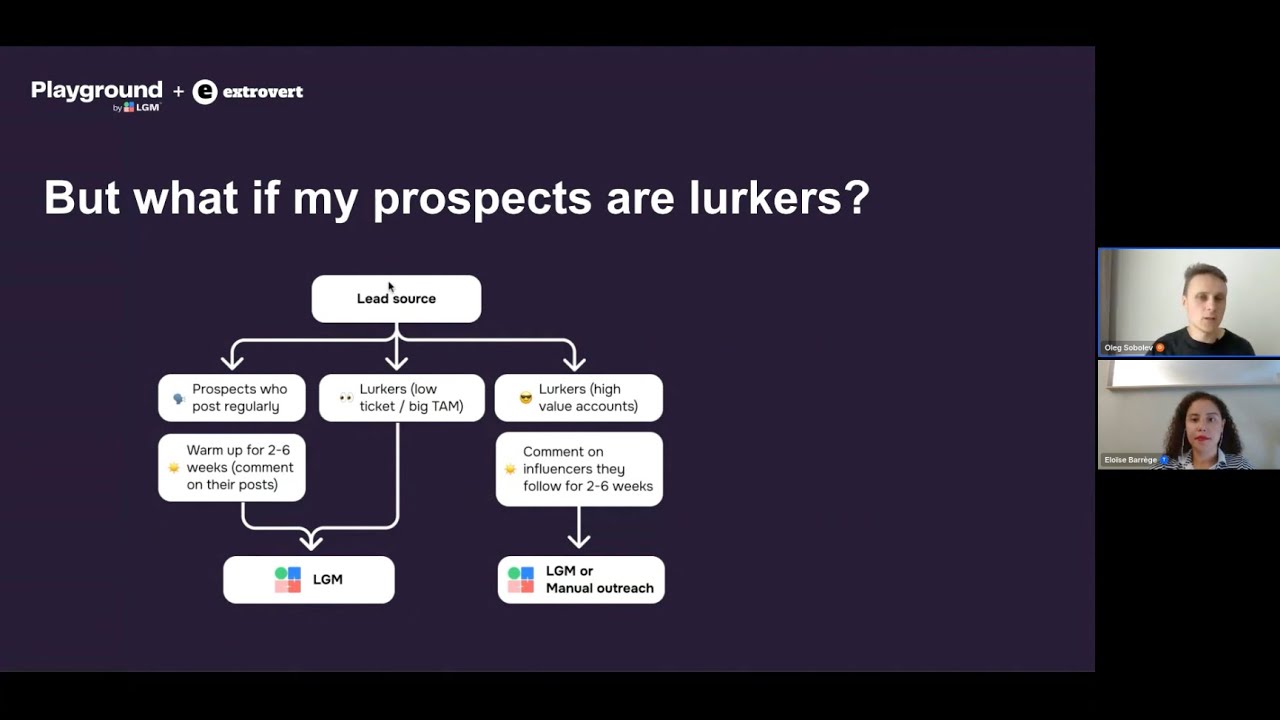
What about prospects who don't post?
If your ICP barely uses LinkedIn, you're not stuck. Extrovert has a "posts they're likely to see" feature: it surfaces posts from creators your prospect has previously engaged with, on the assumption that LinkedIn's algorithm will push those posts into their feed. You comment there, becoming a familiar face in a content stream they may see, without needing direct access to their own posts.
The caveat: this works best for high-value accounts. It requires more judgment per prospect and doesn't scale cleanly to high-volume transactional pipelines.
Blank connection request
After the warm-up period, send the connection request with no note.
In Oleg's tests, a blank request felt natural after he had already commented on someone's posts. They recognize you. Adding a note tends to signal a pitch is coming, which undermines the familiarity you spent weeks building.
In LGM, you can layer additional social warming before the connection: profile visits, follows, and post likes.
The wait
After someone accepts your connection request, wait. For large-TAM markets, that may be three to five days; for enterprise or limited-TAM markets, Oleg recommends four to six weeks. Keep commenting on their posts and posting your own content during that window.
The result: roughly 15 to 20% of prospects DM you first, before you've sent a single outreach message. They've seen your face in their notifications, your content in their feed, and eventually they reach out on their own. When that happens, the conversation is completely different. They initiated it.
"About 15 to 20% of our leads DM'd us first. So even before my first DM, leads DM me first, and this completely flips the script." — Oleg, Extrovert
If you never post, keep the gap shorter. If you post consistently, extend it. Each post that lands in their feed does relationship-building work while you're doing something else.
The DM sequence
When you do send the first DM, keep it pitch-free.
The first message is short and conversational, starts lowercase:
"hey [first name], glad to connect. wanted to ask, are you using LinkedIn as a channel for outbound at all?"
No pitch, no value prop, no booking link. The goal is a reply. LGM's real-chat mode splits this into two lines, the way someone would type on mobile. Oleg said this format worked surprisingly well.
The second message, sent at least seven to ten days later, is where you explain why you reached out. Some people won't reply to a conversational opener without knowing your agenda. The second message catches them: a brief value prop, still short, still relevant to the question you already asked.
Keep follow-ups spaced wide: seven days minimum, often ten to twenty. You have comments and content running in parallel, so the sequence doesn't need to move fast. And follow-ups should carry actual value: an industry insight, a relevant case study, a resource. Not "just wanted to bump this."
Relevance beats personalization
Oleg found that speaking to an ICP's real pain points worked better than hyper-personalized openers such as "I noticed you commented on X post."
Comments, posts, and DMs
The three channels work together because each does something the others can't.
Comments keep you visible in notification feeds. They may also help your own posts appear in the prospect's feed, so even modest reach can matter when it includes target accounts.
Posts build trust during the waiting period. After a prospect interacts with your comments, your posts may be more likely to appear in their feed. You don't need a big audience for this to matter. Even 200 impressions mean something when those 200 people are your target accounts.
DMs are where conversion happens, but they land warmer because the other two channels already did the work. Oleg finds that prospects sometimes respond to a DM because of comment or content activity alone, sometimes months after the original sequence ended.
Keep AI-assisted comments human-reviewed
Extrovert drafts comments, but nothing is posted without approval. In the webinar Q&A, Oleg said he lightly edits or regenerates roughly 20–30% of his suggestions. He reads the post summary and the draft before approving anything.
Review the context, then edit, regenerate, approve, or skip.
Response handling
When someone replies, move to manual conversation. Keep comments and content running in parallel and guide them toward a demo or signup through real back-and-forth.
If they don't reply and they're a low-value prospect, remove them from the sequence and move on. If they're a high-value account, consider moving them to long-term nurture. These are leads you can't afford to lose.
One more thing from the session: Oleg uses Super Whisper, a voice-to-text app with a custom sales playbook prompt, to reply quickly in manual conversations. He dictates his intent, the tool formats it in his voice against the conversation history and playbook.
Long-term nurture
Long-term nurture isn't prospecting. It's staying in front of people who fit your ICP but aren't ready to buy now.
Oleg's number: roughly 70% of Extrovert's paid users came from this stage, not from the initial sequence. They replied, followed, engaged with content for months, and eventually converted. The initial outreach opened the door; the nurture kept it open.
What goes into a long-term nurture sequence in LGM: relevant industry insights, new case studies, useful resources, and company updates when they're worth sharing. Not "just checking in." If you don't have something worth sending, wait.
Review daily comments in ~20–30 min
Comment. Connect. Wait. Message. Nurture.
Extrovert tracks your prospects, surfaces posts to comment on, and drafts comments for your review. Every suggestion stays human-reviewed.
See how it works for B2B sales
Benchmarks
Once the full system is running, here's what to aim for:
- Connection acceptance rate above 60%
- Roughly 15 to 20% of prospects DM you first
- Reply rates at minimum 3x what you were hitting before
These are benchmarks. Reply rate is a vanity metric in the long run. The real number is meetings booked and revenue.
Watch the full session
The replay includes the slide deck, live demos of Extrovert and LGM workflows, and audience Q&A.
FAQ
What is social-first prospecting?
Social-first prospecting means engaging with a prospect's LinkedIn content before you ever send a connection request or DM. The goal is to arrive as a recognized face rather than a cold message. Oleg's A/B test across 10,000 leads showed reply-rate lifts ranging from roughly 2.2× to 6.25× across the three segments.
How long should you warm up a prospect before reaching out?
One to two weeks for transactional or high-volume markets (two to three comments per prospect). Two to three weeks for enterprise or limited-TAM markets where burning a lead is costly (four to five comments, sometimes longer). Space comments two to seven days apart regardless.
Why send a blank connection request after warming up?
After several weeks of genuine engagement on their posts, a blank request feels natural. They recognize you. Adding a note tends to signal a pitch is coming, which undermines the familiarity you've built. In Oleg's tests, blank requests outperformed noted requests once warm-up was in place.
Why wait after someone accepts your connection?
A post-connection wait—three to five days for large-TAM markets or four to six weeks for enterprise or limited-TAM markets—gives prospects time to see your content, process who you are, and optionally reach out first. In Oleg's workflow, roughly 15 to 20% DM'd him before he sent anything while he kept posting and commenting during that window. When they initiate, the conversation dynamic shifts completely.
What should the first DM say?
Keep it short, conversational, and pitch-free. Oleg's example: "hey [name], glad to connect. wanted to ask, are you using LinkedIn for outbound at all?" No value prop, no link, no ask. The goal is a reply, not a close. The pitch comes in the follow-up.
How do LGM and Extrovert work together?
LGM handles the automated sequencing: profile visits, follows, blank connection request, DM 1, follow-ups, and the long-term nurture cadence. Extrovert handles the warm-up commenting and parallel content engagement throughout. The two tools run side by side. Extrovert manages the social layer, LGM manages the outreach layer.
What is the "posts they're likely to see" feature?
A feature in Extrovert that surfaces posts from creators your prospect has engaged with before, on the assumption the LinkedIn algorithm will push those posts into their feed. It lets you warm up prospects who don't post themselves by appearing in a content stream they may see.
Based on the LGM × Extrovert live session, "Get 51% reply rates: The Social-First Prospecting Playbook." Watch the replay.