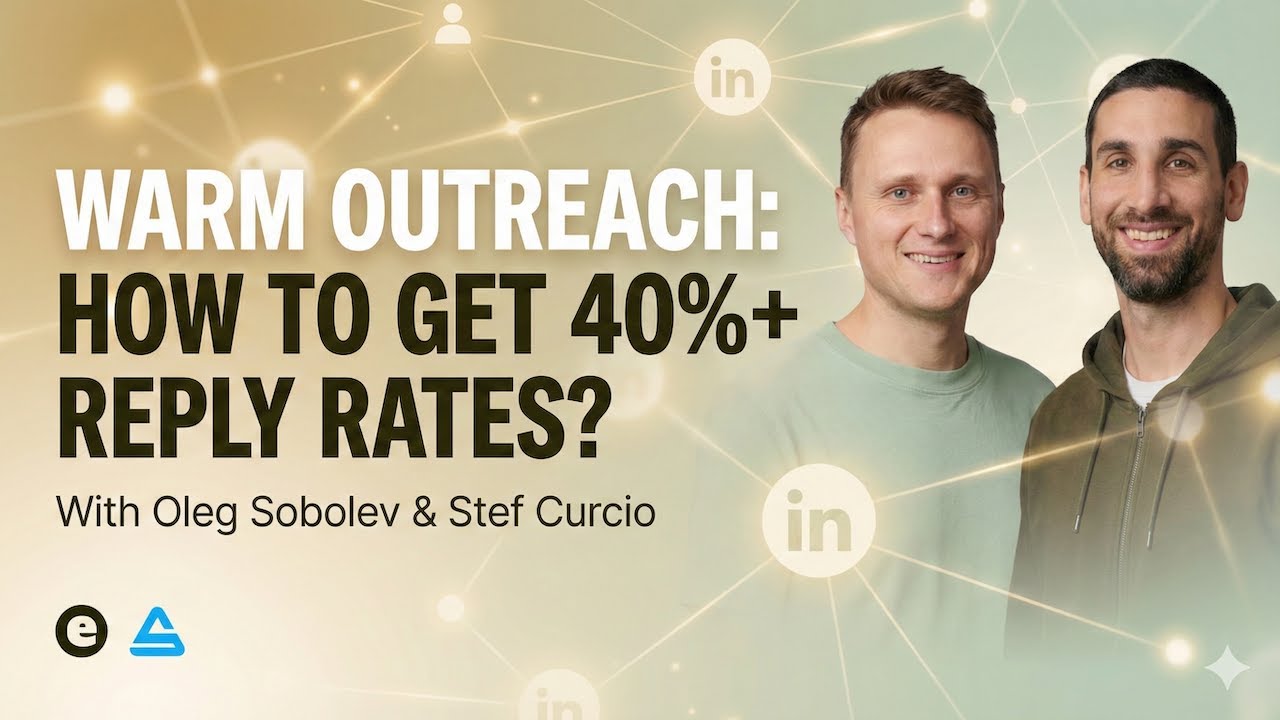
Most LinkedIn outreach gets ignored because it starts cold. The first message lands in a stranger's request inbox, pitches something, and dies there. Stef Curcio, founder of Scale Acquisition AI and someone who has worked with 200+ founders and creators, runs the opposite playbook, and his lifetime first-message reply rate sits near 59%.
In a live session with Extrovert, Stef walked through the exact system: how he builds a test list, warms up accounts before reaching out, the five messaging methods he rotates, and the Pivot → Probe → Invite flow that turns a casual reply into a booked call. This is the written recap. You can watch the full replay here.
Stop landing in the stranger pile. By the time you send a connection request, the lead should already recognize your face. Everything below is built to manufacture that recognition before you ask for anything.
Start with warm traffic, not cold lists
Stef has largely stopped doing cold outreach. Instead he targets three pools of warm traffic: people who visit his profile, people who send him an inbound connection request, and people who start following him. These leads have already taken a small action toward him, so a message reads as a continuation, not an interruption.
For everyone else, he manufactures the warmth. Before reaching out, he (or his VAs) leave a couple of comments on the lead's posts. The result is that he never lands in the "networking" section as a cold stranger. The lead has seen his face before. That history is what makes the reply rate hold up. This is the heart of warm outreach: get known first, pitch later.
He also posts content, and has his clients post content. When someone gets a connection request, they often check the profile, see the posts, and form a rough idea of who you are. The content does relationship-building work while you sleep.
Build a small test list first
Before scaling anything, Stef tests. His list-prep rule is simple:
- Add about 10 new leads a day until you reach at least 15-20 leads per script.
- Run each script against its own batch so you can compare reply rates cleanly.
- Treat the test as two-sided: you're measuring the reply rate and whether the style fits you.
That second point is the one most people skip. There are several ways to do outreach, and reps quit not because outreach doesn't work but because the one approach they copied doesn't sit right with them. Find the method that gets replies and feels natural to send. If you're using automation, push these numbers higher; if you're going manual, 15-20 is enough to get a feel.
Warm up before you reach out
Warming up an account before the first message, a few genuine comments over a week or two, consistently lifts results. Stef has seen it raise reply and connection-acceptance rates by 10-20%. It's optional in theory, but a must-have when your total addressable market is small and you can't afford to burn leads.
The mechanics are easy: comment on a couple of the lead's posts, let them notice you, then send the connection request. If you're warming up at any real volume, this is where a tool earns its keep. More on that below.
The five messaging methods
Stef's scripts revolve around five methods. The first two are conversational and work best on solopreneurs and companies under ~50 employees. The last three scale up to bigger companies, and methods four and five are openly pitchy, so they only land when you have something genuinely relevant to say.
| # | Method | Works best for |
|---|---|---|
| 1 | Compliment + casual question | Solopreneurs, <50 employees |
| 2 | This-or-that conversation | Solopreneurs, <50 employees |
| 3 | Exploratory question | Almost anyone, incl. bigger companies |
| 4 | Name dropping | Bigger companies, relevant niches |
| 5 | Value proposition | Bigger companies, with a strong offer |
1. Compliment + casual question
Open with something real you noticed: a recent post, or a detail from their bio, experience, or banner if they don't post. Add a personal observation that ties back, then ask an easy question.
"Hey, I saw your post on productivity. I also put a sign outside my door so my kids don't disturb me when I'm working. How's life in [city]?"
It looks almost too simple, but this is one of Stef's highest-reply messages, for solopreneurs and small companies.
2. This-or-that conversation
Still conversational, still about them. You hand the lead an easy binary to answer.
"Hey, I saw you run a cookie store in London. Just out of curiosity, do you work mostly with regular customers, or do you rely on new customers coming into the store?"
3. Exploratory question
The safe default for almost any lead, including larger companies. You reference a pattern you're hearing from peers, then ask if it's on their radar.
"I hear from other founders in fintech that lowering developer turnover is often top of mind. Is decreasing developer turnover something you've explored, or not really a priority right now?"
4. Name dropping
Borrow relevant credibility. The name has to mean something to the lead: a competitor or a peer they recognize, not a random logo.
"I did this exact work for [relevant company] and got [result]. I've got the process ready for [their specific use case]. Is that something worth exploring?"
Stef's example: a client in manufacturing who works with a tight set of ~100 big companies that all know each other. Name-dropping a direct competitor's result made new clients easy. Name-dropping "Apple and Microsoft" to a small agency does the opposite: irrelevant credibility reads as noise.
5. Value proposition
A direct offer, used when your offer is genuinely unique or backed by a real guarantee. Stef's example of a message he replied to:
"We sell aged LinkedIn accounts, and some clients make the cost back in 3-6 months just by renting them out. Worth exploring a fit for you?"
Real guarantees matter here. "We guarantee results, pay in advance" isn't a guarantee. A client of his in HR offered to work the first month (or three) for free unless real KPIs (employee satisfaction, turnover) were hit. That landed because it was a true risk reversal on a unique offer.
Methods 4 and 5 are pitchy, and Stef says so plainly. They only work when the relevance is real and you have a little brand behind you. For bigger companies without a slam-dunk offer, default to method 3.
Pivot → Probe → Invite
Getting a reply is step one. Stef moves from a casual chat to a booked call with a three-part flow. He'll sometimes skip a step, but the shape holds.
Pivot
Acknowledge what they said, add a quick observation, then ask a this-or-that question that makes the lead self-select.
"Ha, London rain. Been there, felt that. I saw you're pretty active on here. Are you using LinkedIn mostly to generate clients, or more to expand your network?"
If they say "generate clients," they've given you permission to continue. If they say "just networking," let them go. Stef doesn't try to convince people who aren't looking. He's tried, it doesn't pay off.
Probe
When they open up about a goal or a challenge, acknowledge it, then ask one more validating question: what have they tried, what didn't work. He uses this most on warm traffic, or when he wants to qualify a lead whose company size, budget, or fit isn't clear. With an obviously good-fit big company, he often skips straight to the invite.
"Got it, so you tried running campaigns before but it didn't really land. What have you tried so far?"
Invite
Once it's a fit, he names what he's good at and proposes a call, with a twist on scheduling.
"This is exactly what I'm good at, and I'm confident I can help. Want to grab a quick call to see what it'd look like? I've got an open slot [day/time in their timezone]. Send your email if that works. If not, I've also got [alternative slot]."
Stef avoids dropping a calendar link up front. Links get lost and people forget to book. He offers one or two specific slots first, and only shares the scheduling link if neither works. He admits this is preference over hard data, but it's a habit worth testing.
Reply rate is a vanity trap
A warning from the session: first-message reply rate is easy to game. Send something non-salesy enough and you can hit nearly 100% on message one, while message two and three collapse. Judge the whole conversation's reply rate, not just the opener. And accept that people ghost at any stage, even after a demo. That's why a follow-up and nurture system matters more than any single clever line. (For the relationship-building fundamentals underneath all of this, see how to network on LinkedIn.)
The tool stack
Stef keeps the stack lean:
- Sales Navigator: a near-must. LinkedIn Premium isn't enough for serious prospecting. He also uses Sales Nav to sanity-check ICPs: 70-80% of the time when someone claims "my buyers aren't active on LinkedIn," a quick Sales Nav search proves they are.
- A CRM: nice-to-have, basically free. He runs a Notion template that pulls leads from LinkedIn so he can track who's at what stage. Without one, reply-rate math becomes painful manual work.
- Kondo: a to-do list for DMs, useful at mid-to-high volume.
- Extrovert: he now runs all his outreach through it, including the warm-up comments before reaching out.
After Stef's walkthrough, Oleg showed how Extrovert handles long-term nurture. His campaign has two streams: comments and DMs. A weekly touchpoint frequency means he comments on everyone roughly once a week without stalking daily posters or missing monthly ones. The DM stream surfaces a suggestion every 20-60 days, triggered by elapsed time or a relevant new post, and drafts the message from his playbook in his voice. Oleg reviews each draft, sends a couple of comments, and moves on: a handful of leads, a few minutes, real touchpoints.
Extrovert tracks your prospects and topics, then suggests on-brand comments and DMs from your playbook. You review every suggestion before anything goes out, so warm-up and follow-up stay human without eating your day.
See how it works for B2B salesDo you need authority first?
A common question from the session: does this only work if you're already a big creator? Stef's answer is no. Branding authority helps, but it isn't the deciding factor: client results, a track record, working with recognizable companies, and a unique offer matter more. He once ran a revenue-share offer through pure cold reach and still got a 40% reply rate, no warm-up, because the offer itself was compelling. A little brand makes the conversational methods land better, but results and relevance do the heavy lifting.
Watch the full session
The replay covers everything above with live examples and audience Q&A, plus the slide deck.
Stef is also an Extrovert done-for-you partner. If you'd rather have the system installed for you, that's where to start.
FAQ
What reply rate can you realistically expect on LinkedIn?
Stef's system targets 40%+ on the first message, and his lifetime first-message reply rate is around 59%. For a broader comparison, see Extrovert's LinkedIn acceptance and reply-rate benchmarks. Conversational openers land highest; pitchier value-prop messages run lower. The honest framing is to track the whole conversation's reply rate, not just the opener, since first-message rates are easy to inflate.
Should you warm up leads before sending a connection request?
Yes, especially when your addressable market is small. Leaving a couple of genuine comments on a lead's posts before reaching out raises reply and acceptance rates by 10-20% in Stef's experience, because the lead recognizes you instead of treating you as a cold stranger.
Which LinkedIn outreach method works best for large companies?
For bigger companies, the exploratory-question method (method 3) is the safe default. It works on almost anyone without sounding like a pitch. Name-dropping and value-proposition messages also scale up, but only when the credibility or offer is genuinely relevant to that specific lead.
Why offer time slots instead of a calendar link?
Stef finds calendar links get lost and prospects forget to book. He proposes one or two specific time slots first and only shares the scheduling link if neither works. He notes this is based on experience rather than hard A/B data, so it's worth testing for your audience.
Do you need a big personal brand for this to work?
No. Branding helps the conversational methods land, but client results, a track record, and a unique offer matter more. Stef has hit a 40% reply rate on cold outreach with a strong offer and no warm-up, which shows relevance beats raw authority.
Based on Extrovert's live session with Stef Curcio (Scale Acquisition AI), "Warm outreach: how to get 40%+ reply rates?" Watch the replay.