Most people who try to network on LinkedIn hit the same wall. They send a connection request with a generic note, get accepted, fire off a pitch within 48 hours, and wonder why nobody replies.
The pattern is so recognizable that buyers spot it before the DM arrives. A recurring complaint in r/sales and r/b2bmarketing: the connect-and-pitch is now the LinkedIn equivalent of a cold robocall. Everyone sees it coming. Almost nobody responds.
This guide covers a different approach. Instead of starting with a message, you start with presence. Comment before you connect. Build familiarity through repeated impressions. Send a DM after the prospect already knows who you are. By the time you pitch anything, you are not a stranger.
Step 1: Does your profile do the work before you speak?
Your profile is your landing page, and prospects check it before they accept your request or reply to your message. A weak profile kills the whole chain before it starts.
The most common mistake is writing a headline for your own title, not your buyer. "Senior Account Executive at XYZ Corp" tells a prospect nothing about why they should care. A stronger structure: what you do, who you help, what outcome they get. Example: "I help Series B SaaS teams cut sales cycle time by mapping the full buying committee on LinkedIn."
Your banner image reinforces that positioning. A blank blue background wastes the second most-visible surface on your profile. Use it for a short proof point, a positioning statement, or a visual that signals credibility with your ICP.
The About section closes the narrative. Write it in first person, for one reader (your ideal prospect), and end with a soft direction: what you want them to do next. No resume language, no buzzword lists.
Step 2: Engage before you connect, the LinkedIn networking move most guides skip
This is the step most guides ignore, and it is the one that changes everything.
Engaging before you connect builds familiarity without any ask. Identify 20-30 target accounts, follow the relevant people, turn on post notifications for those who post regularly, and comment on their content before you ever send a request.
The comment has to earn its keep. "Great post" adds nothing. A two-sentence reaction that extends an idea, asks a genuine follow-up, or shares a relevant experience gets noticed by the author, surfaced in the comment thread, and distributed to the feeds of everyone in your network who engages with the post.
This is not a soft tactic. According to research on the LinkedIn algorithm, comments carry roughly 15x more weight than likes in the feed-ranking system. A like is invisible. A comment creates a visible trail: the author sees you, their followers see you, your own connections who interact with the post see you. Do this across 20-30 target accounts for two weeks and you stop being a stranger.
By the time you send the connection request, the prospect has already seen your name and face in a relevant context two or three times. That is how trust forms.
SDRs building pipeline on large volumes of target accounts can scale this workflow systematically. Use a LinkedIn comment generator to draft substantive, on-brand comments quickly when working through a long list.
Step 3: What makes a connection request get accepted on LinkedIn?
Personalized requests get accepted at roughly 3x the rate of generic ones: 45% versus 15%, based on an analysis of 16,492 connection requests (Botdog, 2025). Despite that, only 13% of requests include any personalization. That gap is your advantage.
LinkedIn gives you 300 characters for a connection note. The formula:
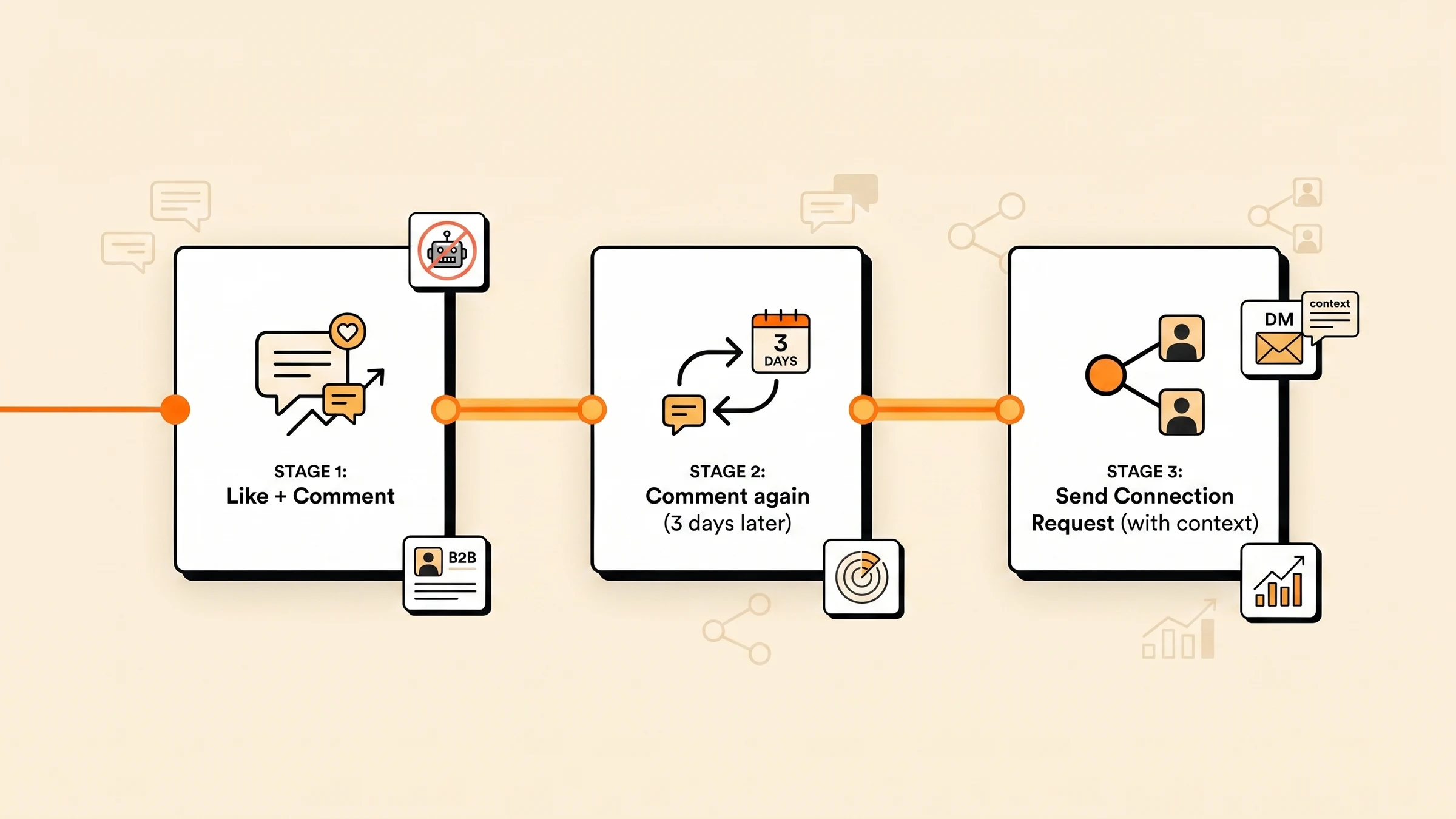
- Reference: something you actually saw (their post, comment, article, or company news)
- Shared context: why connecting makes sense for both of you
- No pitch: not even a soft one
A working example: "Saw your post on pipeline velocity last week, the point about discovery timing was sharp. I work with a few SaaS AE teams on similar problems. Would be good to have you in my network."
That message is specific, relevant, and asks for nothing. It signals you are paying attention to their work, which is the foundation of any professional relationship.
The fastest way to kill acceptance rates is adding a pitch to the note. It signals the connection is transactional, and most prospects will ignore the request or accept and immediately mute you.
A LinkedIn connection request generator can help you format these at scale without losing the personal context that drives acceptance.
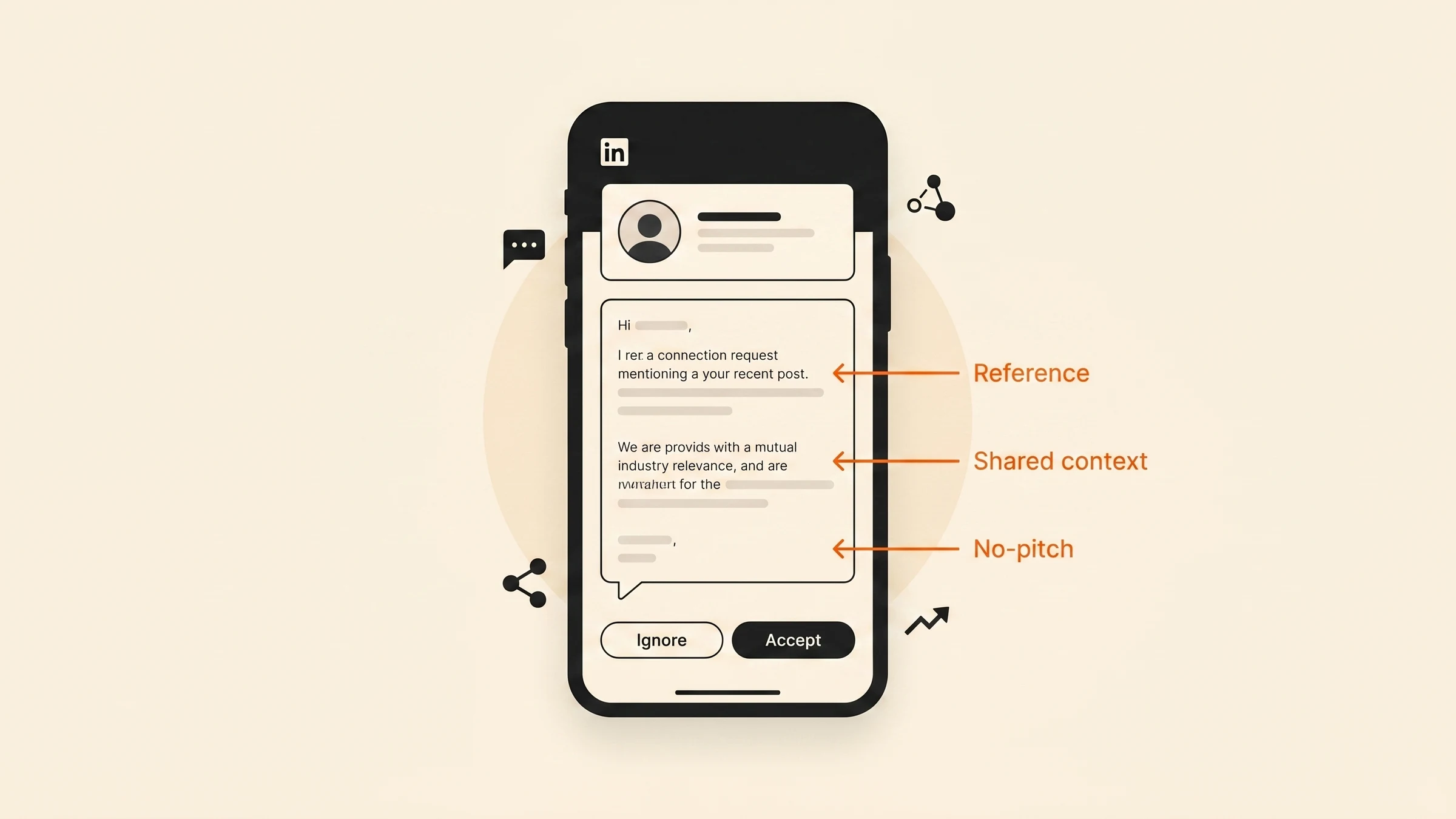
Comment on a prospect''s posts two or three times before sending the request. By the time you reach out, the name is already familiar and acceptance rates climb. This is the core of an engagement-first warm outreach strategy.
Step 4: What do you say in the first message after they accept?
Timing matters. A pitch that arrives within 24 hours of acceptance tells the prospect what the connection request was really about, and makes them feel tricked. The goodwill disappears.
Wait 48-72 hours. Then send something short.
A warm first message:
"Thanks for connecting. I noticed you have been writing about [topic] recently, interesting take on [specific point]. Happy to share what I have seen work in similar situations if that would be useful, no agenda."
A cold pitch disguised as a first message:
"Hi [Name], I help companies like yours [achieve outcome]. Are you open to a 15-minute call this week?"
The difference is intent signal. The first treats the prospect as a person and offers something before asking for anything. The second makes it clear you are on a sequence, not in a conversation.
Do not attach a calendar link to message one. That moves too fast and signals you are running a cadence, not building a relationship. The goal of message one is a reply, nothing more.
| Approach | Accept rate | Reply rate | Ban risk |
|---|---|---|---|
| Cold connect + same-day pitch | ~15% | ~1-3% | Medium |
| Personalized request + delayed warm DM | ~45% | ~10-18% | Low |
| Engage first + personalized request + warm DM | Highest | Highest | Low |
Step 5: The 90-day LinkedIn networking loop that replaces the 2-week sequence
Most networking advice ends at the first message. That is also where most networking relationships die: someone accepts, you exchange a message or two, and then the connection sits dormant until you need something. Reaching out at that point feels awkward because it is.
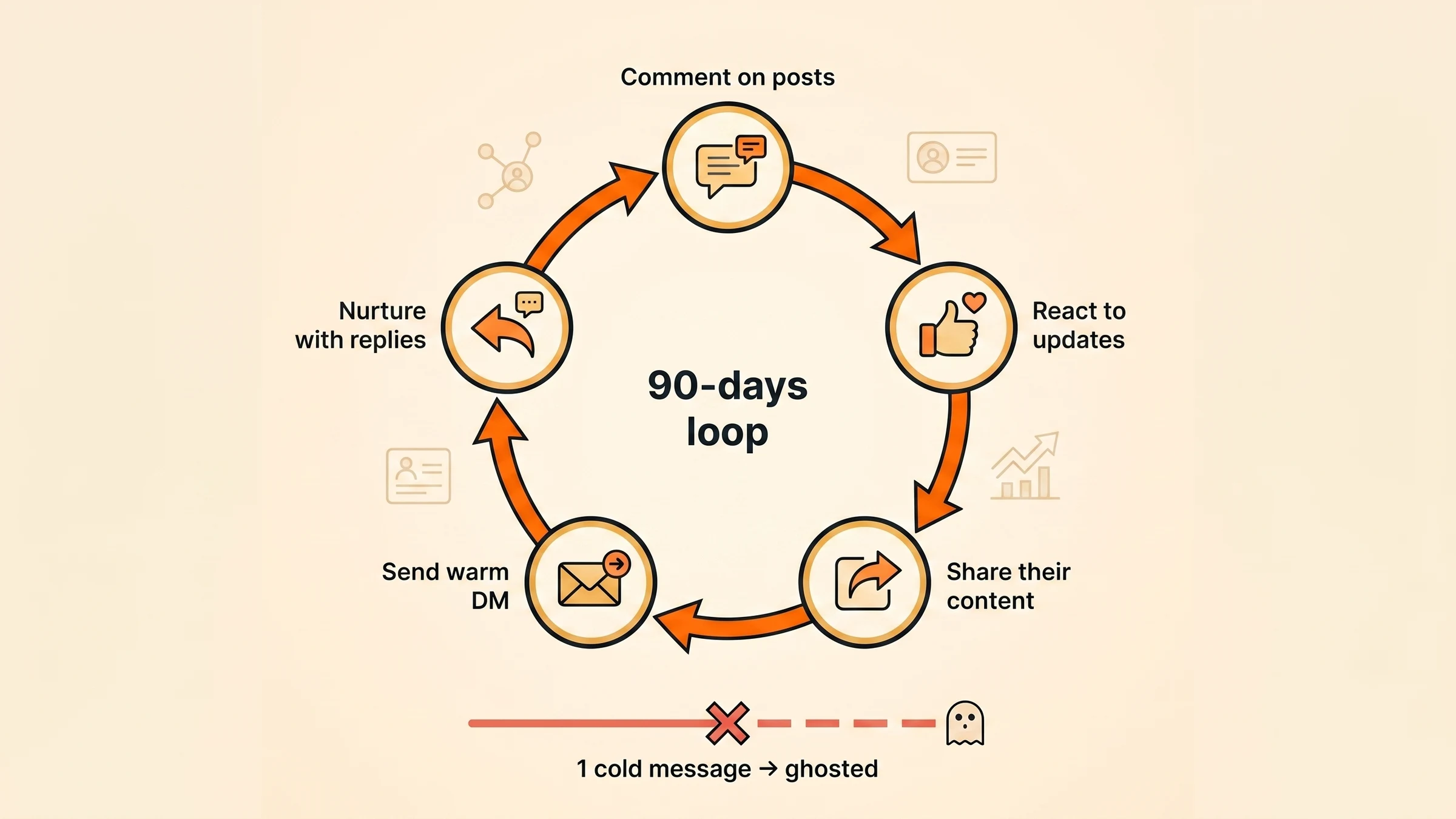
The fix is a 90-day loop, not a two-week sequence. A sequence ends. A loop keeps cycling: low-pressure, event-driven, and give-first.
Here is what a 90-day loop looks like in practice:
| Action | Frequency | Purpose |
|---|---|---|
| Comment on their posts | Weekly if they post | Stay visible, signal attention |
| React to company updates | As relevant | Show awareness of their business |
| Share a useful link or insight | Once a month | Give before you ask |
| Reply to their comments on others'' posts | Opportunistically | Expand touchpoints outside their own content |
| Follow-up DM on a trigger event (job change, announcement) | Event-driven | Convert visibility to conversation |
The underlying principle: every touchpoint gives something before it asks for anything. Share their content with a brief observation. Send an article tied to a challenge they mentioned. Congratulate a promotion before it becomes a follow-up hook.
After 90 days of consistent, low-effort presence, you are not a cold contact. You are someone they recognize. And recognition is what turns a connection into a conversation.
Familiarity beats volume. The fastest path to a reply is being recognized before you ever pitch. Build impressions first; the conversation follows.
Extrovert tracks your prospects and topics, then suggests on-brand comments and DMs from your playbook. Warm and human, with every send reviewed by you first.
See how it worksFAQ
What is the best way to network on LinkedIn without being spammy?
The most effective approach is to engage with someone''s content before you connect or message them. Comment on their posts two or three times, send a context-rich connection request referencing something specific, and hold off on any pitch for at least a few weeks after they accept. The goal is to be recognized, not to sell on first contact.
How many LinkedIn connection requests can I send per day?
LinkedIn''s safe threshold is generally 20-30 personalized requests per day for accounts with no prior restrictions. Above that, especially with generic notes, you risk account review. Quality beats volume: 10 personalized requests will outperform 50 generic ones in both acceptance rate and downstream reply rate.
What should I say in a LinkedIn networking message after connecting?
Keep the first message short and low-stakes. Reference something relevant about their work or a topic they have discussed recently. Offer something useful (an insight, a resource, an observation) and avoid any ask or calendar link in message one. The goal is a reply, not a meeting.
How long does it take to see results from a LinkedIn networking strategy?
Realistically, 60-90 days for consistent engagement to start producing conversations. This is why the 90-day loop matters more than the two-week sequence: most sequences end before trust has time to form. Prospects engage with people they recognize, and recognition requires repeated, useful impressions over time.
Does commenting on LinkedIn posts actually help with how to network on LinkedIn?
Yes, commenting is one of the highest-ROI actions on LinkedIn for networking. Comments carry significantly more algorithmic weight than likes, creating visibility beyond just the person you are engaging. The author sees you, their followers see you, and your connections who interact with the post see you. Every substantive comment compounds your presence across your target audience.
Sources: Botdog: LinkedIn Connection Request Acceptance Rates (2025), Expandi: LinkedIn Outreach Benchmarks 2026, meet-lea: LinkedIn Algorithm 2026