AI has made shipping software faster, cheaper, and dangerously satisfying. A solo founder can spend all day improving the product and still avoid the work that decides whether it becomes a business: choosing a sharp position, finding customers, getting them to use it, and asking them to pay.
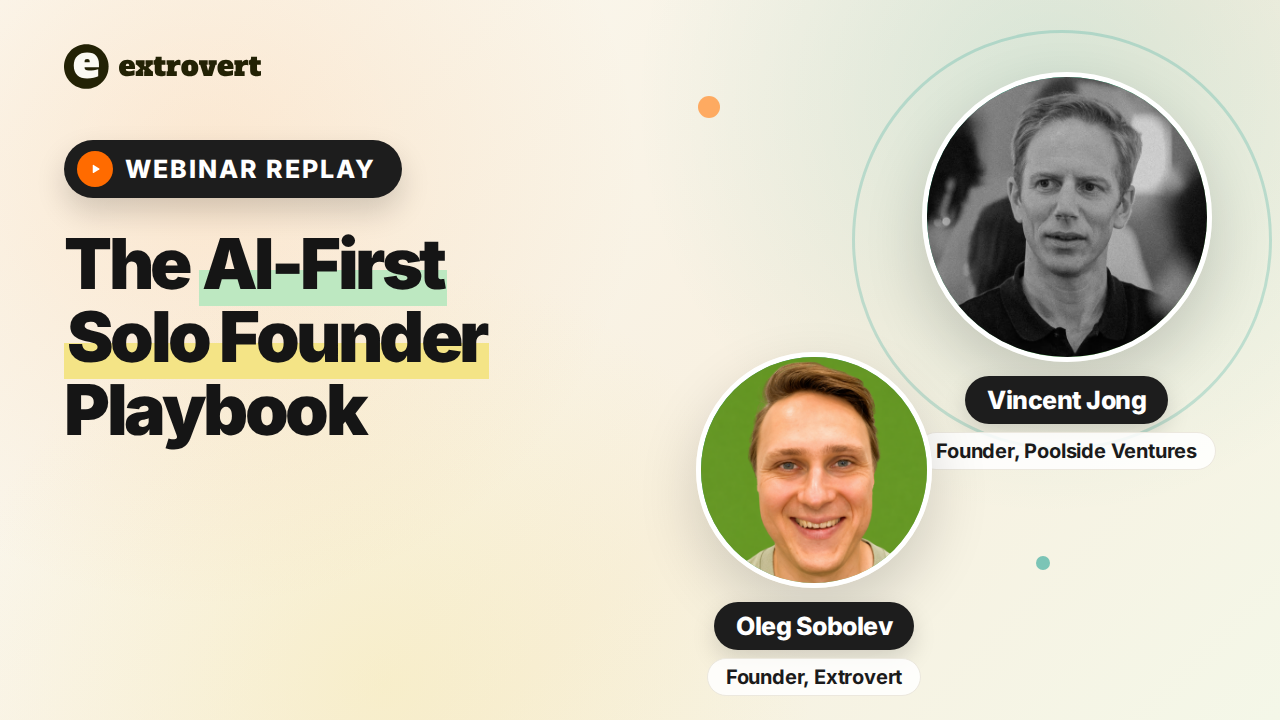
Vincent Jong spent roughly 14 months testing how far one person can go with AI across four early products. The products did not produce one neat success story. That is what makes the experiment useful. Across the portfolio, DataMerge found sales traction, Meet.bot remained inexpensive but revenue-free in 2026, and Scopy shifted toward workshops and assisted onboarding. The main lesson was consistent: AI compressed product execution, but it did not create distribution or customer adoption.
Oleg Sobolev reached the same bottleneck from the GTM side. His answer is less glamorous than another autonomous agent: become familiar before outreach, use real context, and stay visible for longer than a two-week sequence.
Four products, four different signals
Vincent is an experienced B2B SaaS founder and former product leader at Dealfront and ZoomInfo. Through Poolside Ventures, he has been testing a one-person portfolio of AI-first products rather than presenting four mature companies.
The figures below are Vincent’s self-reported July 2026 results. They are point-in-time operating numbers, not audited benchmarks.
| Product | What it does | Time to launch | Reported commercial signal | What Vincent learned |
|---|---|---|---|---|
| Meet.bot | Scheduling for people, products, and AI agents | 12 months | €0 revenue in 2026; about €20/month to operate | The original embedded-scheduling route weakened as AI made custom scheduling easier to build. Low operating cost gives the product time to test new directions. |
| DataMerge | Company and contact data, including legal and hierarchy data | 4 months | €40,000 revenue in 2026; about €600/month to operate | Sales worked, while the original self-serve model did not explain the value clearly enough to less experienced buyers. |
| Scopy | An AI assistant for solopreneurs | 4 weeks | €340/month; about €50/month to operate | Workshops and guided onboarding produced a stronger early signal than pure product-led growth. A relaunch was still in progress. |
| Faro | Tools and live data for AI agents | Not stated | No traction figure shared | Vincent built Faro after repeatedly needing basic utilities and synchronous responses in his own agent workflows. |
One person can now run more experiments, reach a real product faster, and discover the commercial mismatch sooner.
What AI built, and what Vincent still had to decide
Vincent’s assessment was blunt. AI is already good at producing a usable interface. It has improved quickly at infrastructure, although the founder still needs to notice problems and ask the right questions. It is much weaker at deciding what to sell, what to charge, which customer to choose, and how to reach that customer.
A language model predicts likely answers. Without market feedback, it tends to repeat familiar GTM playbooks.
AI becomes more useful after a feedback loop exists. Give it customer calls, campaign results, onboarding failures, support requests, and revenue data, and it can help find patterns or iterate. It cannot manufacture those signals from a blank prompt.
The founder still has to choose a problem and point of view, set the product and business constraints, put the product in front of real people, and learn from usage and payment rather than the speed of the build.
Be intentional before you build
Each of Vincent’s products started with a business premise that shaped what should and should not be built.
Meet.bot tested pay-per-meeting pricing for people who wanted advanced scheduling without another monthly subscription. DataMerge made expensive trade-register and company-hierarchy data available through a self-serve API. Scopy set a price constraint below roughly €30 a month, which forced different choices about models, tokens, and on-device processing.
The premise can be wrong. That is fine. Its job is to make the test clear: who to approach, what behavior to watch, and when to change course.
Without it, AI makes scope creep cheap. Every extra screen and feature feels productive because the build moves. The founder can spend weeks polishing a product while learning nothing about whether anyone wants it.
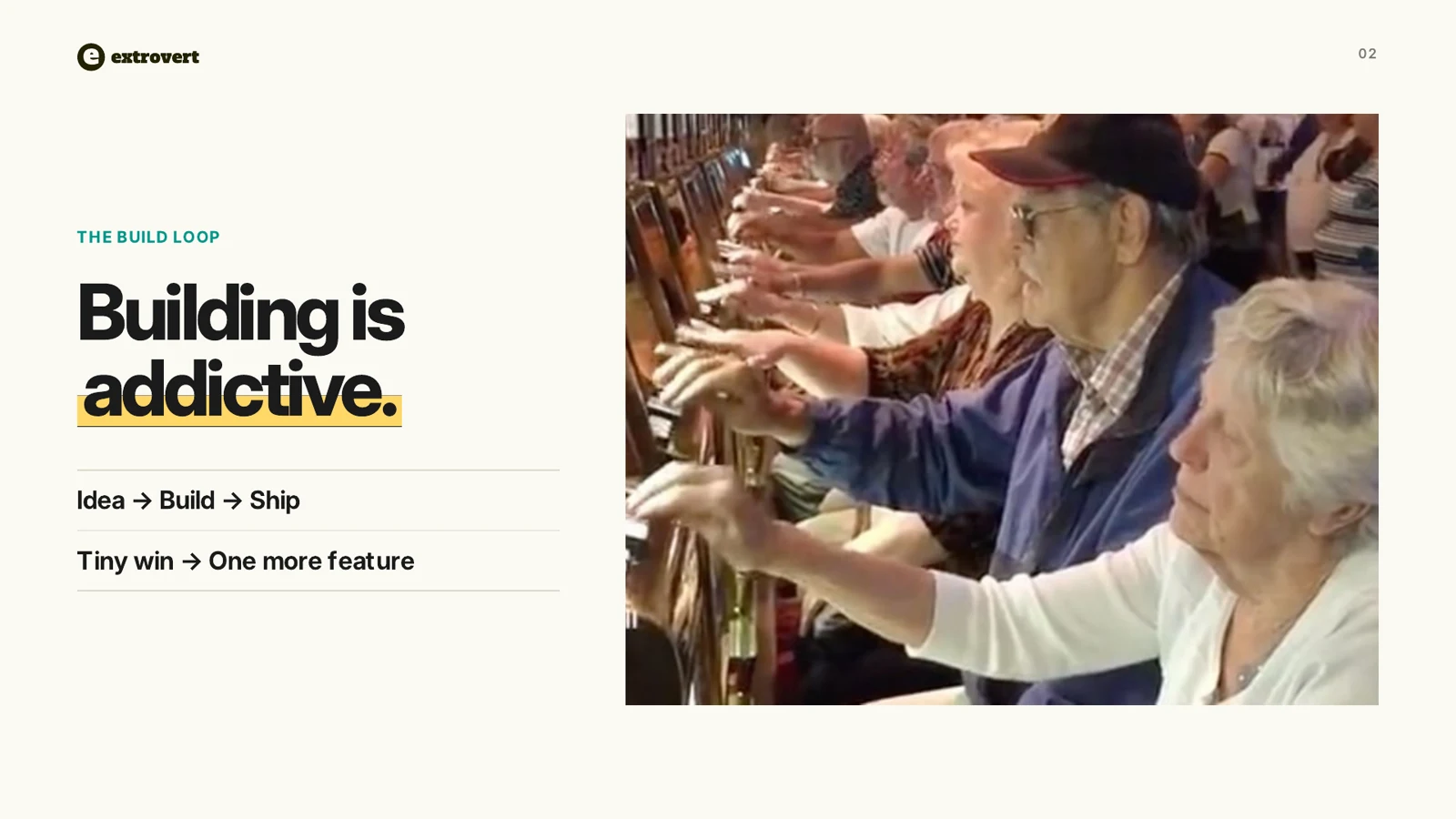
Source: Oleg Sobolev’s webinar deck.
Build a narrow product fast and well
Vincent’s launch-speed progression moved from 12 months for Meet.bot to four months for DataMerge and four weeks for Scopy. The tools improved, but his working style changed too. He stopped controlling decisions that did not affect the product’s edge and set tighter deadlines for the decisions that did.
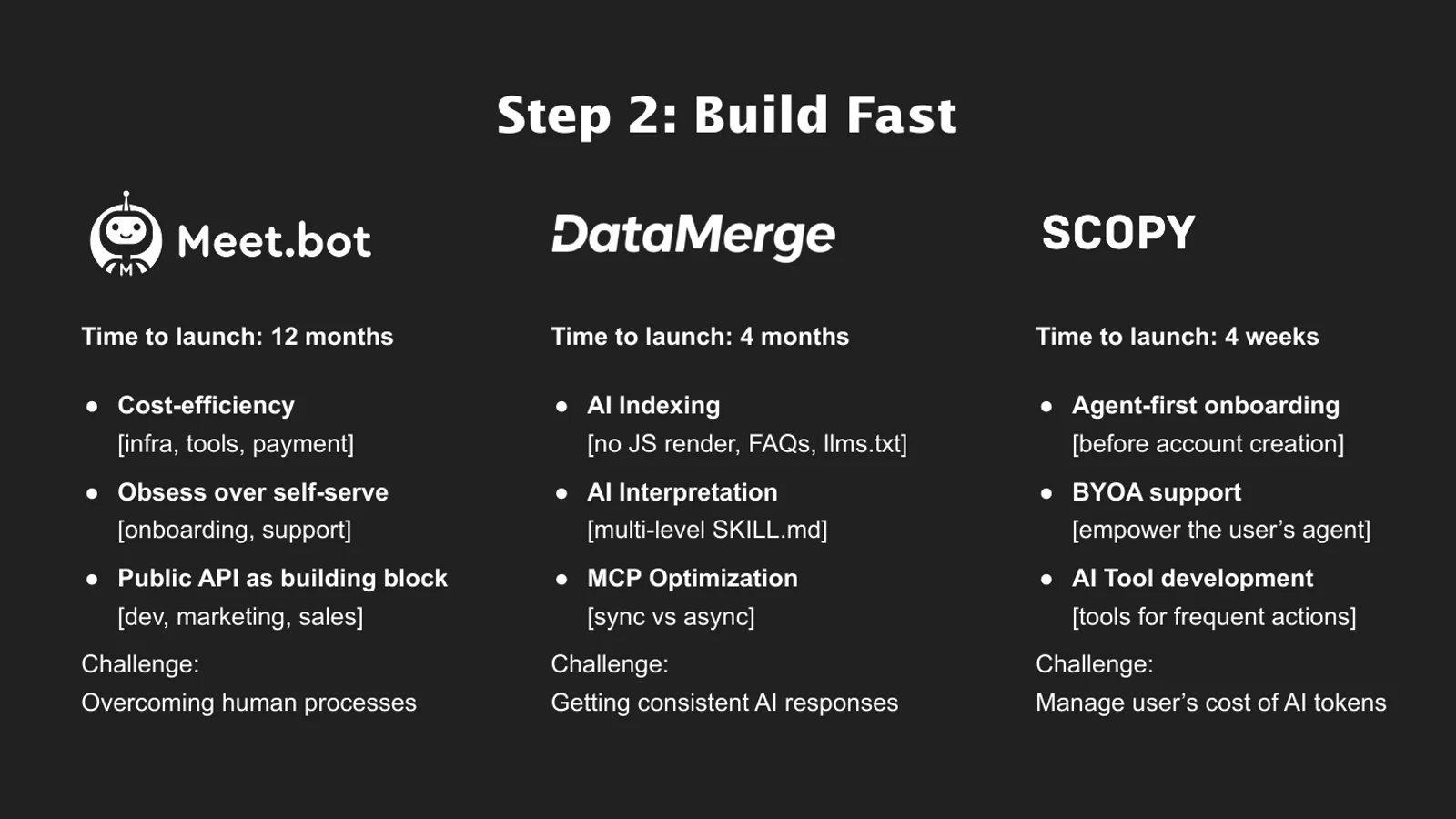
Source: Vincent Jong’s webinar deck. The timelines describe his projects, not a general delivery promise.
Vincent’s target was a good product that solved one intended use case well. Polish onboarding, integrations, and agent-readable documentation for that one use case. Then watch sessions and talk to users.
Let AI handle low-stakes defaults while you keep control of choices that affect whether customers choose, use, and pay.
Cost discipline creates a second advantage. Meet.bot can remain online and keep testing because it costs about €20 a month to operate. Vincent builds or uses open-source alternatives when a stack of small SaaS subscriptions would push a new product toward hundreds of euros before it has customers.
Low costs buy more time to find demand.
Distribution starts before launch
Vincent’s biggest GTM lesson was to ask how he would reach customers before committing to the build.
Vincent found SEO and AI-search optimization weak as zero-to-one channels, although he expects them to help once a product has authority, customers, and mentions. He still recommends agent-readable pages, FAQs, llms.txt, skill files, and synchronous APIs to help agents understand and use a product after discovery. Those assets did not create the social proof his new products needed for discovery.
DataMerge found revenue through sales. When an attendee asked where the sales calls came from, Vincent’s answer was direct: mostly people he met at events. Scopy leaned further into direct interaction with workshops around the problem it solved. Those sessions let Vincent watch people set up the workflow, see where they struggled, and help them reach the first useful outcome.
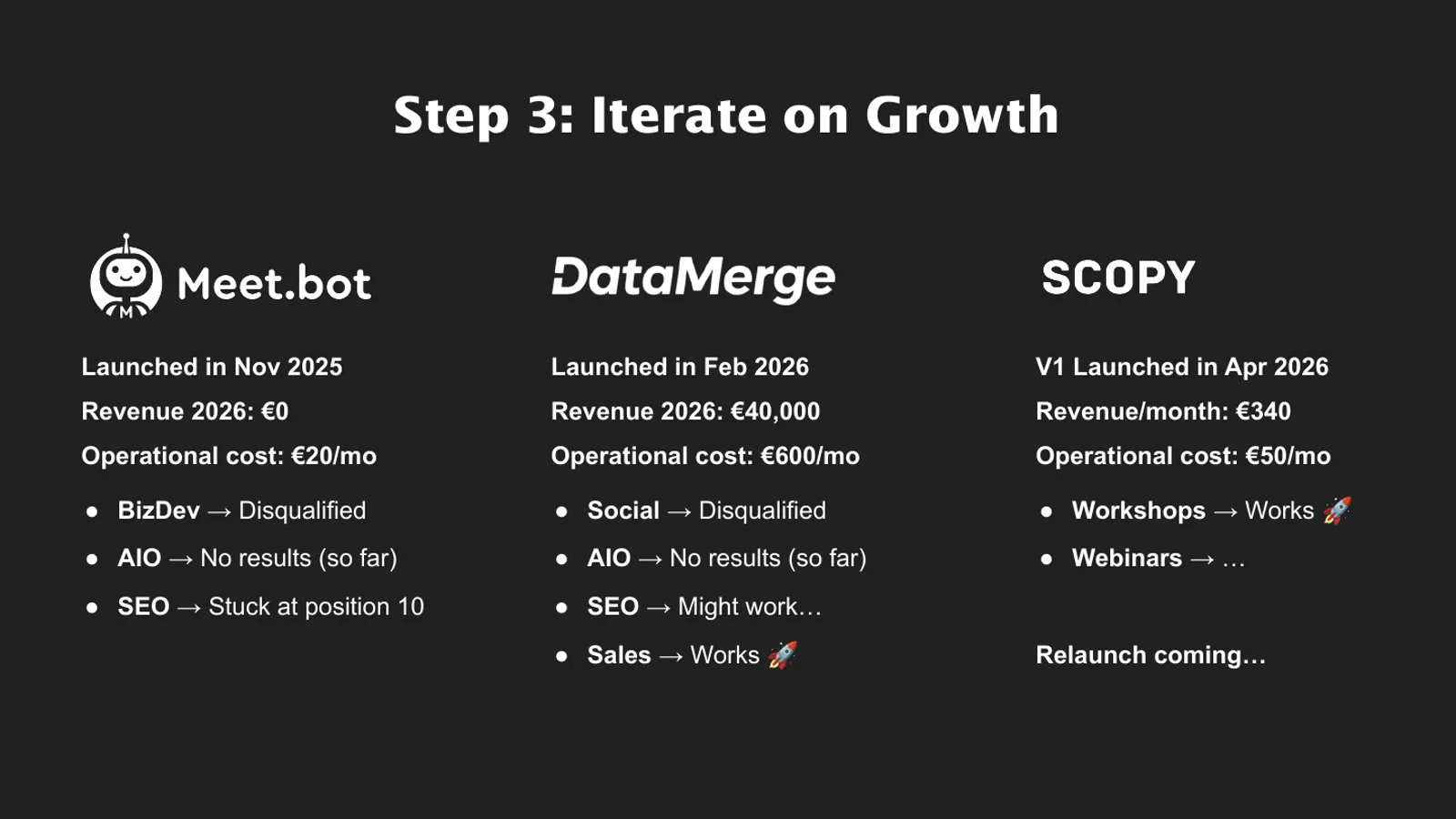
Source: Vincent Jong’s webinar deck. Revenue, cost, and channel results are self-reported point-in-time figures.
That pushed DataMerge from self-serve toward sales and hands-on onboarding because buyers needed help understanding the value. Product-led growth can come later. At zero to one, the founder needs enough contact to see why people hesitate, what they misunderstand, and whether they return.
Usage and payment complete the experiment
Validation starts when customers use the product repeatedly and pay. Vincent’s full test was to build a focused product, get a customer to use it, see whether they returned, ask them to pay, and feed the result into the next product and GTM decision.
Direct onboarding exposes the gap between the workflow the founder imagined and the one the customer can actually complete.
Watch sessions. Ask where the user got stuck. Integrate with the tools they already use. Remove friction from the first useful outcome. Add fewer features and improve the one job the product promises to do.
Oleg’s distribution layer: familiarity, timing, and patience
Oleg’s GTM framework adds a digital route for founders who cannot meet every buyer in person:
- Become a familiar face.
- Reach out with relevant context at the right time.
- Stay visible until the timing changes.
In Extrovert’s observational production data, connection requests sent after one or two thoughtful comments had a 41% acceptance rate, compared with 27% for cold requests. Among warmed requests, acceptance was 44% when the request followed within 24 hours of the latest interaction and 33% when it came roughly a month later.
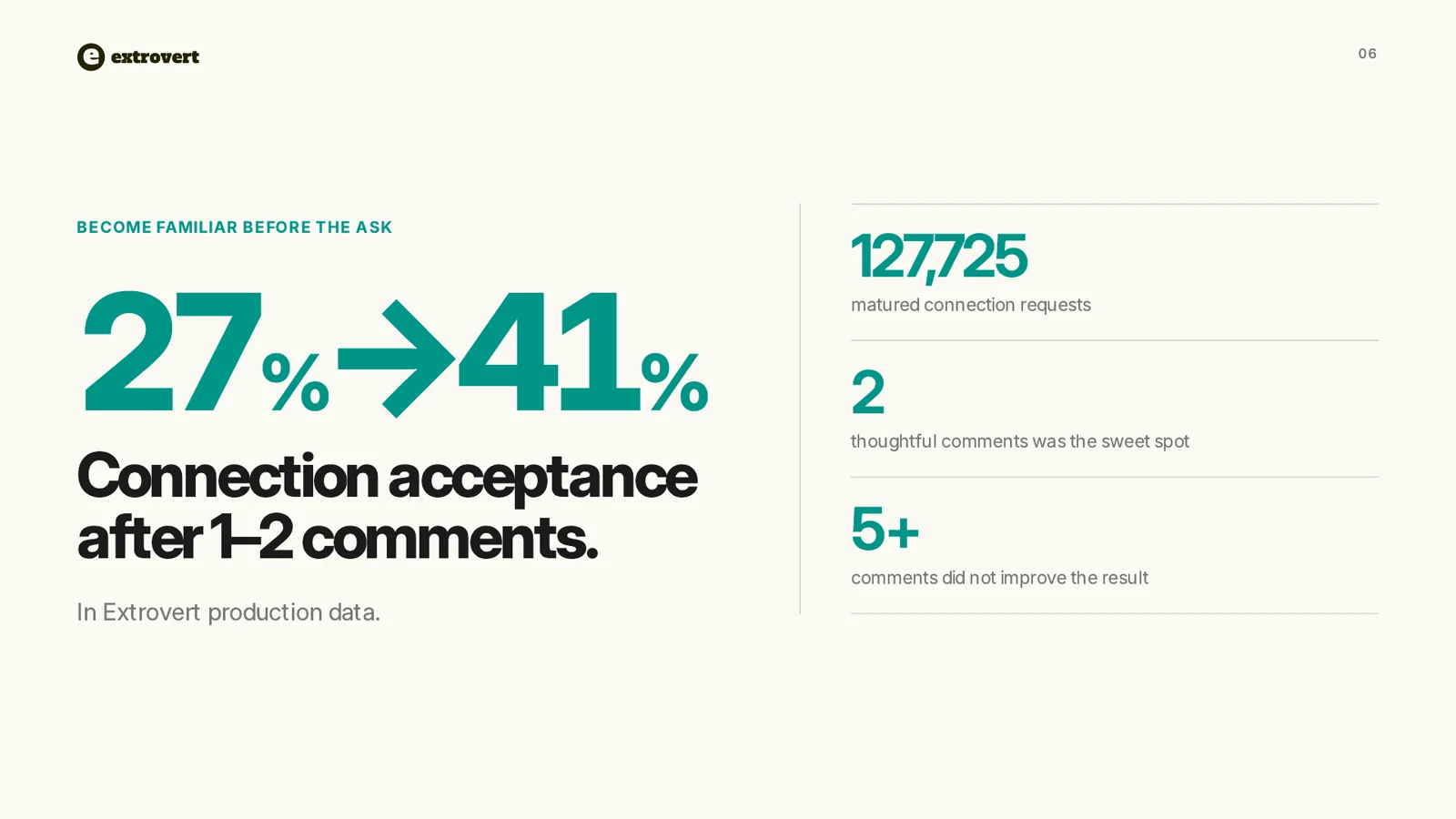
Source: Extrovert production data presented by Oleg Sobolev. The comparison is observational and does not prove that comments alone caused the lift.
Oleg’s explanation is recognition: a useful comment may help the prospect recognize the sender’s name before the connection request arrives. The sender still needs a relevant offer, a credible profile, and good timing.
The second mistake is matching a six-month buying cycle with a two-week sequence. A longer relationship does not need more “checking in” messages. It needs lower effort per prospect and better reasons to return.
Oleg uses two sources of follow-up context:
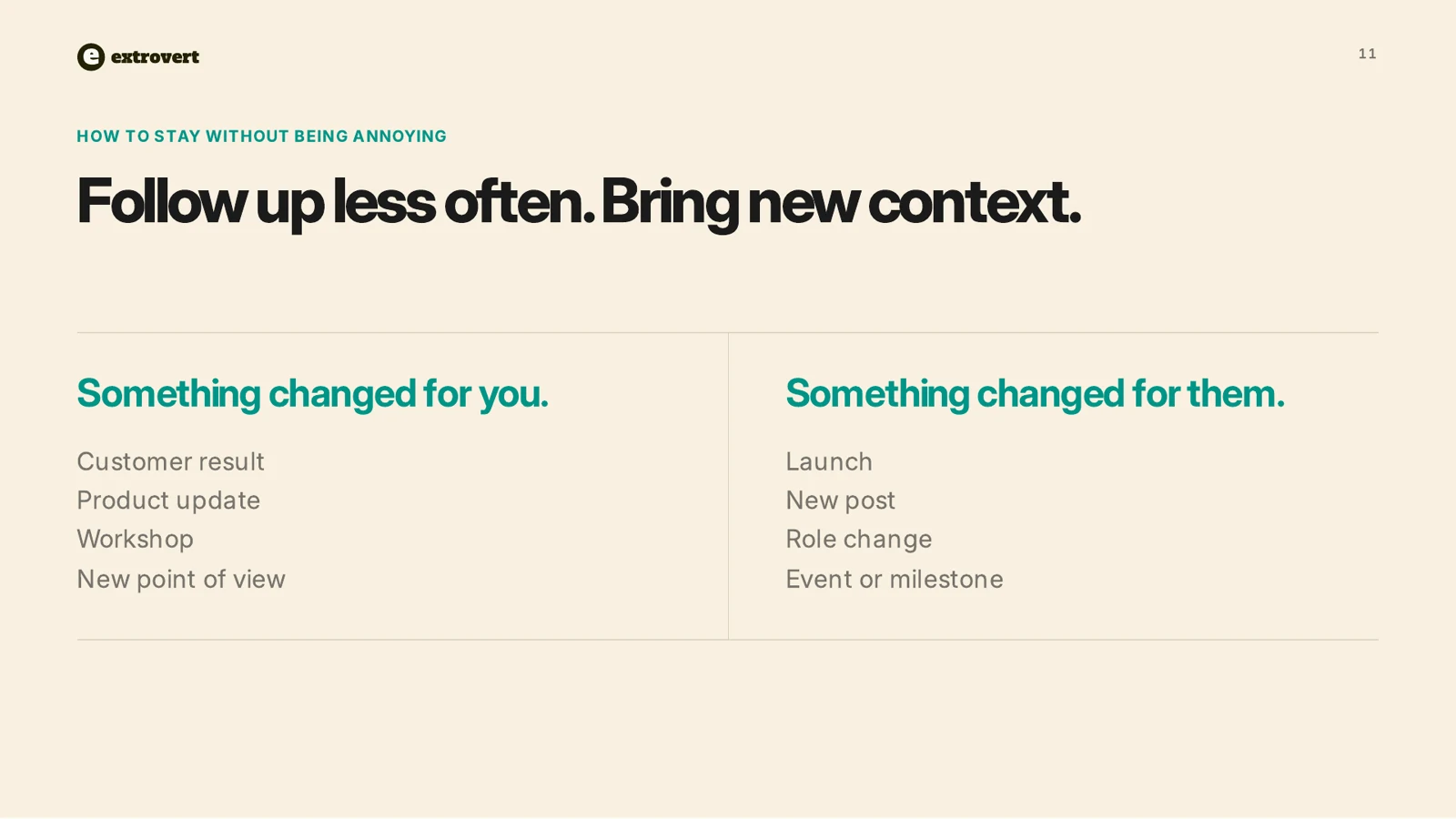
- Something changed for you: a customer result, product update, workshop, resource, or new point of view.
- Something changed for them: a launch, role change, event, milestone, new post, or public opinion.
Source: Oleg Sobolev’s webinar deck.
A role change or event attendance can provide context for restarting a human conversation without implying purchase intent. Extrovert calls these moments Conversation Restarters. In Extrovert, AI can monitor these changes and draft a follow-up; the user decides what gets sent.
Six steps to run the experiment
A solo founder does not need a grand autonomous company. A better first system has six parts:
- Write the premise. Why should this product exist, and why are you positioned to reach the customer?
- Set hard constraints. Pick the use case, launch date, price range, and maximum operating cost.
- Ship the narrow experience. Let AI handle low-stakes implementation choices; protect the product’s differentiating decisions.
- Create direct contact. Run sales calls, workshops, onboarding sessions, or small events before assuming self-serve growth will work.
- Track usage and payment. Treat returning users and paid behavior as stronger evidence than feature output or signup volume.
- Build a patient distribution layer. Stay familiar through useful LinkedIn engagement and context-led follow-up, with a person reviewing every action.
The faster a founder moves from a product decision to customer feedback, the faster the product can be corrected.
FAQ
Can AI replace a founder’s GTM strategy?
Not reliably at zero to one. AI can research, draft, compare options, and iterate once real feedback exists. The founder still needs to choose the customer, define the edge, create access to buyers, and decide which evidence changes the plan.
What is the best first channel for an AI product?
Use the channel that gives direct access to the intended customer. Vincent’s strongest early signals came from events, sales conversations, workshops, and guided onboarding. LinkedIn can extend that access when founders build familiarity and use relevant context instead of dropping a cold pitch.
Should a solo founder start with product-led growth?
Self-serve is a better fit when the buyer already understands the problem and can reach value without help. DataMerge exposed a mismatch between a self-serve product and buyers who did not immediately understand the value of the underlying data. Assisted sales and onboarding can teach the founder what a future self-serve experience needs.
Do SEO, AEO, `llms.txt`, and agent documentation matter?
Yes, but they solve different problems. Vincent recommends agent-readable pages, FAQs, llms.txt, skills, and agent-friendly APIs to help an agent understand and use a product once it finds it. They did not replace the mentions, customers, and authority his new products needed for discovery.
How can a founder nurture prospects without spamming them?
Follow up over a longer period, but less often and only when you have relevant context. Comment when you have something useful to add. Treat public events as conversation context, not proof of buying intent. Use AI for monitoring and drafts, while a person reviews every comment and DM.