Expandi reports that connection-note reply rates fell from 3.5% in May 2025 to 2.2% in April 2026. Finn's playbook tackles the same problem from the other side: become known through useful executive content, then act when the right buyers engage.
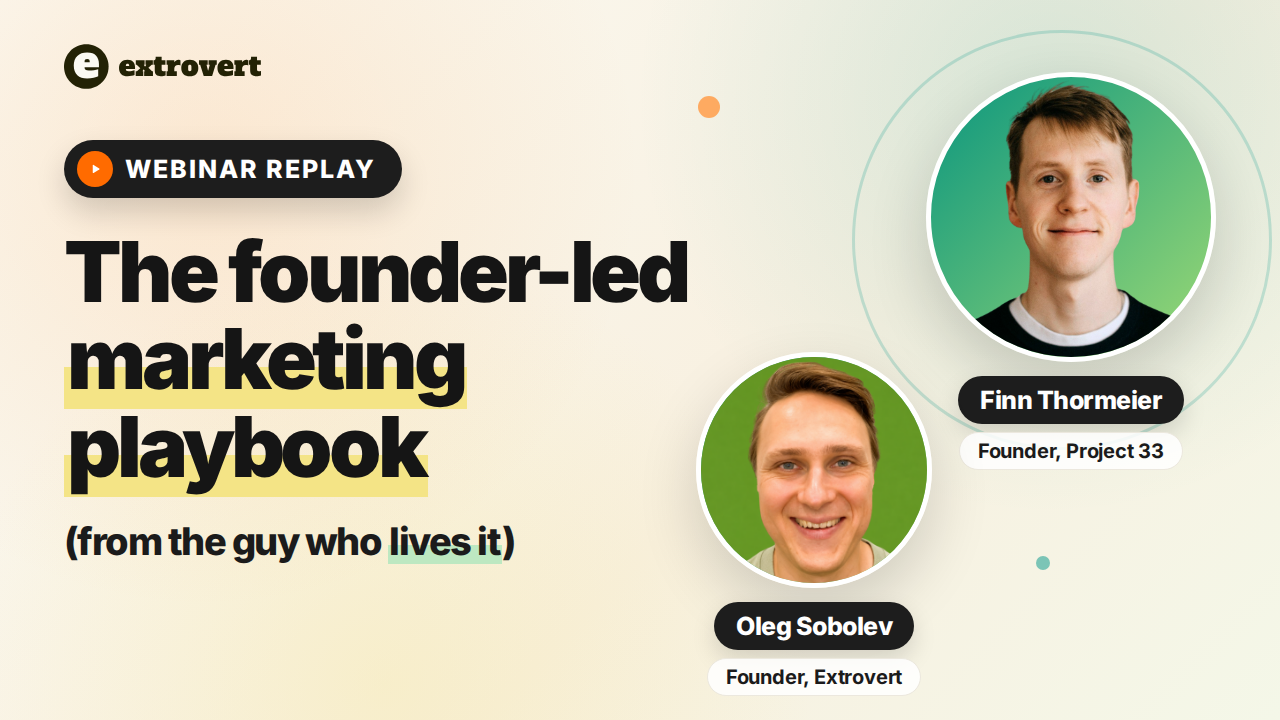
Finn has been building executive LinkedIn programs for B2B companies for five years. He says Project 33 has run programs for more than 50 B2B tech companies, and he hosts The Executive Brand Podcast (140+ interviews with operators). His playbook covers who should post, how to extract content from an executive, and how to act on engagement.
One example is company news. A CEO explaining an acquisition can be more interesting and shareable than a corporate press release.
You can watch the full session replay or read the summary below.
Who should post?
Finn looks for two things:
1. They genuinely want to do it. They need to want to share their knowledge publicly, not merely agree to try it. Finn has seen VP-of-Marketing-led programs fail when the CEO was not bought in.
2. They have insights the ICP cares about. This is why it is not automatically the founder.
At Siteimprove, the founder had left the company, so Project 33 worked with the CMO, whose audience included other CMOs. At SafetyWing, the Head of Revenue was a digital nomad and a power user of its remote-insurance product. That gave her relevant material to discuss.
For enterprise deals with larger buying committees, Finn recommends content from several relevant leaders alongside the founder or subject-matter expert.
For smaller companies: start with whoever genuinely wants to do this and has something worth saying. If that is the founder, great. If an employee volunteers, support them. Never force it.
The extraction interview
The system starts with a one-hour interview every two weeks. The ICP is the audience for this internal podcast.
The interviewer needs context on the company, its ICP, what it sells, and the executive’s areas of expertise. That context helps the interviewer pull for material buyers would find relevant.
When the interviewer does not know the ICP deeply, Finn suggests asking: "What would someone in your ICP's position disagree with here?" That shifts the executive from talking to the interviewer toward making the case for the buyer.
Numbers matter on LinkedIn. Finn extracts them on the call wherever possible. When the executive does not have a specific number ready, they get tagged in the Google doc draft: "Can you provide the stat here before we publish?"
Finding the right content angles
Content angles Finn mentioned include:
Recent company events. An acquisition, for example, can prompt an interview about why the company bought, its vision, and the expected customer benefits.
What competitors are saying. Finn asks this directly in the interview: "A competitor just said X publicly. Do you agree? Where would you push back?" If a competitor's post performed well, use it as a springboard to get the executive's real reaction.
The ICP's active problems. Focus on the buyer's current struggles rather than the executive's strengths. The content that lands is content that makes the ICP think "this is exactly what I am dealing with right now."
Tip
When you do not know the ICP deeply, ask the executive: “What would someone like your ideal customer disagree with in what you just said?”
Track engagement and route the signals
Finn pairs content with engagement tracking and outreach.
Track organic engagement with ICP precision. Project 33 uses Jungler (jungler.ai) to pull organic post engagers via API. Those engagements go into a Clay table, where each profile gets enriched and qualified. The table tracks every company and person who has engaged with the executive's content over time, including how many times and on what date.
Layer in thought leader ad signals. For clients running LinkedIn thought leadership ads, Fibbler captures company-level engagement data on the ad side. Because the campaigns target specified accounts and job titles, Project 33 treats those engagements as relevant account-level signals.
Merge into one place and act. Clay deduplicates and scores. When an ICP engages, it pushes a notification to a shared Slack channel: "this CISO just liked your CEO's post." The executive should start with a simple connection request. If the account is a named target, that signal flows into HubSpot or Salesforce and becomes one input alongside webinar attendance, website visits, and event activity.
Act on the account history. Project 33 keeps a history of engagement by person and company. Each client sets its own threshold for when an SDR or BDR should prioritize an account based on those buying signals.
Evaluate posts by ICP engagement
Finn evaluates total engagement alongside how many engagers fit the ICP.
If you sell into chief information security officers and a post gets 30 likes, seven of which are CISOs, that post is more useful than one with 60 likes and one CISO. Total engagement still matters, but relevant engagement matters more.
| Post | Total likes | ICP likes | Verdict |
|---|---|---|---|
| Post A | 30 | 7 CISOs | Strong signal |
| Post B | 60 | 1 CISO | Weak signal |
This framing changes what you do next. When a post gets 10 likes, most founders feel discouraged. Finn's advice: check who those 10 people are. If two of them are actual prospects, reach out to those two. Finn cited HockeyStack co-founder Emir Atli as an early example: he posted daily, got 5-10 likes per post, and manually reached out to every ICP who engaged. Finn said that work booked demos even when the posts looked low-performing.
For founders building this on LinkedIn from scratch, the how to prospect on LinkedIn guide covers the engagement-first mechanics in detail.
Key takeaway
Judge engagement by relevance as well as volume, then follow up with relevant prospects.
Measure beyond visible engagement
Finn adds an important limit to the engagement data: senior buyers are less likely to like or comment publicly. A CISO at a large company has less incentive to be active in comment threads, so visible engagement captures only part of the audience.
He still expects some ICP engagement. If nobody relevant ever reacts, the content probably has a relevance problem. But he pairs the dashboard with qualitative evidence: prospects mentioning a post at a conference, buyers saying they saw a video, and self-reported attribution in sales conversations.
Repost evergreen outliers
Some posts will significantly outperform your average. Project 33 calls these outliers. Finn defines the threshold relative to each account's own baseline, not against any absolute number. When a post qualifies and it is evergreen (not a funding announcement, not a dated news reference), repost it verbatim every three months. Keep reposting until it starts performing at average instead of above average. Some posts run on a quarterly cycle for nine months or a year.
| Action | Frequency | Logic |
|---|---|---|
| Interview-based content | Every 2 weeks | Fresh material from the executive |
| Evergreen outlier repost | Every 3 months while it outperforms | Stop once it returns to the account average |
Put this into practice with Extrovert
Build trust on LinkedIn in about 15 minutes a day. Extrovert tracks your prospects and topics, then suggests on-brand comments and DMs for you to review and send.
How Project 33 uses AI for drafting
Finn uses AI. Project 33 has a custom N8N agent built for the drafting step. But the architecture matters.
The content director gives the agent interview excerpts and a brief covering the angle, hook, and what to include or exclude. That gives the model real material to draft from. A prompt like "write an interesting LinkedIn post for a head of supply chain" does not.
One specific technique changes the output quality. Tell the model to write a mini essay. The "LinkedIn post" frame can produce excessive line breaks, emojis, and forced formatting. "Mini essay" avoids those preconceptions.
Human review stays in the loop at every step. The content director runs the interview, gives the agent a brief with the angle and the key excerpts from the transcript, reviews the output, sends it back if needed, and approves before the client sees it. The agent replaces the ghostwriter. The content director still makes every meaningful decision.
Finn’s starter checklist
If you are a small founder and want to start next week, Finn's checklist:
- Post 2-3 times a week. Block the time, either batch it in a four-hour session once a week or block an hour three days a week. Both work; pick one and keep it.
- Spend 30 minutes a day active on the platform: comment on your prospect list's content, answer your own comments, answer DMs. For SDRs running the same system, LinkedIn for SDRs covers the full workflow.
- If you have any ad budget, run thought leader ads against a narrow list of target accounts.
- Connect something like Jungler to a Clay table and set up a Slack notification when an ICP engages with your content.
- Act on those notifications: send a connection request or a short message when a named target shows up in your engagers.
The final step is to follow up instead of waiting for an engager to book a demo.
For founders in more competitive categories, martech, sales tech, Finn is direct: more competition means more effort. You cannot prompt an AI for five minutes and expect to build a meaningful brand in three months in a category where 20 other founders are already established on LinkedIn. In less crowded verticals, even minimal consistent output gives you the field to yourself.
FAQ
What is founder-led marketing?
Founder-led marketing uses founder or executive content to build relevant relationships and support pipeline.
Does the founder have to be the one posting?
Not necessarily. The right person to own founder-led marketing is whoever genuinely wants to create content and has insights directly relevant to the ICP. At some companies that is the CMO, the head of revenue, or a functional leader whose expertise maps to the buying committee. For early-stage companies, the founder is usually the right default, but only if they are actually willing to commit to it.
How often should an executive post on LinkedIn for founder-led marketing?
Finn recommends posting two to three times a week and blocking time for it. Pick a cadence you can keep instead of posting daily for a month and stopping.
How do you turn LinkedIn engagement into sales pipeline?
Track who engages with your content using a tool like Jungler, push that data into Clay, enrich and qualify it, and alert your team when a named target account engages. The minimum action is a connection request from the executive. For more mature programs, LinkedIn engagement becomes one signal in a CRM account score alongside website visits, webinar attendance, and event activity.
Should you use AI to write executive LinkedIn content?
AI can draft content efficiently when it has real signal to work from: an interview with the executive where they share specific insights, numbers, and opinions. AI without that signal produces generic content that sounds like everyone else. The other key prompt detail: tell the model to write a "mini essay," not a "LinkedIn post." The "LinkedIn post" prompt activates preconceptions about formatting that produce the line-break-heavy output that looks like AI.
What should teams do after publishing?
Track relevant engagers and follow up instead of waiting for an inbound demo request.
Sources
Sources: Expandi: LinkedIn Outreach Benchmarks 2026, Finn Thormeier x Extrovert webinar (2026-06-11), Executive Brand podcast and newsletter