A buying signal is any observable action that suggests a prospect may be open to a conversation: a job change, a post about a problem you solve, a visit to a competitor's pricing page, or a content consumption surge around a topic you own. Sales teams that time outreach to those moments see 2-3x higher reply rates than teams sending the same sequence to everyone on a list.
The tools that surface buying signals range from LinkedIn-specific trackers to enterprise intent data platforms pulling anonymous web traffic from thousands of publisher sites. They are not interchangeable, and the right one depends on which signals actually move your pipeline.
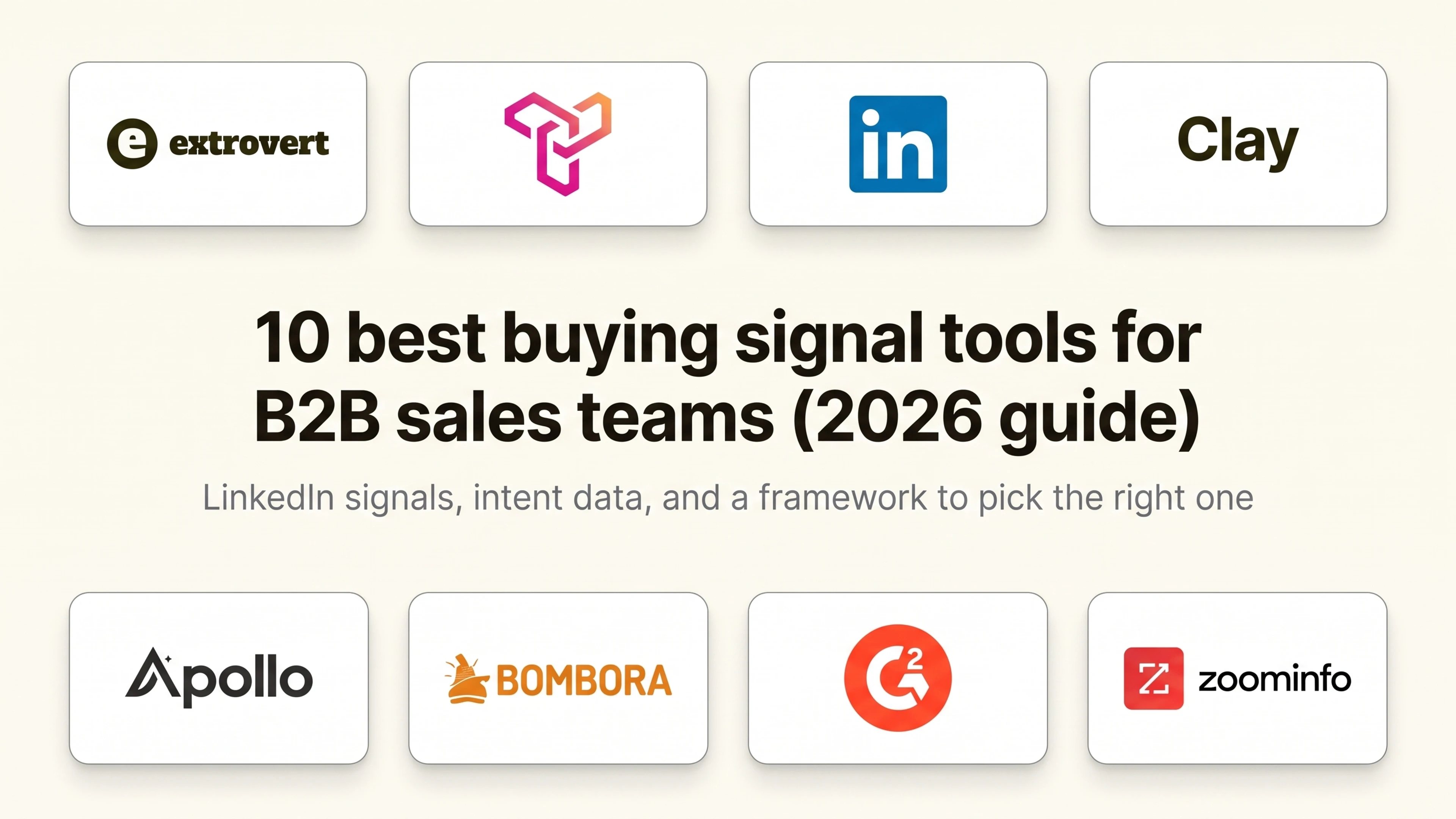
This guide covers the 11 best buying signal tools for B2B sales in 2026: what each tracks, who it fits, current pricing, and a framework to help you pick the right one.
Best buying signal tools: a brief overview
LinkedIn signals
If you want to act on a buying signal the moment it fires instead of just getting alerted to it, Extrovert is the best LinkedIn signals pick because detection and response live in the same workflow. Here's how it compares to the other LinkedIn-native tools.
- Extrovert: Best for LinkedIn buying signals paired with an integrated engagement workflow. You track prospects and topics; Extrovert surfaces their activity and suggests comments and DMs that fit your playbook so you can act on the signal without switching tools.
- Trigify: Best for teams that want granular, rule-based alert routing: trades Extrovert's built-in engagement layer for detection-only signals piped to your CRM or Slack.
- LinkedIn Sales Navigator: Best for native LinkedIn signals combined with a full prospecting database: trades Extrovert's suggested-response workflow for raw signal detection and list building, with no messaging layer of its own.
Signal aggregation
- Clay: Best for building a custom signal stack by pulling from 50+ data providers and routing outputs into any outreach tool you already use.
Broad intent data
- Apollo: Best for combining intent signals with a large B2B contact database and built-in sequencing, at a price point that works for smaller teams.
- 6sense: Best for predicting which accounts are in-market before they raise their hand, using anonymous web traffic signals across a publisher network.
- Bombora: Best for content-consumption intent data at scale, with integrations into most CRMs and marketing automation platforms.
- G2 Buyer Intent: Best for capturing high-intent signals from prospects actively researching your product or competitors on G2.
- ZoomInfo Intent: Best for pairing contact-level intent data with ZoomInfo's contact database, for teams already on the ZoomInfo platform.
- Demandbase: Best for enterprise ABM teams that need buying group tracking, intent signals, and account-based ad targeting in one platform.
- HG Insights: Best for combining buyer intent with technology-install and IT-spend context to prioritize accounts.
| Tool | Key strength | Pricing | Platforms |
|---|---|---|---|
| Extrovert | LinkedIn signal tracking with an integrated engagement workflow | Free trial; from $49/month | Web, Chrome extension |
| Trigify | Granular LinkedIn signal alerts routed to CRM or Slack | From ~$299/month | Web, API |
| LinkedIn Sales Navigator | Native LinkedIn signals, buyer intent, and prospect filtering | From $99.99/month | Web, mobile |
| Clay | Custom signal stacks from 50+ data providers | Free tier; from $149/month | Web, API |
| Apollo | Intent data plus contact database and sequencing | Free tier; from $49/user/month | Web, Chrome extension |
| 6sense | Predictive account scoring from anonymous web traffic | Custom pricing | Web, integrations |
| Bombora | Content-consumption intent co-op across 5,000+ publisher sites | Custom pricing | Integrations |
| G2 Buyer Intent | Profile and competitor page views on G2 | Bundled with G2 Business plans | Web, CRM integrations |
| ZoomInfo Intent | Contact-level intent data within the ZoomInfo platform | Add-on to ZoomInfo plans | Web, CRM integrations |
| Demandbase | Buying group tracking and intent-based ABM | Custom pricing | Web, integrations |
| HG Insights | Buyer intent with technographic and IT-spend context | Custom quote; no free trial | Web, integrations |
1. Extrovert, best for LinkedIn signals with an engagement workflow
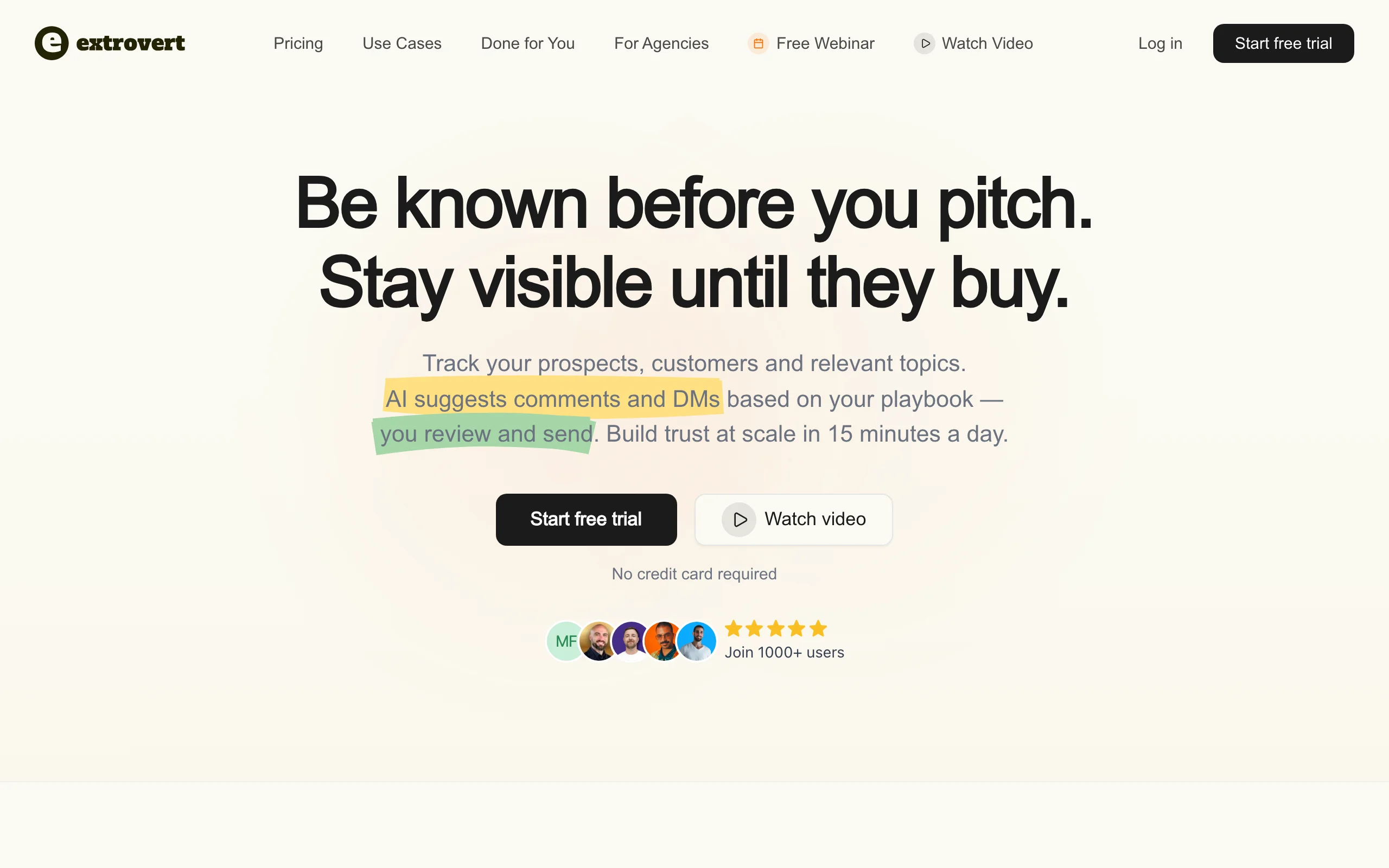
Extrovert tracks your prospect list, customers, and relevant topics on LinkedIn and surfaces their activity as buying signals: job changes, posts about problems you solve, and company news worth responding to. Where most signal tools stop at the alert, Extrovert takes the next step: its AI suggests on-brand comments and DMs based on your playbook so you can act on the signal immediately without leaving the tool.
The workflow runs in about 15 minutes a day. You review AI-suggested comments and DMs, approve or edit them, and post from the app. Nothing fires unattended. Over what Extrovert calls the 90-day loop, those consistent touches compound into warm familiarity that makes outreach land closer to a referral than a cold sequence. This approach is particularly useful for LinkedIn prospecting, where the signal and the response belong in the same platform.
Key features:
- Prospect, customer, and topic tracking on LinkedIn
- Job change and champion-movement alerts
- AI comment and DM suggestions tuned to your playbook and voice
- Human-in-the-loop approval on every action
- Signal and response workflow in a single tool
Best for:
- SDRs and AEs who want to act on LinkedIn signals immediately, in the same platform
- Founders and small teams that cannot afford enterprise intent data but need signal coverage on their active prospect list
Pricing:
- Free trial available
- Paid plans from $49/month; see Extrovert pricing
Pros:
- Signal and engagement workflow in one place; no stitching tools together
- Every action is human-reviewed before it goes out, which avoids unattended posting
- Affordable compared to enterprise intent platforms
Cons:
- LinkedIn-only; no web traffic or anonymous intent signals
- Built for steady daily activity, not batch campaigns
2. Trigify, best for LinkedIn signal alerts routed to your existing stack
Trigify trades Extrovert's built-in engagement layer for pure detection: it monitors LinkedIn for a set of signals you define, job changes, posts mentioning specific keywords, funding rounds, and others you configure. When a signal fires, Trigify routes the alert to your CRM, Slack, or outreach tool via webhook. You define the signal logic; Trigify handles the detection.
The appeal for RevOps teams is the granularity. Instead of a generic "prospect posted something" notification, you can define rules like "prospect posted about pipeline challenges in the last 7 days" and route those to your highest-converting sequence. Trigify does not include an engagement workflow; it is a detection layer that slots into your existing stack.
Key features:
- Customizable LinkedIn signal definitions (keywords, events, company attributes)
- Webhook and CRM routing for automated alert handling
- Account-level and person-level signal coverage
- Integrations with Salesforce, HubSpot, and common outreach tools
Best for:
- RevOps and SDR managers who want to route LinkedIn signals into existing sequences
- Teams that already have a strong outreach tool and need the detection layer to sit on top
Pricing:
- Plans from approximately $299/month; check Trigify for current pricing
Pros:
- Granular, rule-based signal definitions
- Clean routing into existing tech stacks
- Covers both account and contact level signals
Cons:
- LinkedIn-only; no web intent or anonymous signals
- No built-in action layer; requires a separate outreach tool to close the loop
- Higher price point than tools with a built-in engagement workflow
3. LinkedIn Sales Navigator, best for native LinkedIn signals and list building
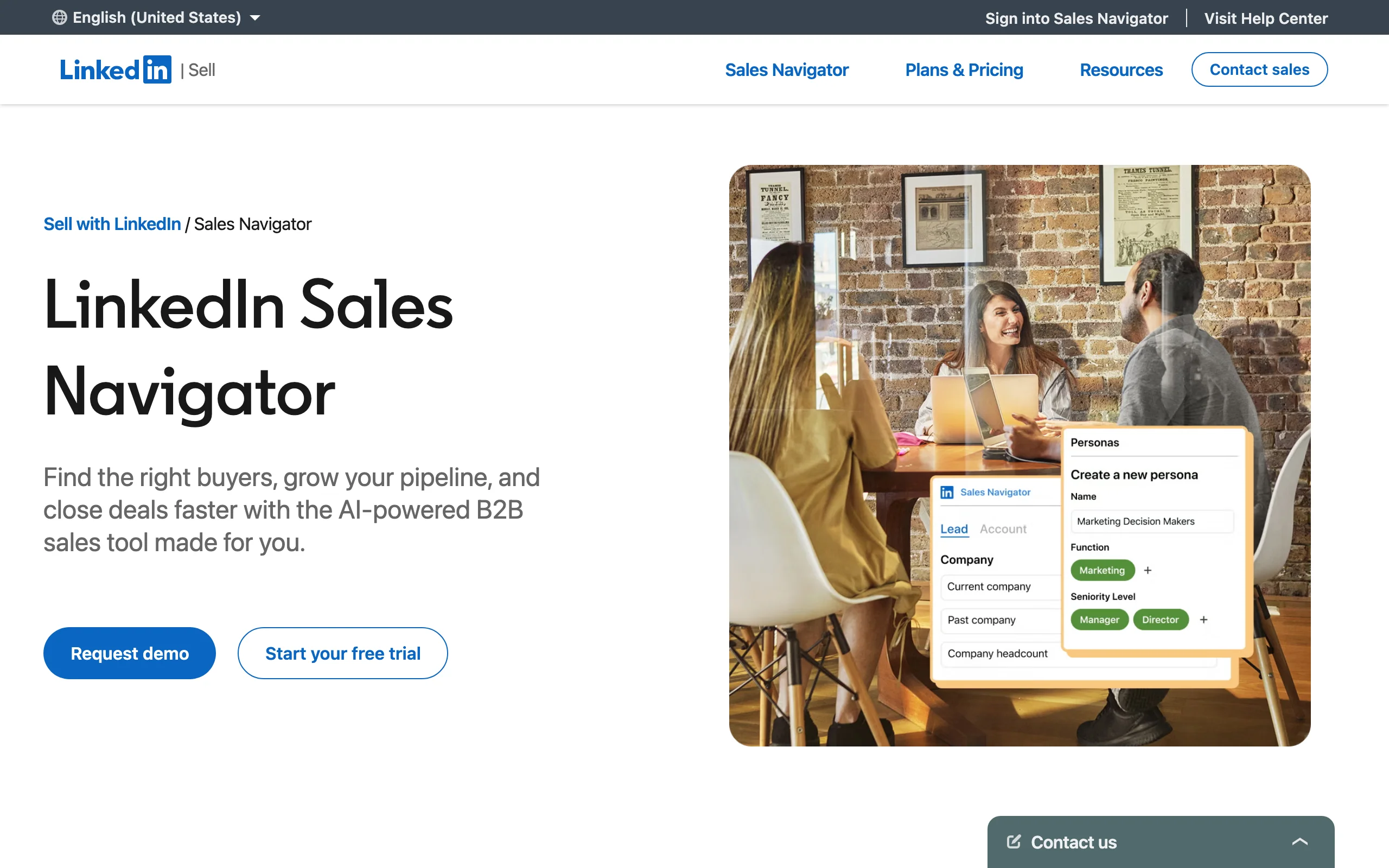
LinkedIn Sales Navigator trades Extrovert's suggested-response workflow for LinkedIn's own prospecting and signal data. It gives you real-time alerts when a saved lead changes jobs or shares company news. Advanced plans include "Buyer Intent" data showing which accounts have employees actively engaging with your LinkedIn company page or similar content. As the only tool on this list with direct access to LinkedIn's full data graph, it is the reference point for LinkedIn signal quality.
For teams doing LinkedIn for SDRs, Sales Navigator covers the targeting and signal detection layer well. What it does not do is suggest what to say in response or track whether your outreach is building familiarity over time. It pairs naturally with Extrovert for teams that want native signal detection plus an engagement workflow in the same day.
Key features:
- Real-time job change and activity alerts for saved leads
- Buyer Intent signals on Advanced plans
- Advanced filtering to build and save prospect lists
- TeamLink connections for warm intro paths
- CRM sync with Salesforce and HubSpot
Best for:
- Any team doing LinkedIn prospecting at scale
- AEs and SDRs who need both signal detection and list-building in one platform
Pricing:
- Core: from $99.99/user/month (billed annually)
- Advanced: from $149.99/user/month (billed annually)
- Advanced Plus: custom pricing
Pros:
- Native LinkedIn data with no third-party compliance concerns
- Rich filtering and signal coverage in one tool
- Buyer Intent available at the account level on Advanced plans
Cons:
- Expensive for small teams, especially at Advanced tier
- Signals stay inside Sales Navigator; routing them elsewhere requires manual steps
- No engagement workflow or AI-suggested responses
4. Clay, best for building a custom signal stack
Clay is a data enrichment and workflow platform that lets you pull signals from 50+ providers and act on them automatically. You build tables that pull a contact list, run enrichment waterfalls (check source A, then B, then C), layer on signals like job changes from Crunchbase or intent from Bombora, and push enriched rows into your CRM or outreach tool. The flexibility is unmatched: if a signal exists somewhere in the data ecosystem, Clay can probably access it.
The trade-off is complexity. Clay is built for technically-inclined RevOps engineers or growth operators willing to invest time in setup. It is less a buying signal tool and more a signal-routing infrastructure layer. Teams that build it well report dramatically better signal-to-noise ratios than using any single-source tool.
Key features:
- 50+ data provider integrations (Clearbit, Crunchbase, Bombora, LinkedIn, and more)
- Waterfall enrichment logic for maximum data coverage
- Custom signal definitions and conditional routing
- CRM and outreach tool integrations
- AI-powered enrichment for contact research at scale
Best for:
- RevOps engineers and growth operators comfortable with no-code and low-code automation
- Teams that want to combine signals from multiple sources without paying for multiple platforms
Pricing:
- Free tier available
- Explorer: from $149/month; scales with credit usage
- Additional per-lookup costs apply depending on the data providers used
Pros:
- Most flexible signal aggregation available
- Combines data from sources that no single-vendor tool can match
- Wires into any downstream outreach or CRM tool
Cons:
- Steep learning curve; not plug-and-play
- Credit-based billing adds up with high-volume enrichment
- Does not generate outreach itself; still needs a connected tool to close the loop
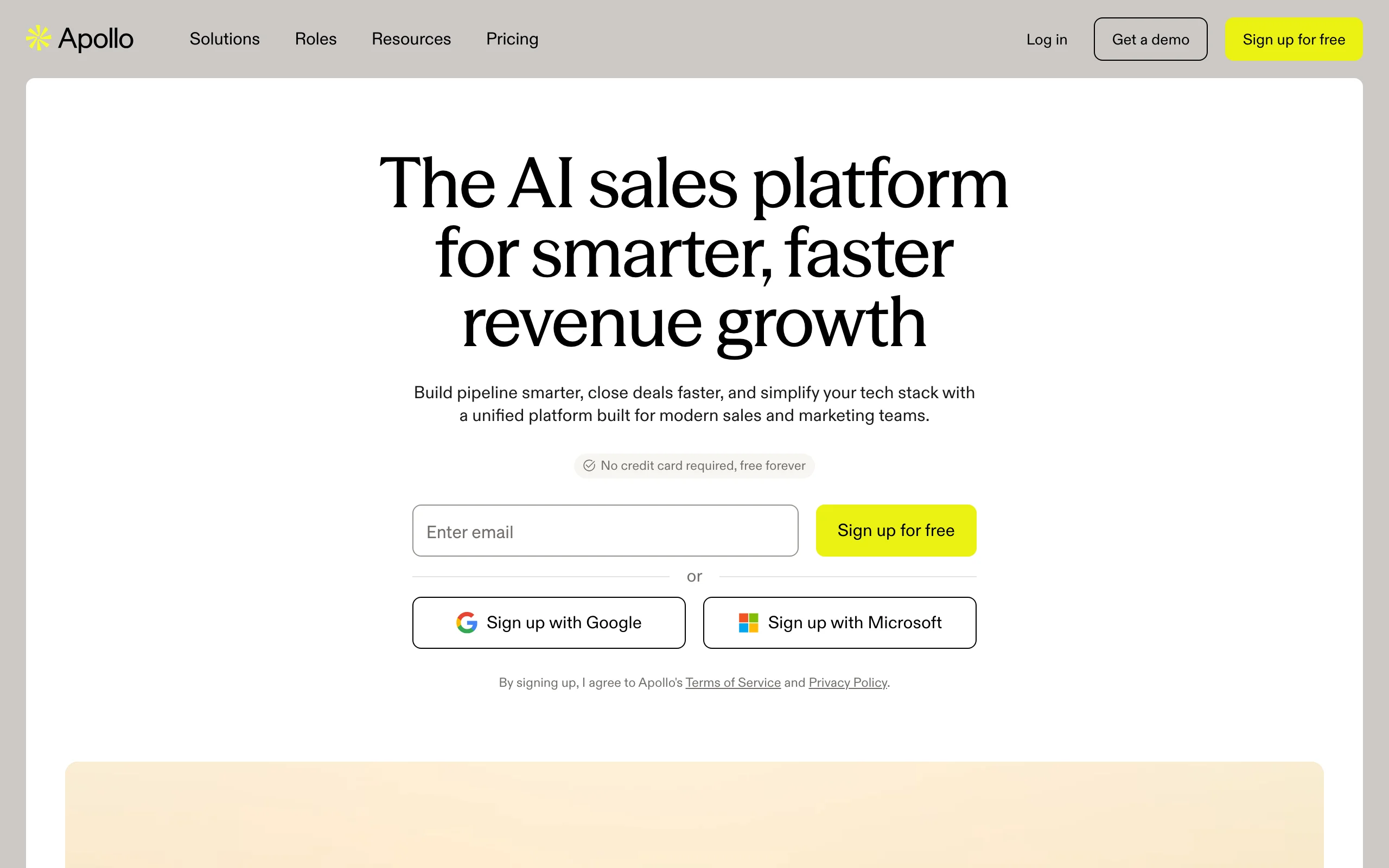
5. Apollo, best for intent signals with a contact database and sequencing
Apollo combines a B2B contact database, a buying intent feature, and email plus LinkedIn sequencing in one platform. Its "Intent" feature surfaces accounts actively researching topics relevant to your product, based on web activity signals similar to Bombora's but at a significantly lower price point. You can layer intent scores onto contact searches to prioritize outreach to accounts showing active interest.
For smaller sales teams, Apollo's appeal is the all-in-one nature: find the contact, see the intent signal, and send the sequence without switching tools. The intent data is thinner than dedicated platforms like 6sense or Bombora, but at a fraction of the cost it covers the basics well enough for most SMB pipelines.
Key features:
- Buying intent signals for accounts researching relevant topics
- Contact and account database with 275M+ contacts
- Email and LinkedIn sequencing built in
- CRM integrations with Salesforce and HubSpot
- Free tier with limited features
Best for:
- SDRs and founders who want signals and outreach in one affordable platform
- Teams moving from cold lists to signal-based prioritization for the first time
Pricing:
- Free tier available
- Basic: from $49/user/month (billed annually)
- Professional: from $99/user/month (billed annually)
Pros:
- Affordable access to intent signals for teams that can not justify enterprise pricing
- Database, intent, and sequencing in one tool
- Solid free tier for getting started
Cons:
- Intent data is thinner than what dedicated platforms provide
- Email deliverability requires careful warm-up and list hygiene
- The low barrier to sequencing can push teams toward cold volume rather than signal-led timing
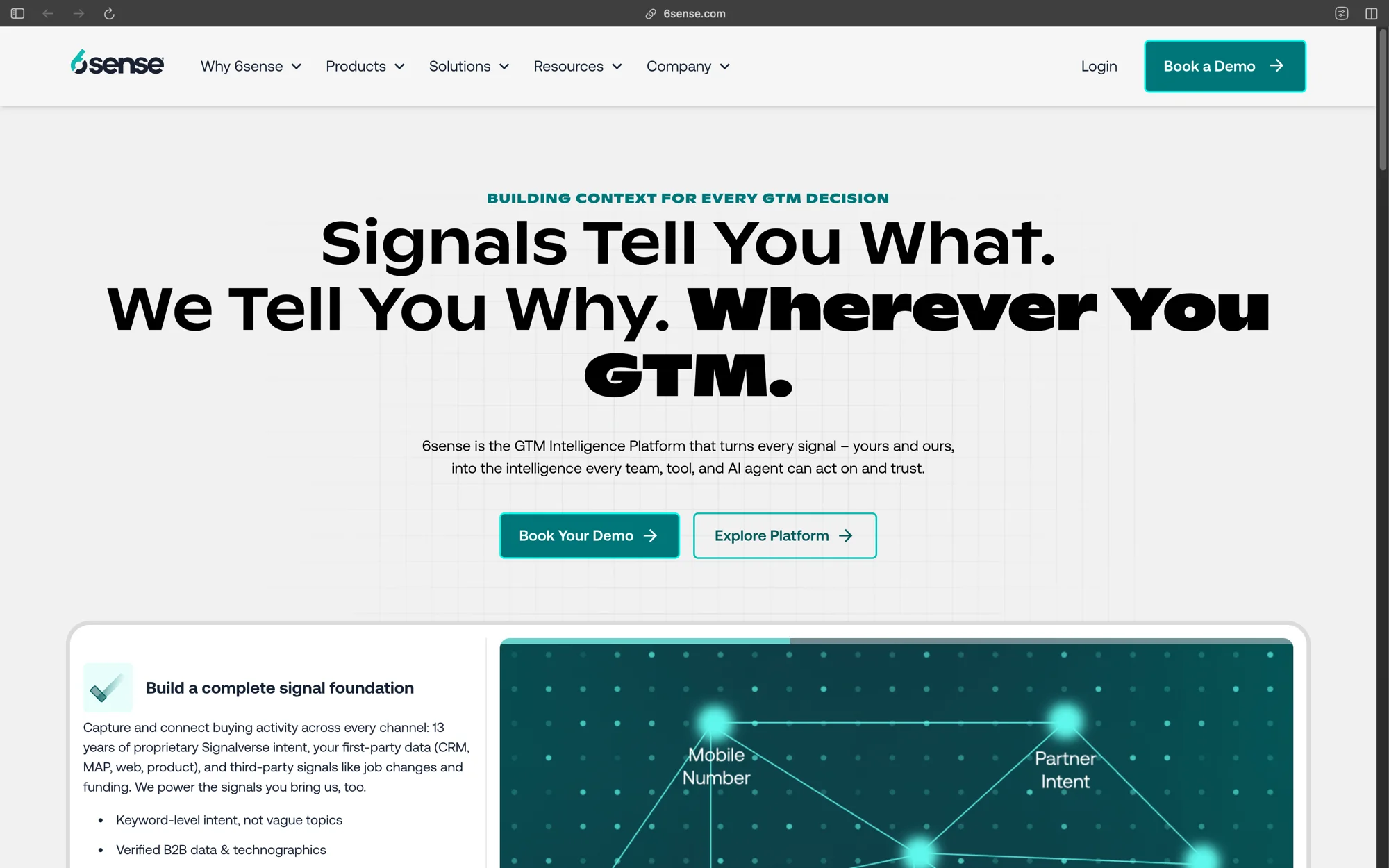
6. 6sense, best for predicting in-market accounts from web traffic
6sense uses AI to analyze anonymous web traffic signals across a publisher network and predict which accounts are in an active buying cycle. It assigns accounts to buying stages (Awareness, Consideration, Decision) and surfaces prioritized account lists for sales to act on. Because the signals come from anonymous traffic, 6sense can identify companies showing intent before they ever fill out a form or respond to outreach.
The platform integrates with Salesforce, HubSpot, Marketo, and most enterprise GTM stacks. For mid-market and enterprise teams running coordinated sales and marketing motions, 6sense is one of the most thorough intent data platforms available. The pricing puts it out of reach for most SMBs.
Key features:
- Predictive account scoring based on web traffic intent signals
- Buying stage assignment (Awareness through Decision)
- Anonymous company identification from web visitors
- Integrations with Salesforce, HubSpot, Marketo, and Salesloft
- Account-based advertising targeting using intent data
Best for:
- Mid-market and enterprise teams running ABM programs
- Revenue teams that need coordinated sales and marketing signal routing
Pricing:
- Free tier with limited features
- Team and Growth plans available; enterprise pricing starts above $50,000/year (custom quotes)
Pros:
- Wide intent signal coverage from anonymous web traffic
- Predictive scoring reduces manual prioritization time
- Tight integrations into enterprise GTM stacks
Cons:
- Enterprise pricing excludes most SMBs
- Signals are probabilistic; accuracy varies by industry and topic
- Complex setup and ongoing data hygiene requirements
7. Bombora, best for content-consumption intent data at scale
Bombora runs the largest B2B intent data co-op: it tracks content consumption across 5,000+ B2B publisher sites and produces surge scores when a company's employees are reading heavily about a topic relevant to your product. A company with a rising surge score for "sales engagement software" is likely in active evaluation of that category. Bombora integrates with most CRM and marketing automation platforms.
Unlike 6sense, Bombora is primarily a data provider rather than an all-in-one platform. Most teams consume Bombora signals through their CRM or via Salesforce, HubSpot, or Clay. The data is topic-level and company-level, not person-level, so there is still work involved in identifying the right contact once a surge fires.
Key features:
- Surge scores across 6,000+ B2B intent topics
- Data sourced from 5,000+ publisher sites in the co-op
- Company-level intent (not person-level)
- Integrations with major CRM, MAP, and sales engagement platforms
- Weekly or daily data refreshes depending on plan
Best for:
- Demand gen and RevOps teams at mid-market companies building intent-driven campaigns
- Teams that consume intent data through their existing CRM or marketing automation platform
Pricing:
- Custom pricing; no self-serve tier
- Typically $20,000 to $100,000+/year depending on usage and integrations
Pros:
- Largest B2B intent co-op with the widest publisher coverage
- Integrates with virtually every major GTM platform
- Reliable topic-level surge scores with consistent methodology
Cons:
- No self-serve or SMB option
- Company-level only: you still need to find the right contact
- Data latency can run from days to weeks
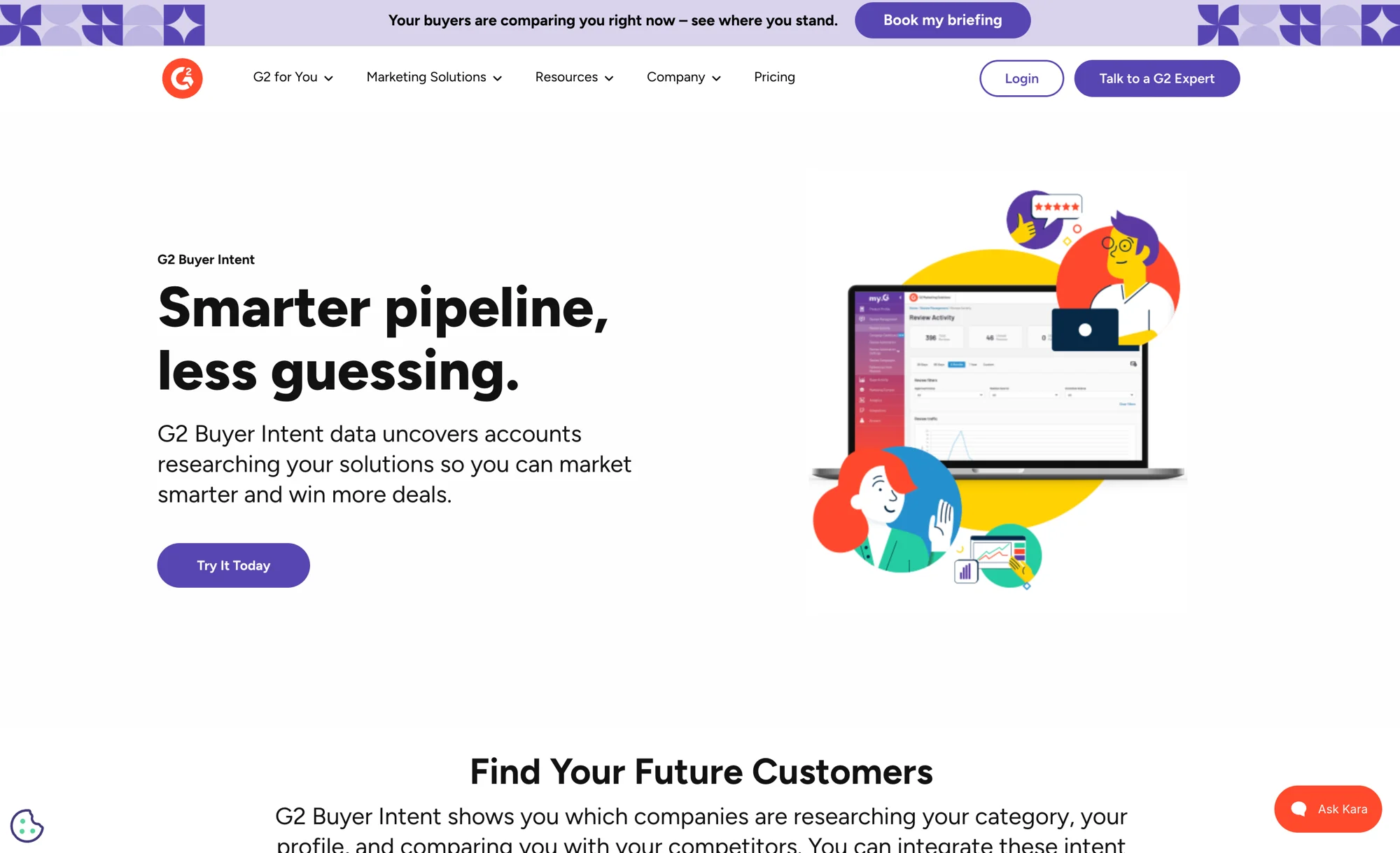
8. G2 Buyer Intent, best for signals from software review research
G2 Buyer Intent tells you when a company's employees have viewed your G2 profile, a competitor's profile, or a software category page. Since G2 is where B2B buyers go to research and validate tool choices, a company spending time on your listing or a competitor's is a very high-intent signal. G2 routes those signals into your CRM and can trigger sequences when a target account shows activity.
For SaaS companies with a strong G2 presence, this is one of the highest-quality intent signals available because the research intent is explicit. The limitation is scope: you only see G2 activity, and the value depends heavily on how well maintained your G2 profile and review count are.
Key features:
- Profile view signals when a company visits your G2 listing
- Competitor page view signals for displacement targeting
- Category page signals for top-of-funnel intent
- CRM and marketing automation integrations
- Available on G2 Business plans and above
Best for:
- SaaS companies actively investing in their G2 presence and review count
- SDRs doing competitive displacement based on who is researching alternatives
Pricing:
- Bundled with G2 Business plans; pricing on request from G2 sales
- Requires an active G2 subscription
Pros:
- Very high-intent signals: the prospect is actively comparing tools, not browsing content
- Competitive intelligence from who views rival listings
- Integrates directly into CRM and sequence triggers
Cons:
- Only surfaces G2-specific activity; no web-wide intent coverage
- Requires a G2 subscription before you can access intent data
- Signal value depends on how active your G2 profile is
9. ZoomInfo Intent, best for contact-level intent within the ZoomInfo platform
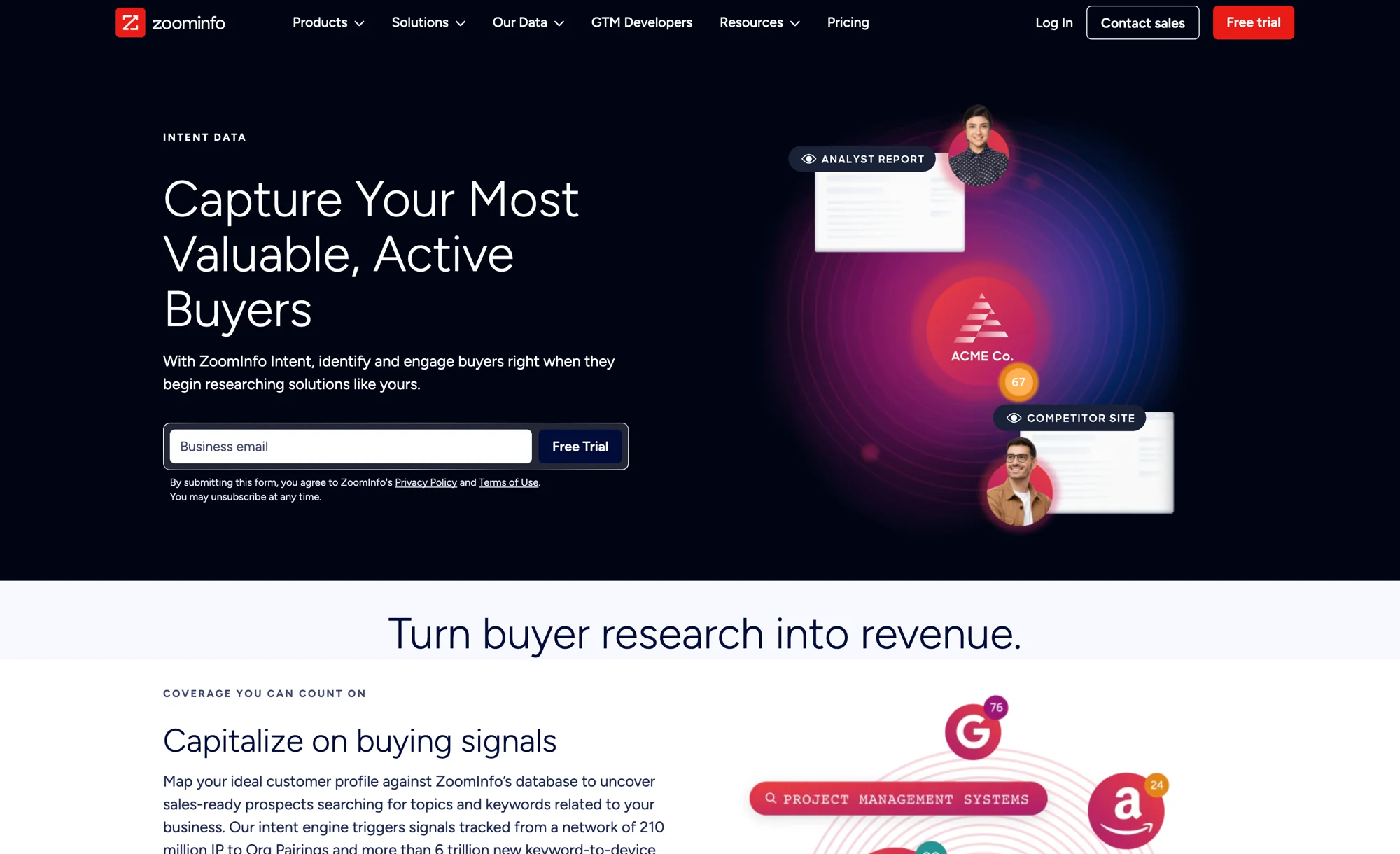
ZoomInfo Intent adds an intent data layer on top of ZoomInfo's contact and company database. Where most intent platforms show you the company, ZoomInfo attempts to surface the specific contacts doing the research, based on web activity signals. For teams already paying for ZoomInfo, it is the most natural way to add buying signals to their existing workflow without onboarding another vendor.
The combined platform lets you find the right contact, see the intent signal, and launch outreach through ZoomInfo Engage from the same interface. The total cost is significant: you need a ZoomInfo base subscription before Intent becomes an option.
Key features:
- Contact-level intent signals, down to the individual doing the research
- Web activity tracking across ZoomInfo's publisher network
- Integrated with ZoomInfo's contact database and ZoomInfo Engage for sequencing
- Salesforce and HubSpot sync
Best for:
- Enterprise sales teams already using ZoomInfo as their primary data provider
- RevOps teams that want contact-level intent without adding a new vendor to the stack
Pricing:
- Add-on to a ZoomInfo base subscription
- ZoomInfo base plans start around $15,000/year; Intent is priced separately
- Custom pricing based on team size and usage
Pros:
- Intent pinned to a named contact, making prioritization faster
- Integrated with a large, well-maintained contact database
- No new vendor onboarding for teams already on ZoomInfo
Cons:
- Expensive before you add Intent: requires a ZoomInfo subscription as the base
- Intent accuracy varies by topic and industry
- Less flexible than standalone intent platforms for custom signal logic
10. Demandbase, best for enterprise ABM with buying group tracking
Demandbase is a full ABM platform built around account intent. It tracks intent signals from its own publisher network and maps the buying group at each account: the full committee of stakeholders involved in the decision. The platform runs targeted ads to in-market accounts and surfaces all of that in a unified view alongside your CRM data. No other tool on this list connects intent to the full buying committee this directly.
For enterprise B2B companies selling to multiple stakeholders per deal, buying group tracking adds something intent platforms aimed at single contacts cannot provide. The platform requires significant setup, data hygiene, and coordination between sales and marketing to return full value.
Key features:
- Account-level intent signals from a proprietary publisher network
- Buying group identification across multiple stakeholders in a deal
- Account-based advertising using intent signals for targeting
- Pipeline prediction and account prioritization scoring
- Integrations with Salesforce, Marketo, Salesloft, and Outreach
Best for:
- Enterprise B2B companies running coordinated ABM programs
- Revenue teams selling to buying committees where multiple stakeholders must be influenced
Pricing:
- Enterprise pricing only; typically $40,000 to $200,000+/year depending on modules
- Custom quotes based on account volume and product configuration
Pros:
- Only major platform with explicit buying group tracking
- Connects intent to advertising, sales prioritization, and pipeline prediction in one place
- Deep integration with enterprise GTM stacks
Cons:
- Prohibitively expensive outside enterprise budgets
- Heavy implementation and ongoing management requirement
- Overkill for companies selling to a single buyer or a small buying committee
11. HG Insights, best for enterprise buyer intent backed by technographic and IT spend data
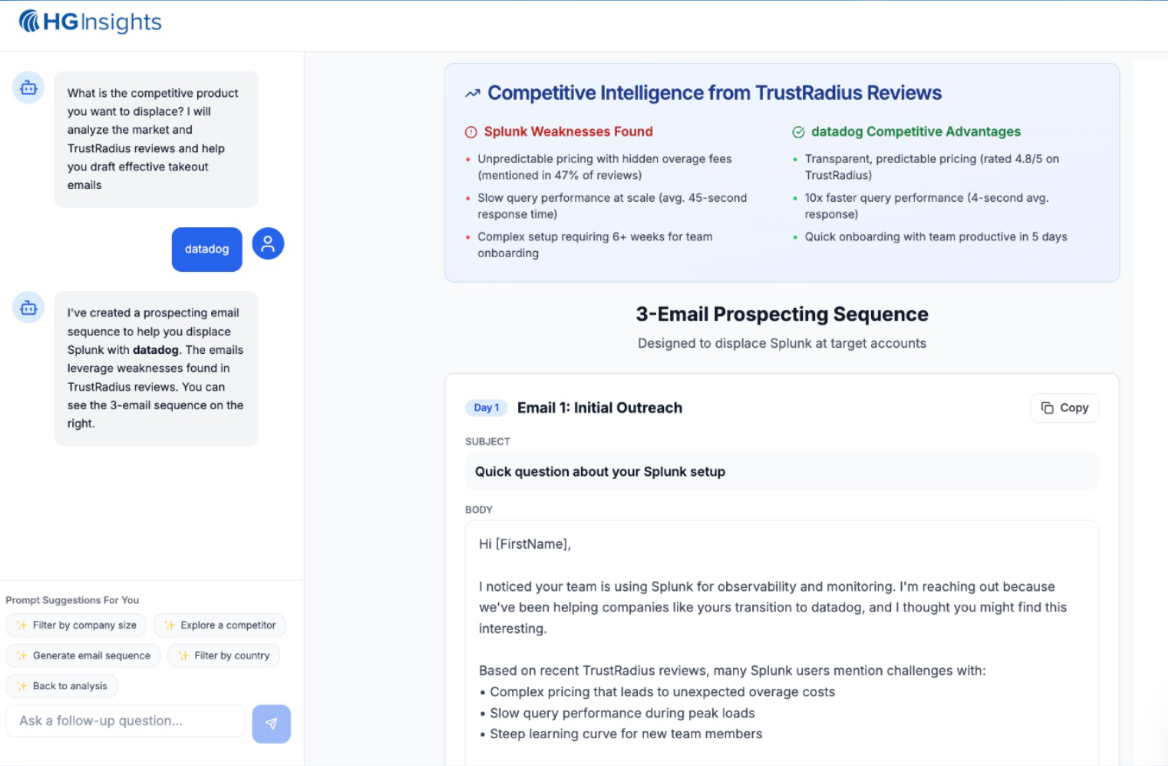
HG Insights pairs buyer intent with technographic and IT-spend data. Its signals can show what technology an account already runs alongside its product, competitor, or category research, helping teams distinguish an expansion opportunity from competitive displacement or a net-new account. HG says its data foundation covers more than 20 million companies and 20 billion external data points.
HG added TrustRadius in 2025, bringing review and comparison-based buying signals alongside its technology and spend data. It also acquired MadKudu for predictive account scoring. For teams running ABM or competitive-displacement programs, that mix gives a buying signal more context than a topic match alone: you can see what an account may already be using before deciding how to approach it.
Key features:
- Install-enriched buyer intent tied to an account's technology stack
- Historical technographic data and location-level deployment signals
- Account-level IT-spend models, including AI and cloud spend
- TrustRadius product and competitor research signals, plus predictive account scoring
- Integrations with CRM, data, and ABM platforms
Best for:
- Enterprise and mid-market teams running ABM or competitive-displacement campaigns
- RevOps and data teams combining technology, spend, and intent signals for account prioritization
Pricing:
- No published self-serve price or free trial
- Contact HG Insights for a quote based on data scope and platform modules
Pros:
- Connects intent to an account's existing technology and estimated spend
- Review-based signals and account scoring add context for prioritization
Cons:
- No published pricing or free trial for a quick evaluation
- Broad data and platform scope may be more than a small team needs for basic alerts
How to choose the best buying signal tool for your needs
LinkedIn signals vs web intent signals
The first question to answer is where your buyers leave visible signals. LinkedIn buying signals (job changes, posts about pain, champion movements) are identified and tied to a named person from the start. Web intent signals tell you a company is researching a topic based on anonymous traffic, but you still need to find the right contact separately.
If your buyers are active on LinkedIn and you're doing account-based prospecting, start with LinkedIn-native tools. Extrovert, Trigify, and Sales Navigator give you identified signals tied to people already on your list. If you need to surface accounts in-market before they engage with you, web intent platforms like 6sense or Bombora add coverage that LinkedIn tools cannot provide. Many teams run both layers.
Signal only vs signal plus action
Some tools detect signals and stop there. Trigify sends an alert; you still need a separate tool to act. G2 Buyer Intent flags the account; you still need to find the right person and write the message. Other tools close that loop: Extrovert surfaces the signal and suggests the comment or DM in the same workflow; Apollo detects intent and lets you launch a sequence in the same platform.
For small teams with limited tool budgets, a signal-plus-action tool reduces integration work and context switching. For larger teams with an existing outreach stack, a dedicated detection layer like Trigify or Bombora may slot in more cleanly.
Budget: SMB vs enterprise
The pricing gap between tiers is significant. Extrovert starts at $49/month. Apollo's paid plans start at $49/user/month. Both cover the most common signal types for teams with deal sizes that support that spend. Move to ZoomInfo Intent, Bombora, or 6sense and you're looking at $15,000 to $100,000+ annually before you send a message.
For teams under 10 people doing LinkedIn for B2B prospecting, the SMB-tier tools cover the signals that matter most. Enterprise intent data makes sense when you're running coordinated marketing and sales motions across hundreds of target accounts.
Which signal type fits your motion
Different signals work best for different selling situations:
- Job changes and career events: Sales Navigator, Extrovert, Clay pulling from Crunchbase
- Content consumption and research behavior: Bombora, 6sense, ZoomInfo Intent
- Software review research and competitive displacement: G2 Buyer Intent, Demandbase
- Tech stack additions and existing installs: HG Insights for account-level technographic context; Clay pulling from BuiltWith or Clearbit for a custom signal stack
Start by identifying which signal type has actually preceded closed deals in your pipeline history. That narrows the list quickly and prevents you from paying for intent data that your buyers do not generate.
FAQ
What is a buying signal in B2B sales?
A buying signal is any observable action that suggests a prospect may be closer to a purchase decision: a job change, a visit to your competitor's pricing page, or activity on a review site. The value is timing. Outreach that arrives right after a signal fires converts at a higher rate than outreach sent on a fixed sequence schedule.
What is the difference between intent data and buying signals?
Buying signals is a broad term covering any observable action. Intent data specifically refers to signals derived from anonymous web traffic and content consumption patterns, typically sold by platforms like Bombora, 6sense, and ZoomInfo. Intent data is one type of buying signal. Buying signals also include LinkedIn activity, job changes, and CRM events that intent data platforms do not track.
How do I act on a buying signal once I detect it?
Match the response to the signal. A job change calls for a congratulations or a reconnect on a new priority. A post about a pain you solve is the moment to comment with something relevant before you pitch. G2 profile activity suggests active evaluation, so a direct and specific message tends to land. The common mistake is routing all signals into the same generic sequence regardless of what triggered them.
Are LinkedIn buying signals more reliable than anonymous web intent?
For identified outreach, yes. LinkedIn signals are tied to a named person with a profile you can research. Anonymous web intent tells you a company is interested but requires a separate step to find the right contact. The two are complementary: LinkedIn signals work best on your active prospect list, while web intent helps you find accounts worth adding to that list in the first place.
Do buying signal tools work for small sales teams?
Yes, but the right tool matters. Enterprise platforms like 6sense and Demandbase are priced for large GTM teams with marketing automation budgets. For a team of one to five people, Extrovert, Apollo, and LinkedIn Sales Navigator cover the most common signal types at a cost that makes sense for typical SMB deal sizes. Clay is a strong option for technically-inclined small teams that want to combine multiple signal sources without paying for multiple platforms.
Which buying signal tools integrate with Salesforce?
Most do. Sales Navigator, Apollo, ZoomInfo Intent, Bombora, 6sense, G2 Buyer Intent, and Demandbase all have Salesforce integrations. Extrovert's primary home is LinkedIn, with CRM sync available. Clay connects to Salesforce through its workflow engine and can push enriched signal data into any standard object.
How much do buying signal tools cost?
The range is wide. LinkedIn-native tools start around $49 to $100/month. Apollo's paid plans start at $49/user/month. Sales Navigator starts at $99.99/user/month. Enterprise platforms like Bombora, 6sense, and Demandbase require custom quotes and typically start at $20,000 to $50,000/year. Most tools offer a free trial or limited free tier; testing signal quality on your actual prospect list before committing is worth the time.
What is the best free option for buying signal tracking?
LinkedIn's free profile shows limited activity, but Sales Navigator's free trial gives you the most useful starting point for LinkedIn signals. Apollo's free tier includes limited intent data. Extrovert offers a free trial. None of the enterprise intent platforms have meaningful free tiers.
Can I use multiple buying signal tools together?
Yes, and many teams do. A common mid-market stack: Sales Navigator for LinkedIn list building and signal detection, Extrovert for the engagement layer on that list, and Apollo or Bombora for broader web intent on target accounts. Clay can sit underneath all of them as the routing layer for teams that want a single source of truth. The risk to avoid is duplicate alerts from different tools for the same signal, which leads to over-contacting and burns goodwill with prospects.