Most "LinkedIn prospecting" advice still means one thing: buy Sales Navigator, build a list, blast connection requests. That gets you a list. It does not get you replies, because a cold request from a stranger reads the same whether it came from a human or a script.
The reps pulling ahead treat prospecting as four separate jobs: finding the right people, getting their contact data, catching the moments they're actually in-market, and showing up familiar before the first ask. No single tool does all four well, so the stack matters more than any one pick.
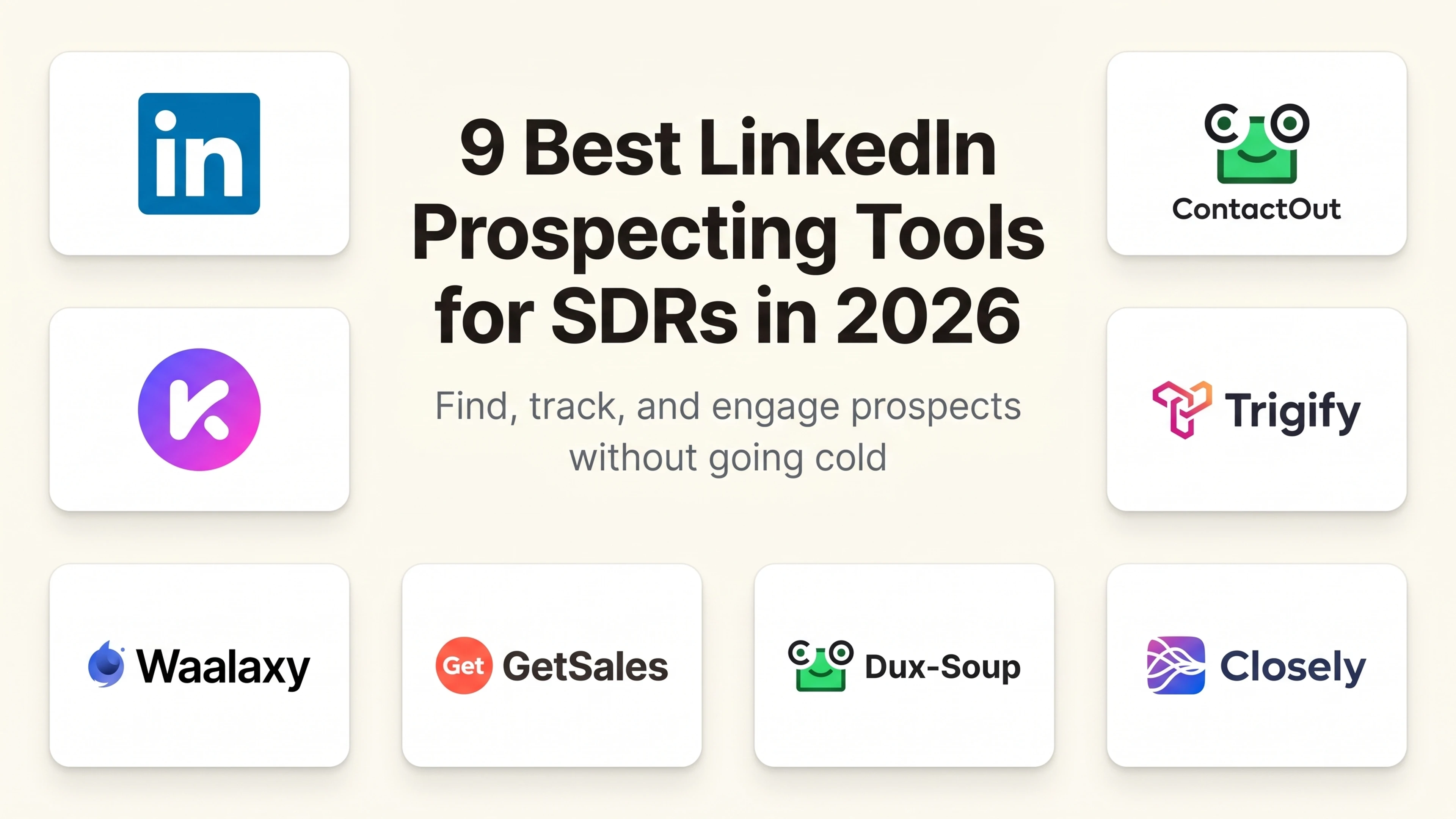
This guide compares the 9 best LinkedIn prospecting tools for SDRs in 2026 across list building, contact enrichment, signal tracking, and warm engagement, with current pricing, honest pros and cons, and a framework for building a stack instead of buying one tool and hoping.
Extrovert tracks your prospects and topics, then suggests warm, on-brand comments and DMs from your playbook. You review and send.
See how it worksBest LinkedIn prospecting tools: a brief overview
If you want the first real touch to land warm instead of cold, Extrovert is the best LinkedIn prospecting pick because it's built entirely around engagement before the ask, not list volume. Here's how it stacks up against the list-building and automation tools it usually pairs with.
- Extrovert: Best for warm, engagement-led prospecting. Track prospects and topics, then comment and DM from your own playbook so the first real touch lands familiar, not cold.
- LinkedIn Sales Navigator: Best for native list building: trades Extrovert's engagement and messaging layer for LinkedIn's own search and filters, still the most accurate source for who's who and where they work right now.
- Kaspr: Best for one-click contact enrichment. Reveals verified phone numbers and emails directly on LinkedIn profiles from a Chrome extension.
- ContactOut: Best for bulk contact finding at scale. A large searchable database plus a Chrome extension built for high-volume list building.
- Trigify: Best for granular buying-signal alerts. Flags job changes, competitor engagement, and in-market keywords, then routes them to Slack or your CRM.
- Waalaxy: Best for LinkedIn plus email prospecting on a small team's budget: trades Extrovert's human-reviewed sending for automated sequence templates across both channels.
- GetSales: Best for agency-scale multi-account prospecting: trades Extrovert's single, human-reviewed account for isolated cloud sessions across many seats.
- Dux-Soup: Best for veteran, browser-based automation: trades Extrovert's human review for the oldest unattended-sending tool in the category, still actively maintained.
- Closely: Best for cloud automation with a built-in CRM: trades Extrovert's human-reviewed workflow for always-on cloud sequences and a bundled pipeline view.
| Tool | Key strength | Pricing | Platforms |
|---|---|---|---|
| Extrovert | Warm, AI-suggested comments and DMs from your playbook | Free trial; from $29/seat/month (billed annually) | Web, Chrome extension |
| LinkedIn Sales Navigator | Native search, filters, and list building on LinkedIn's own data | From $119.99/month | Web, mobile |
| Kaspr | One-click phone and email reveal on LinkedIn profiles | Free tier; from $49/month | Chrome extension, web, API |
| ContactOut | Large contact database with bulk search and export | Free tier; paid plans from a per-seat quote | Web, Chrome extension, API |
| Trigify | Buying-signal and job-change alerts across LinkedIn and other networks | From $40/month | Web, API, MCP |
| Waalaxy | LinkedIn and email sequences in one campaign builder | From €19/user/month | Chrome extension, web |
| GetSales | Multi-account cloud automation with account-health monitoring | From $39/seat/month | Web, API |
| Dux-Soup | Chrome-extension automation with a 300k+ user base | From $14.99/month | Chrome extension, cloud tiers |
| Closely | Cloud-based multichannel automation with built-in CRM | From $29/month (billed annually) | Web |
1. Extrovert, best for warm, engagement-led prospecting
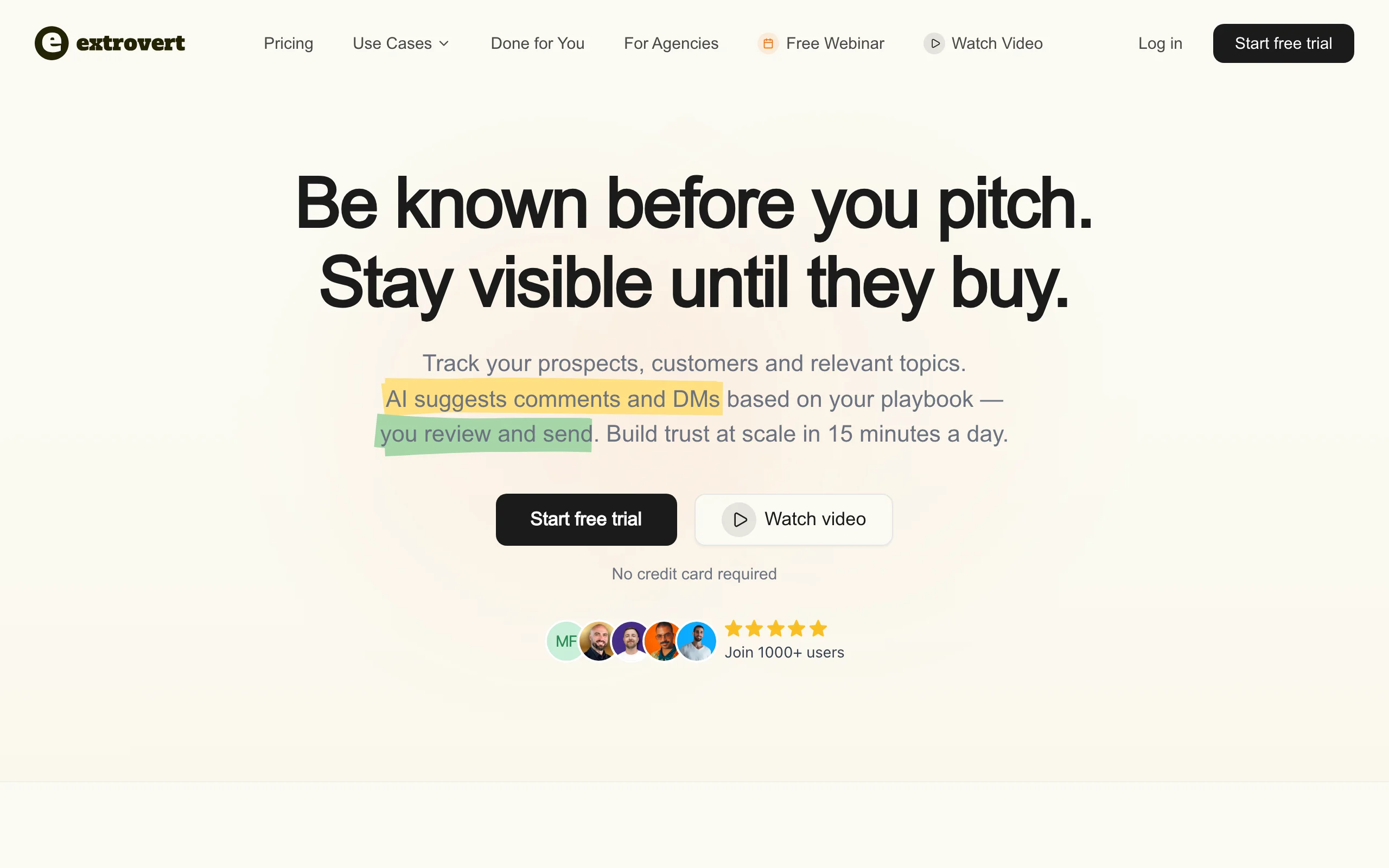
Most tools on this list are built to find people or reach them faster. Extrovert is built for the step everyone skips: getting known before you ask for anything. You track your prospects, customers, and relevant topics on LinkedIn, and Extrovert's AI suggests on-brand comments and DMs based on your own playbook, so by the time you send a real pitch, the name is already familiar.
The workflow runs in about 15 minutes a day. You review each suggested comment or DM, edit or approve it, then send it yourself, so nothing goes out unattended. Extrovert calls this the 90-day loop: steady, low-effort touches that compound into relationships instead of a two-week sequence that goes cold. It's a natural fit once you've already built a list, whether through LinkedIn for SDRs or a LinkedIn for prospecting motion.
Key features:
- Prospect, customer, and topic tracking on LinkedIn
- AI comment and DM suggestions tuned to your voice and playbook
- Buying-signal and champion-change alerts
- Human-in-the-loop review before every send
- About 15 minutes a day to run
Best for:
- SDRs and AEs who want the first real touch to land warm, not cold
- Teams that tried heavier automation and want less account risk
Pricing:
- Free trial, no card required
- Paid plans from $35/seat/month ($29/month billed annually), see Extrovert pricing
Pros:
- Every comment and DM is human-reviewed before it sends, which avoids unattended automation
- Builds compounding familiarity instead of one-off blasts
Cons:
- LinkedIn-focused, not a multichannel cold-email platform
- Doesn't build or enrich your prospect list, you bring it in
2. LinkedIn Sales Navigator, best for native list building
Sales Navigator trades Extrovert's engagement and messaging layer for LinkedIn's own paid search and filtering data. It remains the most accurate source for finding the right people on the platform. Filter by title, seniority, company headcount, industry, and recent posting activity, then save leads and accounts to lists that track job changes automatically. Because the data comes straight from LinkedIn's own profiles, its accuracy on current title and employer beats scraped or third-party-enriched databases.
Sales Navigator finds and organizes people well. It doesn't draft messages, enrich contact data beyond LinkedIn's own fields, or track signals outside its own alerts, which is why most teams pair it with a data or engagement tool rather than treating it as the whole stack.

Key features:
- 50+ advanced search filters across seniority, function, and tenure
- Saved leads and accounts with automatic job-change alerts
- Lead and Account IQ AI insights on Advanced-tier plans
- TeamLink warm-intro mapping through teammates' networks
- CRM sync with Salesforce, HubSpot, and Dynamics on Advanced Plus
Best for:
- Teams building accurate target-account lists before outreach starts
- Anyone doing LinkedIn for account executives work who needs a current org chart
Pricing:
- No permanent free tier; free trial available
- Core from $119.99/month ($89.99/month billed annually); Advanced from $159.99/month; Advanced Plus is custom
Pros:
- Most accurate title and employer data on LinkedIn, since it's first-party
- Job-change alerts catch champion moves other tools can miss
Cons:
- No native Chrome extension for outreach, and no messaging suggestions
- CRM sync and the deepest AI features sit behind the priciest tier
3. Kaspr, best for one-click contact enrichment
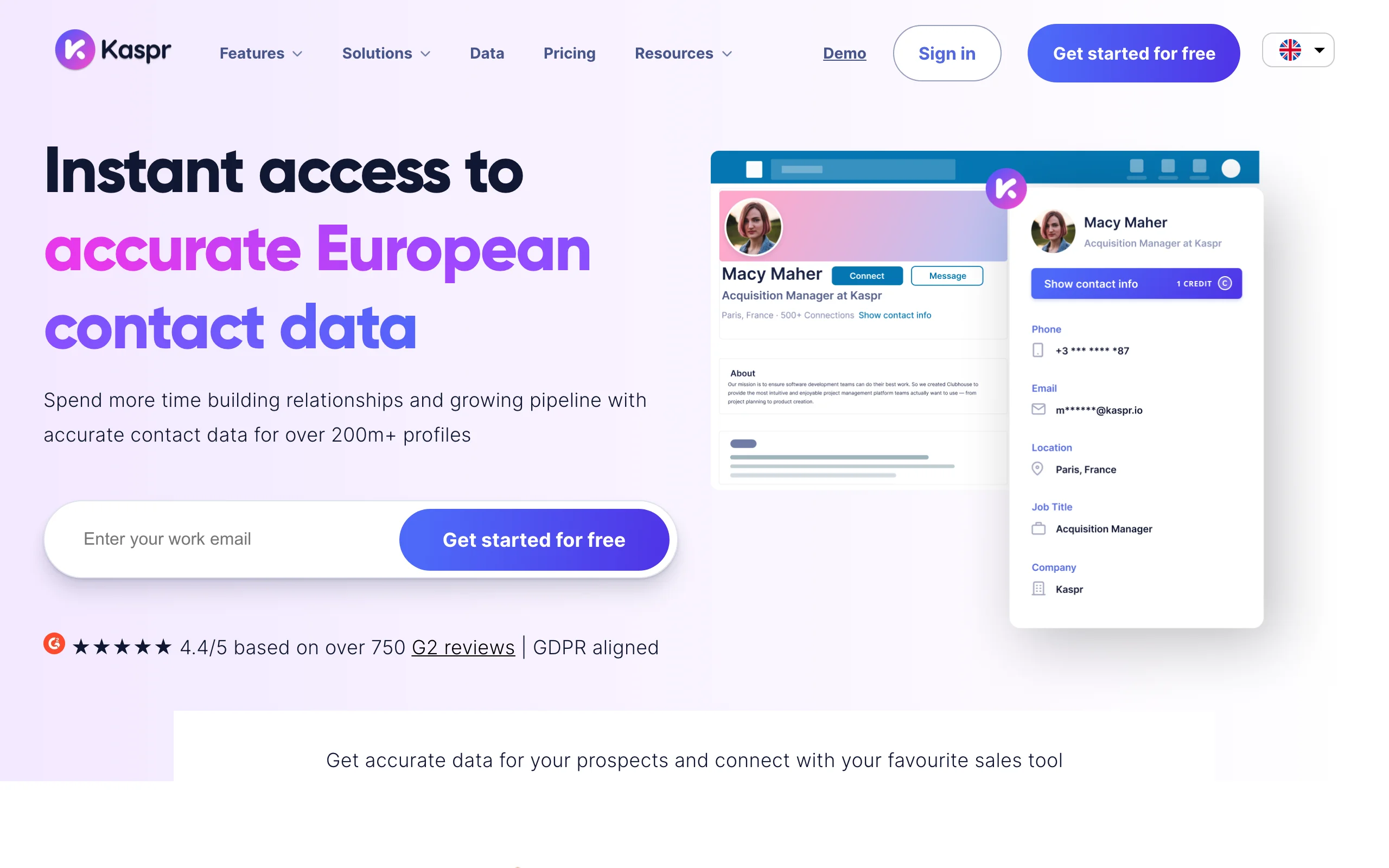
Kaspr is a Chrome extension that reveals verified phone numbers and emails directly on LinkedIn and Sales Navigator profiles, drawing from a database of 500 million-plus contacts across 200 million profiles. It's built for the moment you've found the right person on LinkedIn and need a way to reach them outside the platform, without leaving the profile page.
Beyond one-off lookups, Kaspr supports bulk CSV enrichment for existing lists and syncs contact data straight into a CRM on paid tiers. The free tier is genuinely usable for testing, though phone and direct-email credits stay capped even on paid plans.
Key features:
- Chrome extension reveals phone and email on any LinkedIn profile
- Bulk CSV list enrichment
- Sales Navigator integration on paid tiers
- CRM sync and API access
- Built-in lead management dashboard
Best for:
- Reps who build lists in Sales Navigator and need contact data to act on them
- Recruiters sourcing candidates alongside sales prospects
Pricing:
- Free tier: 15 email credits, 5 phone credits, 100-lead export cap
- Starter from $49/month; Business from $79/month; Enterprise is custom
Pros:
- Large verified contact database with native LinkedIn capture
- Usable free tier, no card required to start
Cons:
- Phone and direct-email credits are capped even on paid plans
- Full API and Recruiter access require the higher tier
4. ContactOut, best for bulk contact finding at scale
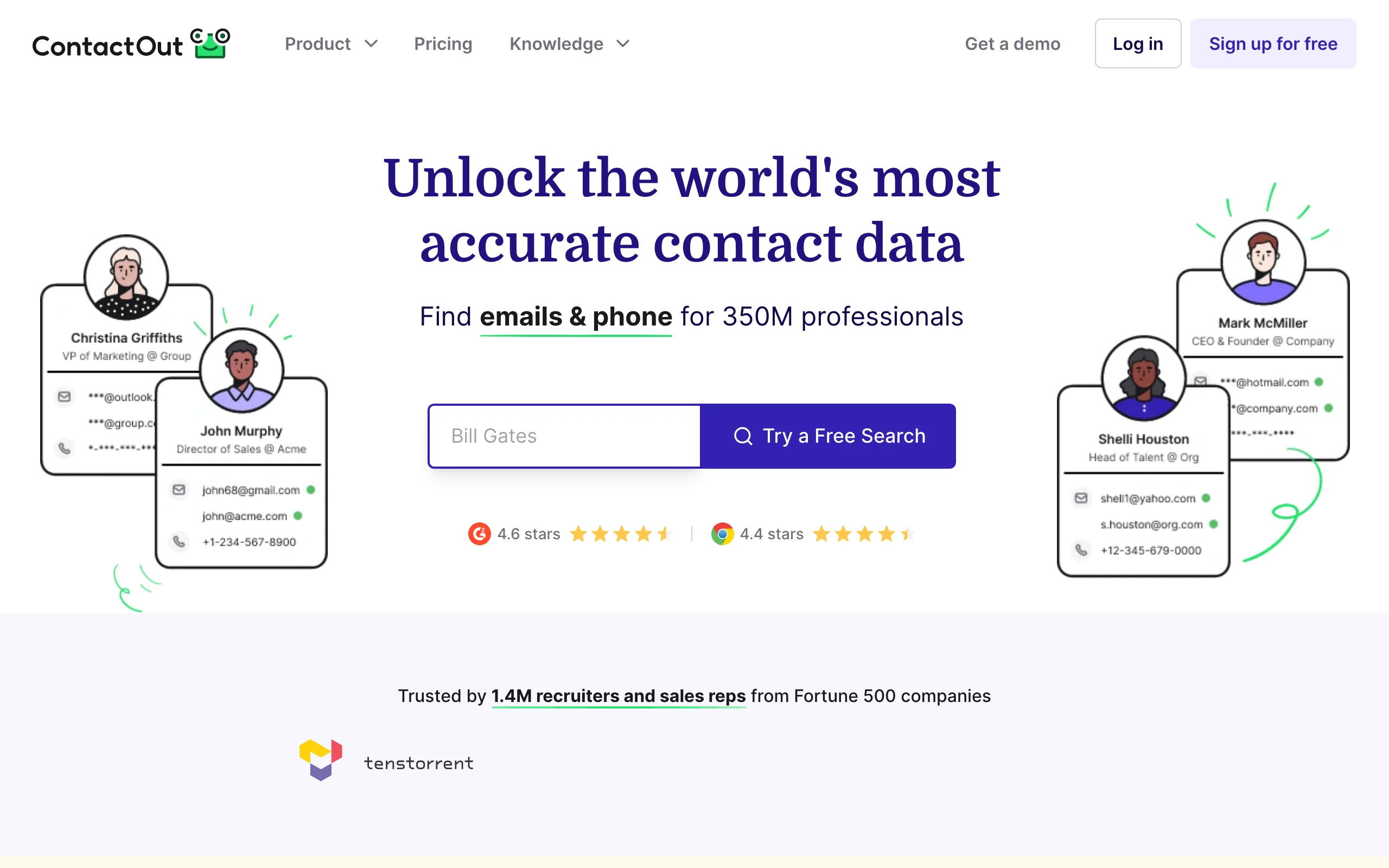
ContactOut pairs a searchable database of 350 million-plus professionals with a Chrome extension that pulls contact data for the large majority of LinkedIn profiles it covers. It leans toward volume: bulk search, 20-plus filters (title, revenue band, tech stack), and CSV export make it a fit for teams building large outbound lists rather than looking up one contact at a time.
The free tier caps out fast at a handful of credits a day, and full pricing detail for team and API plans requires a live quote rather than a public price sheet, so budget for a sales conversation before committing at scale.
Key features:
- Chrome extension pulls email and direct-dial data from LinkedIn profiles
- Searchable database with 20+ filters (title, revenue, tech stack)
- Bulk search and CSV export for list building
- AI email personalization and campaign automation
- API access and Salesforce/ATS integrations on the Team plan
Best for:
- Teams building high-volume outbound lists that need contact data fast
- Agencies licensing bulk contact data across client accounts
Pricing:
- Free tier: 5 credits/day, no card required
- Paid per-seat plans and a Team/API tier, both quote-based
Pros:
- Large database with high claimed match rate across LinkedIn profiles
- Extension surfaces data directly on the profile, no separate lookup step
Cons:
- Free tier is too thin for anything beyond testing
- Exact per-tier pricing isn't published, so budgeting takes a sales call
5. Trigify, best for granular buying-signal alerts
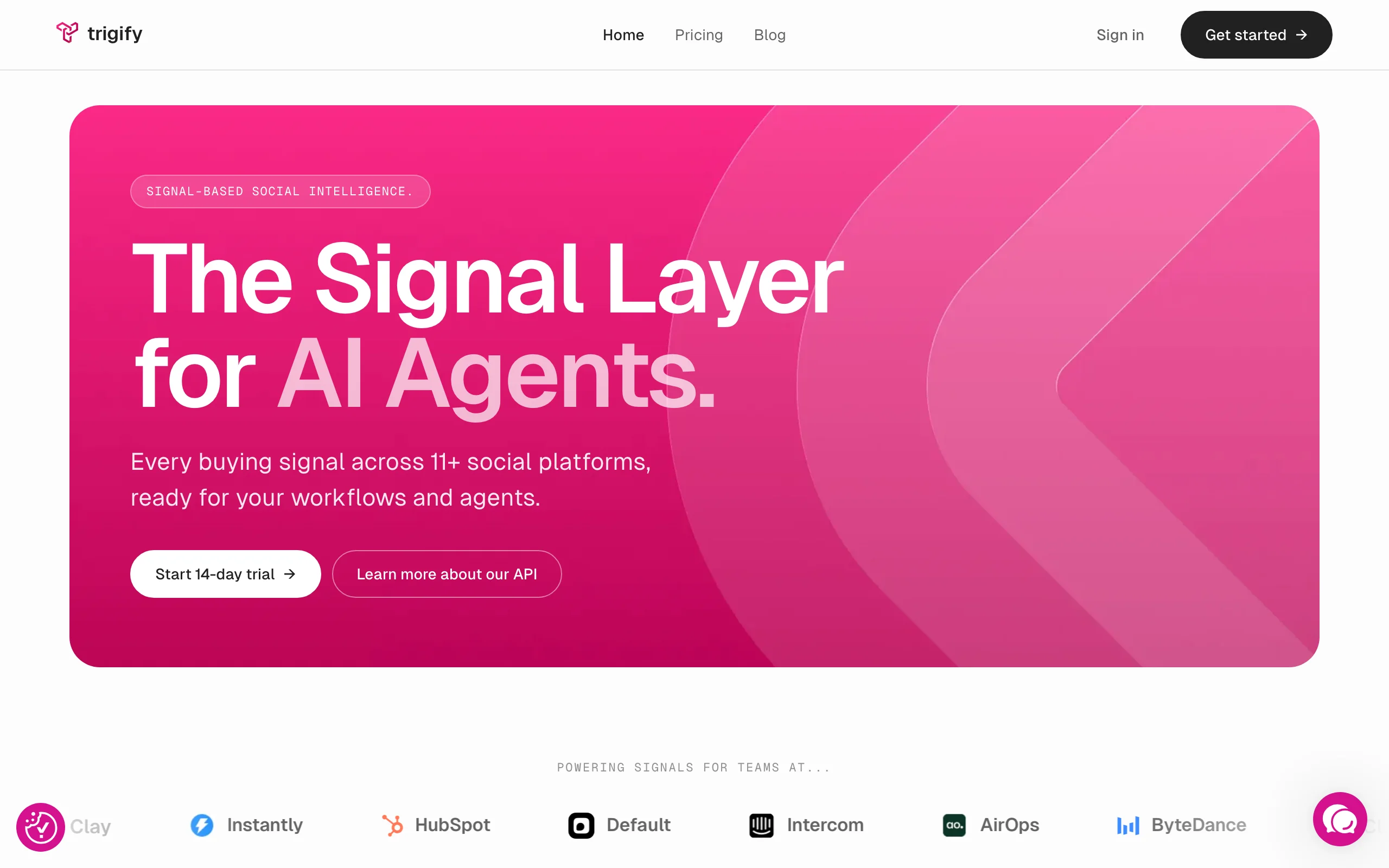
Trigify watches for the moments that make a cold list turn warm: job changes, new hires, competitor mentions, and posts that signal someone's actively evaluating a category. Signals get tied to the specific person and post, then routed into a CRM, Slack, Notion, or a custom workflow via API or MCP, which makes it more of a routing layer than a standalone outreach tool.
It covers more than LinkedIn (11-plus networks), so it's a stronger fit for teams that already have a way to act on a signal once it lands. The credit-based pricing model takes more effort to size against a flat-rate tool, and the entry tier's profile and credit caps push active users toward the $199/month plan quickly.
Key features:
- Job-change and new-hire alerts
- Competitor and brand engagement tracking
- Buying-intent signal detection from posts and discussions
- Person- and company-level data enrichment
- Workflow automation into CRM, Slack, Notion, and Sheets
Best for:
- Sales teams that want signals surfaced before they build a full list
- Technical teams piping signal data into custom agents via API or MCP
Pricing:
- 14-day free trial, no card required
- Starter from $40/month; Max from $199/month; Enterprise is custom
Pros:
- Multi-platform signal coverage beyond LinkedIn alone
- Flexible routing into whatever tool your team already uses
Cons:
- Credit-based pricing adds friction when comparing against flat-rate tools
- Entry tier's profile and credit caps run out fast for active users
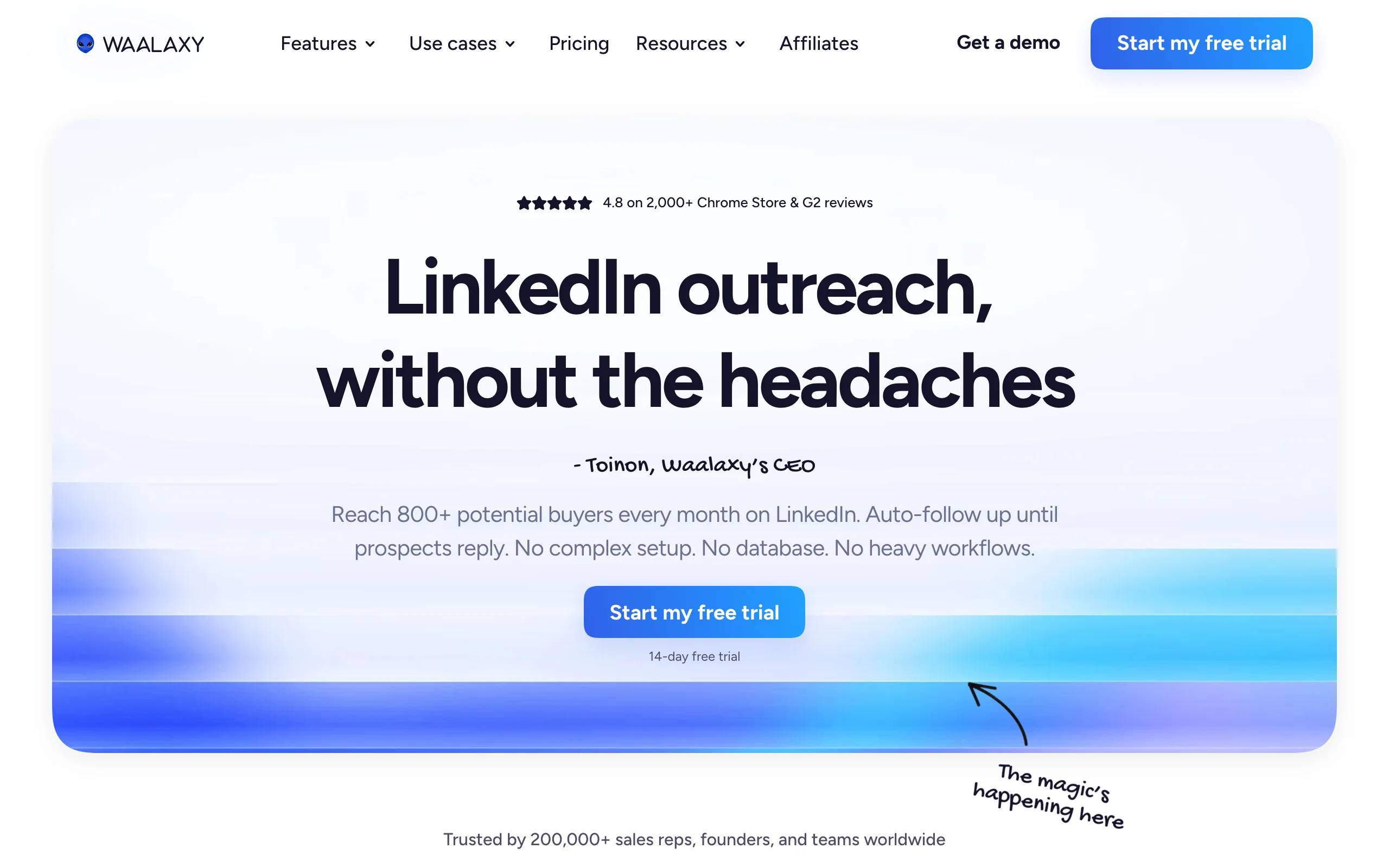
6. Waalaxy, best for LinkedIn plus email prospecting on a small budget
Waalaxy trades Extrovert's human-reviewed sending for automated volume. It combines LinkedIn connection and message sequences with a built-in email finder, so a small team can run a multichannel cadence without stitching together separate tools. Nearly 100 pre-built sequence templates cover common use cases, and a smart inbox centralizes replies across both channels.
The catch is that true multichannel sequencing (LinkedIn plus cold email in one campaign) sits behind the top Business tier, and invite and email credits are capped on every plan, so cost climbs fast once volume grows. As with any tool that sends LinkedIn actions on autopilot, unattended sequences carry more account risk than a workflow with human review before each send.
Key features:
- LinkedIn invite and message sequences from Search, Sales Navigator, or Recruiter Lite
- 99+ pre-built sequence templates
- Built-in email finder and enrichment
- CRM sync to HubSpot, Pipedrive, plus 2,000+ apps via Zapier
- Smart inbox for centralized replies
Best for:
- Founders or small teams who want LinkedIn plus email without hiring for it
- Recruiters running proactive candidate sourcing sequences
Pricing:
- No permanent free tier; 14-day free trial, no card required
- Starter/Pro from €19/user/month; Advanced from €49/user/month; Business from €69/user/month
Pros:
- Large template library shortens setup time
- Strong CRM and Zapier ecosystem for a tool at this price point
Cons:
- Full multichannel sequencing is gated behind the priciest tier
- Invite and email credits are capped, so cost scales quickly with volume
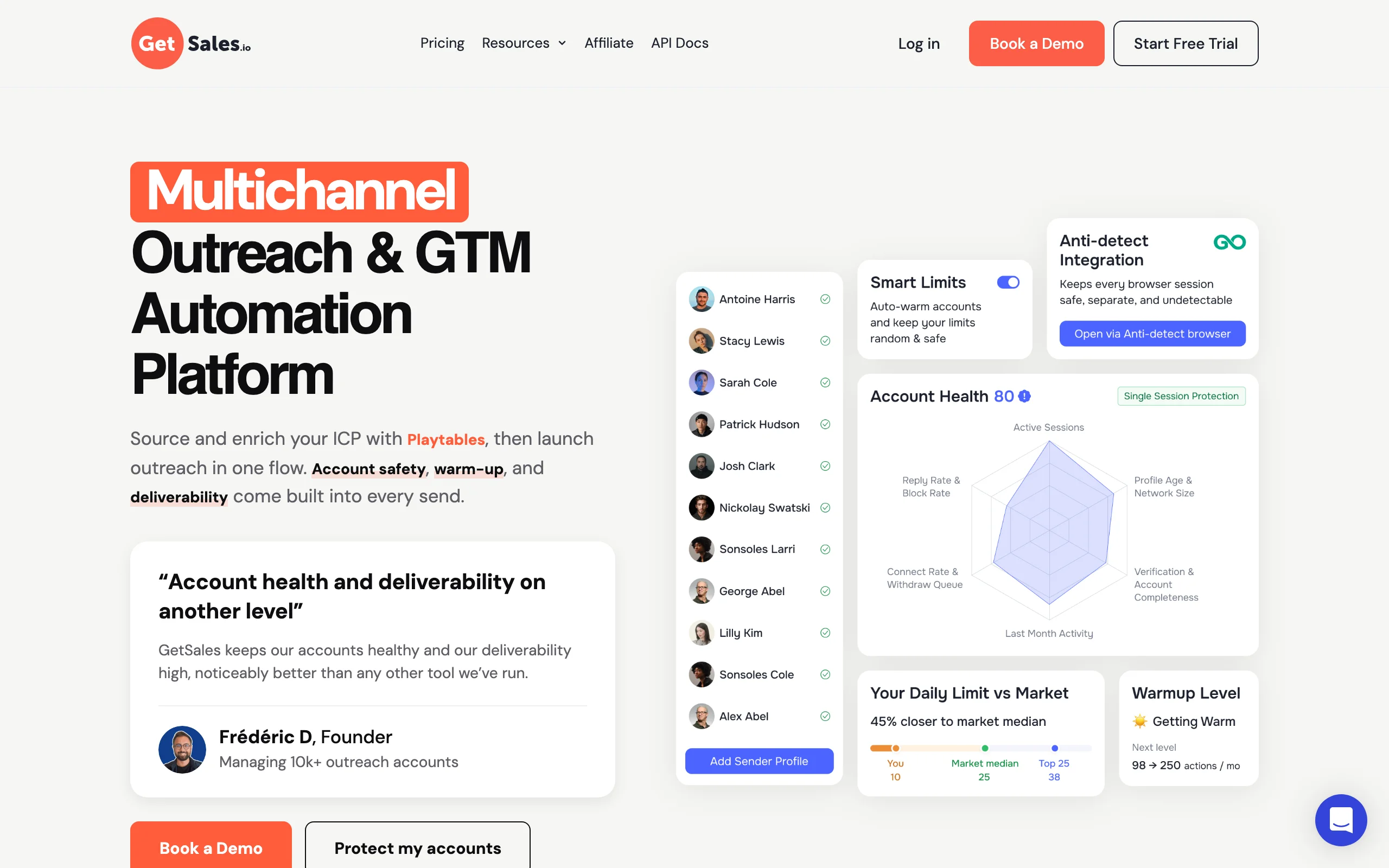
7. GetSales, best for agency-scale multi-account prospecting
GetSales trades Extrovert's single, human-reviewed account for isolated automation across many. It's built for teams running LinkedIn outreach across many client or rep accounts at once. Each LinkedIn seat runs in an isolated cloud browser session, so one flagged account doesn't put others at risk, and Smart Limits auto-throttle invites and messages while an account-health score tracks 24-plus signals per profile.
Beyond sending, it bundles an outreach CRM, a unified team inbox, and per-SDR performance analytics, which makes it closer to an agency operations platform than a single-purpose sequencer. Pricing scales per seat, so it gets expensive fast for teams managing dozens of accounts, and no amount of throttling fully removes the underlying risk of automating LinkedIn actions.
Key features:
- Isolated cloud browser sessions per LinkedIn account
- Smart Limits and account-health monitoring across 24+ signals
- Omnichannel sequences (LinkedIn plus email) with AI-generated templates
- Team Unibox and rotating sender profiles
- Built-in outreach CRM with SDR-level analytics
Best for:
- Agencies running outreach for multiple clients from one dashboard, similar to Extrovert for agencies use cases but for automated sending
- GTM teams managing many LinkedIn seats who need centralized reporting
Pricing:
- Free trial available on all plans
- Send from $39/seat/month; Enrich from $49/seat/month; Scale from $69/seat/month; custom pricing for large teams
Pros:
- Strong multi-account isolation reduces cross-account risk
- Unified CRM and analytics across a whole team's accounts
Cons:
- Per-seat pricing adds up fast for larger agencies
- Automated sends still carry inherent account-detection risk, throttling reduces it but doesn't remove it
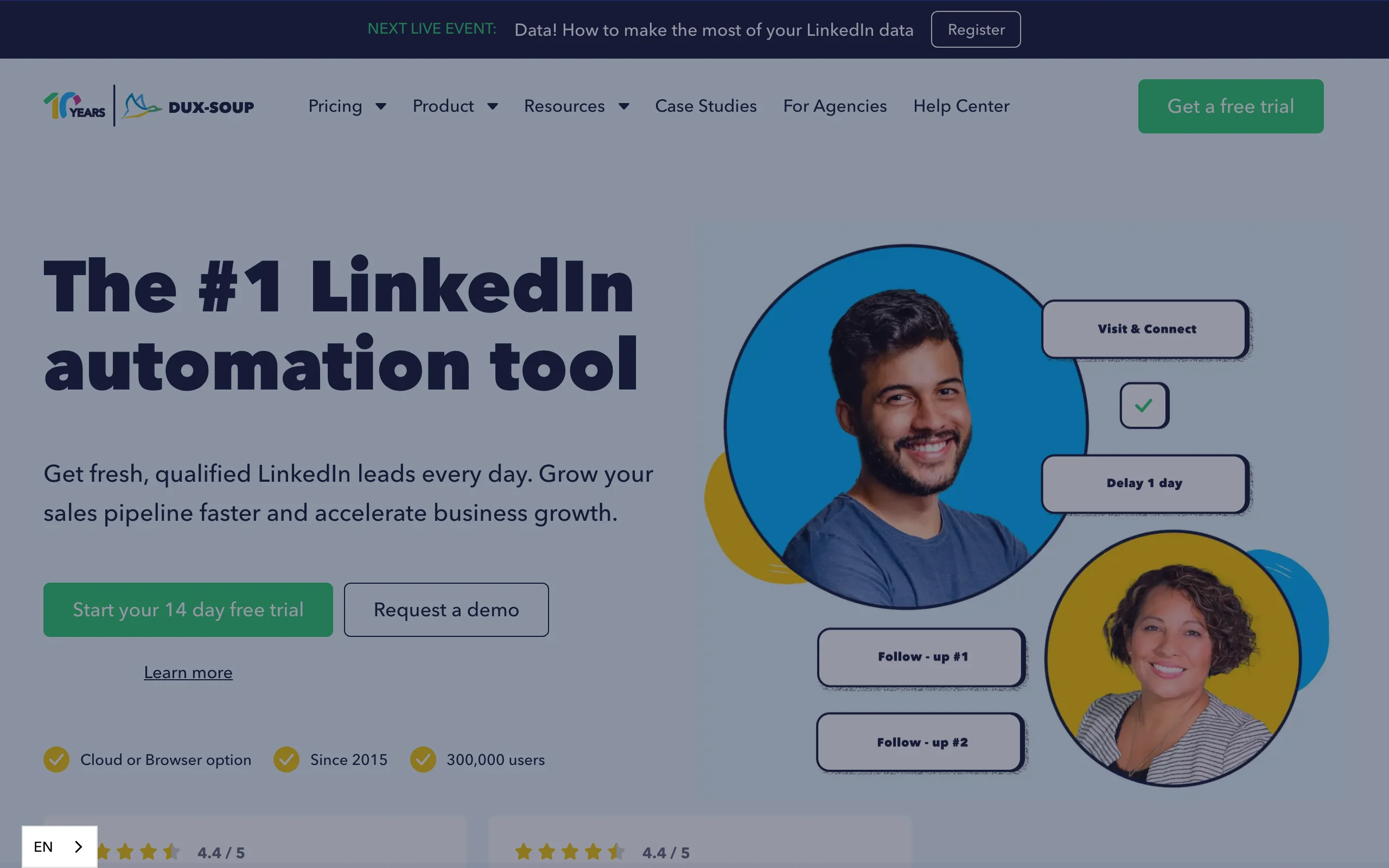
8. Dux-Soup, best for veteran, browser-based automation
Dux-Soup trades Extrovert's human review for the oldest unattended-sending tool in the category. It has run as a Chrome extension since 2015 and still has one of the largest user bases in the category (300,000-plus). It automates profile visits, connection requests, and time-delayed messaging directly from the browser, with AI-drafted campaign messages and a tagging system for organizing who's been touched and when.
Its age is also its trade-off: the core Pro Dux plan requires Chrome to be running locally, and moving to always-on cloud automation means stepping up to the pricier Turbo or Cloud tiers. Like any tool automating connection requests and messages, fully unattended sends carry more account-restriction exposure than a workflow where a human reviews before each one goes out.
Key features:
- Automated connection invitations, profile visits, and follows
- Time-delayed, personalized messaging to first-degree connections
- AI-drafted campaign messages
- CRM integrations with Salesforce, HubSpot, and Pipedrive, plus Zapier
- Activity logs, tagging, and CSV export
Best for:
- Solo reps or growth hackers running manual LinkedIn campaigns on a budget
- Agencies managing multiple client accounts from one dashboard
Pricing:
- No permanent free tier; 14-day free trial, no card required
- Pro Dux from $14.99/month; Turbo Dux from $55/month; Cloud Dux from $99/month; Cloud Agency from $371/month for 5+ seats
Pros:
- Mature product with a deep CRM and Zapier integration list
- Scales from a $14.99/month solo plan up to agency tiers
Cons:
- Fully automated sends aren't human-reviewed, which raises account-restriction risk
- Core plan depends on Chrome running locally rather than the cloud
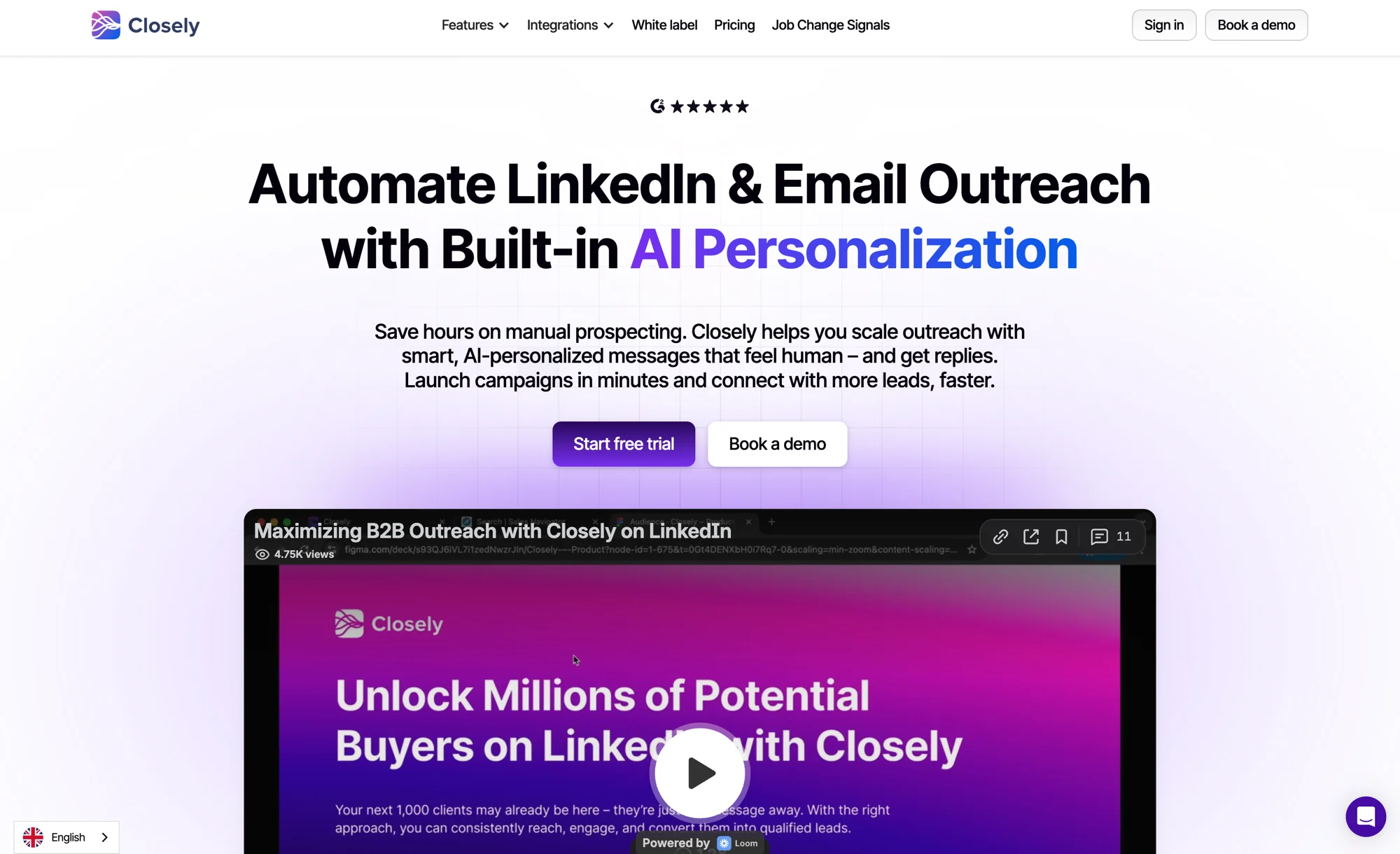
9. Closely, best for cloud automation with a built-in CRM
Closely trades Extrovert's human-reviewed workflow for always-on cloud automation. It runs LinkedIn and email sequences entirely in the cloud, so there's no browser extension to keep open. A unified inbox handles LinkedIn DMs, InMails, and email replies in one place, and a built-in CRM with HubSpot, Salesforce, and Pipedrive sync means outreach and pipeline tracking live in the same tool.
A 14-day warm-up mode and cloud-based sending are positioned as lower-detection-risk than extension-based automation, though as with every tool on this list that sends LinkedIn actions unattended, pacing and warm-up reduce risk rather than remove it. Pricing scales by LinkedIn seat count, which adds up for teams running several accounts.
Key features:
- Cloud-based LinkedIn and email sequences with smart delays
- 14-day account warm-up mode
- Unified inbox for LinkedIn DMs, InMails, and email
- Built-in CRM with HubSpot, Salesforce, and Pipedrive sync
- Team workspaces with cross-rep analytics
Best for:
- Teams that want multichannel sequencing and a CRM in one login
- Agencies running outreach for multiple clients who want cloud delivery over a browser extension
Pricing:
- Free trial referenced on-site, duration not published
- Starter from $49/month ($29/month billed annually, 1 LinkedIn account); Growth from $127/month ($87/month annually, 3 accounts); Essential from $205/month (5 accounts)
Pros:
- Cloud delivery avoids the browser-fingerprint exposure of extension-based tools
- CRM and unified inbox remove the need for a separate pipeline tool
Cons:
- Pricing scales with LinkedIn seat count, not just user count
- Still automates LinkedIn actions, so it reduces account risk rather than eliminating it
How to choose the best LinkedIn prospecting tool for your needs
Start with what you're missing, not what looks impressive
Most reps don't need all four jobs (finding people, getting contact data, catching signals, and engaging warmly) covered by new tools. If you already have Sales Navigator and a CRM, the gap is usually engagement or signal tracking, not another list-building tool. Audit what you own before adding a subscription.
Decide how much automation risk you're willing to carry
Sales Navigator, Kaspr, and ContactOut don't touch LinkedIn's send limits, they're search and data tools. Waalaxy, GetSales, Dux-Soup, and Closely all automate connection requests and messages to some degree, and every one of them is honest that pacing and warm-up reduce account-restriction risk rather than remove it. If you want the upside of consistent outreach without that exposure, a human-reviewed workflow like Extrovert's is the closer fit; every action gets approved before it sends, which avoids unattended automation entirely.
Match team size to pricing model
Solo reps and small teams do fine on Kaspr's free tier, Trigify's $40 Starter plan, or Dux-Soup's $14.99 Pro Dux. Agencies managing multiple client accounts should weight GetSales or Closely's per-seat, multi-account isolation more heavily, since the per-seat cost buys account safety features solo plans skip.
Don't skip the signal layer
A list without a way to know who's actually in-market is just a list. Sales Navigator's own alerts cover job changes; Trigify goes deeper with competitor mentions and post-level intent. For reps doing LinkedIn for B2B sales, pairing a list-building tool with a signal tool, then closing the loop with warm engagement, consistently outperforms running one tool alone.
Run a real pilot before you commit
Test any tool that touches send limits on one account for two weeks before rolling it to a whole team. Watch reply rate, not just connection-acceptance rate, since a high accept rate on a cold pitch still converts poorly if nobody remembers who sent it.
FAQ
What's the difference between a LinkedIn prospecting tool and a LinkedIn automation tool?
Prospecting tools help you find and organize the right people, through search filters (Sales Navigator), contact data (Kaspr, ContactOut), or buying signals (Trigify). Automation tools like Waalaxy, GetSales, and Dux-Soup go a step further and send connection requests or messages on a schedule. A tool can do both, but the distinction matters for account risk: finding people carries none, sending unattended does.
Is LinkedIn automation against LinkedIn's terms of service?
LinkedIn's user agreement prohibits third-party automation of platform actions like connecting and messaging. Tools vary in how closely they mimic human behavior and how aggressively they pace sends, and none can guarantee an account won't be restricted. Human-reviewed workflows, where you approve each action before it sends, carry less risk than fully unattended automation.
Do I need Sales Navigator if I already have a prospecting tool?
Most contact-data and automation tools still rely on Sales Navigator or LinkedIn's own search for the initial list, since it remains the most accurate and current source for titles and employers. Tools like Kaspr and Trigify integrate with it rather than replace it.
Which of these tools is free?
Kaspr and ContactOut both offer usable free tiers with daily or monthly credit caps, and most of the others (Trigify, Waalaxy, GetSales, Dux-Soup) offer a free trial rather than a permanent free plan. Extrovert and Sales Navigator both offer free trials with no permanent free tier.
Can I use one of these tools instead of a CRM?
Closely and GetSales both bundle a basic CRM, which covers small teams that don't want a separate system of record. Larger teams typically keep a dedicated CRM and sync prospecting tools into it, since a bundled CRM rarely matches a dedicated one on reporting depth.
What's the best LinkedIn prospecting tool for a solo founder?
Kaspr's free tier plus Sales Navigator's search covers list building and contact data cheaply. For the outreach itself, a LinkedIn for founders workflow that leans on warm, human-reviewed engagement tends to convert better than automated sequences at this scale, since a founder's name carries more weight when the outreach feels personal.
How many tools should a prospecting stack actually include?
Most effective stacks run two to three: one for list building or contact data, one for signal tracking, and one for engagement or outreach. Stacking more than that usually means overlap, not more coverage.
Do buying-signal tools like Trigify replace manual research?
They reduce it. Trigify surfaces job changes and intent signals automatically, but someone still needs to review the signal and decide whether it's worth a touch, which is where an engagement workflow picks up.
What pricing model should I expect across this category?
Search and data tools (Sales Navigator, Kaspr, ContactOut) price per seat with credit caps. Automation tools (Waalaxy, GetSales, Dux-Soup, Closely) price per seat or per LinkedIn account, and jump significantly at tiers that unlock multichannel sequencing or cloud delivery. Engagement tools like Extrovert price per seat with usage limits tied to plan tier rather than per-send credits.