
On this page
Demand generation tools help a B2B team create awareness, educate buyers, turn interest into conversations, and measure the pipeline that follows. Start with the work your team needs to do: publishing useful content, running webinars, reaching named accounts, explaining the product, or connecting campaigns to revenue.
Extrovert covers the LinkedIn relationship-building part of that stack. Semrush supports search and content planning; Livestorm runs webinars; Storylane creates interactive demos; HubSpot connects campaigns to CRM records. ABM, data, visitor-identification, and attribution tools address other gaps. You do not need every layer at once.
Demand generation tools at a glance
Compare the job each product does before comparing prices. A per-seat engagement plan, an attendee-credit pack, and an enterprise ABM contract cover different work.
| Tool | Demand generation role | Entry pricing and billing | Material condition |
|---|---|---|---|
| Extrovert | LinkedIn engagement, discovery, and warm follow-up | $49/seat/month, monthly | One seat per LinkedIn account; discovery uses Credits |
| Semrush | Content planning and search visibility | SEO $139/month, monthly | Toolkit, currency, and tracking allowances affect cost |
| Livestorm | Webinars and replay follow-up | $3/attendee credit at 400 credits | Yearly credit pack; distinct sessions consume credits |
| Storylane | Self-guided interactive demos | Free; Starter $50/month monthly or $40 annual | Editable HTML demos start in Growth |
| HubSpot | CRM-connected forms, email, and campaigns | Free; platform Starter €7/seat/month, annual billing, limited-time offer | Marketing contacts and onboarding affect cost |
| Mutiny | Personalized ABM pages and campaign assets | Free; Business $50/month at 50 credits | Credit-selected, not per-seat pricing |
| 6sense | Predictive account intent and coordinated ABM | Custom enterprise quote | Implementation and RevOps capacity matter |
| Demandbase | Account intelligence, ABM, and B2B advertising | Custom enterprise quote | Platform scope and ad spend affect total cost |
| ZoomInfo | Contact and company data with account signals | Lite offering; paid plans custom-quoted | Data access, users, and usage affect the contract |
| Apollo | Contact search, sequencing, and calling | Free; Basic $49/seat/month, annual billing | Credits apply; advanced dialer is an add-on |
| Clay | Multi-provider enrichment and AI research | Free; Launch $185/month, monthly | Actions and Data Credits are separate allowances |
| Warmly | Website visitor identification and inbound follow-up | Web-Deanonymization from $10,000/year | Chat and Autopilot are higher-priced packages |
| RB2B | Website visitor identification and routing | Free company-level plan; Starter $79/month | Person-level ID is US-only; Starter excludes emails |
| Dreamdata | Account journeys and revenue attribution | Free analytics; paid attribution custom-priced | Free analytics does not include the full attribution product |
On mobile, swipe the table to compare prices and plan conditions. Select a tool name to jump to its section.
For content and buyer education, look at Semrush, Livestorm, and Storylane. For account activation, compare Extrovert, Mutiny, 6sense, and Demandbase. HubSpot supplies the CRM-connected campaign layer; ZoomInfo, Apollo, and Clay support data and research. Warmly and RB2B capture site interest. Dreamdata addresses cross-channel measurement.
1. Extrovert for engagement-led demand generation on LinkedIn
Demand generation on LinkedIn starts with showing up in the conversations your buyers already follow. Extrovert's LinkedIn outreach workflow helps founders, marketers, SDRs, and account executives join those conversations and follow up with context.
Import named prospects from your CRM, CSV, or Sales Navigator, or use Lead Finder to search by role, company, and location. Track prospects, customers, and relevant topics. For a marketing team, that can mean separate campaigns for target-account familiarity, industry visibility, and customer nurturing. Extrovert finds posts worth joining and drafts comments and messages from your playbook, so you can spend about 15 minutes a day on the conversations that matter.
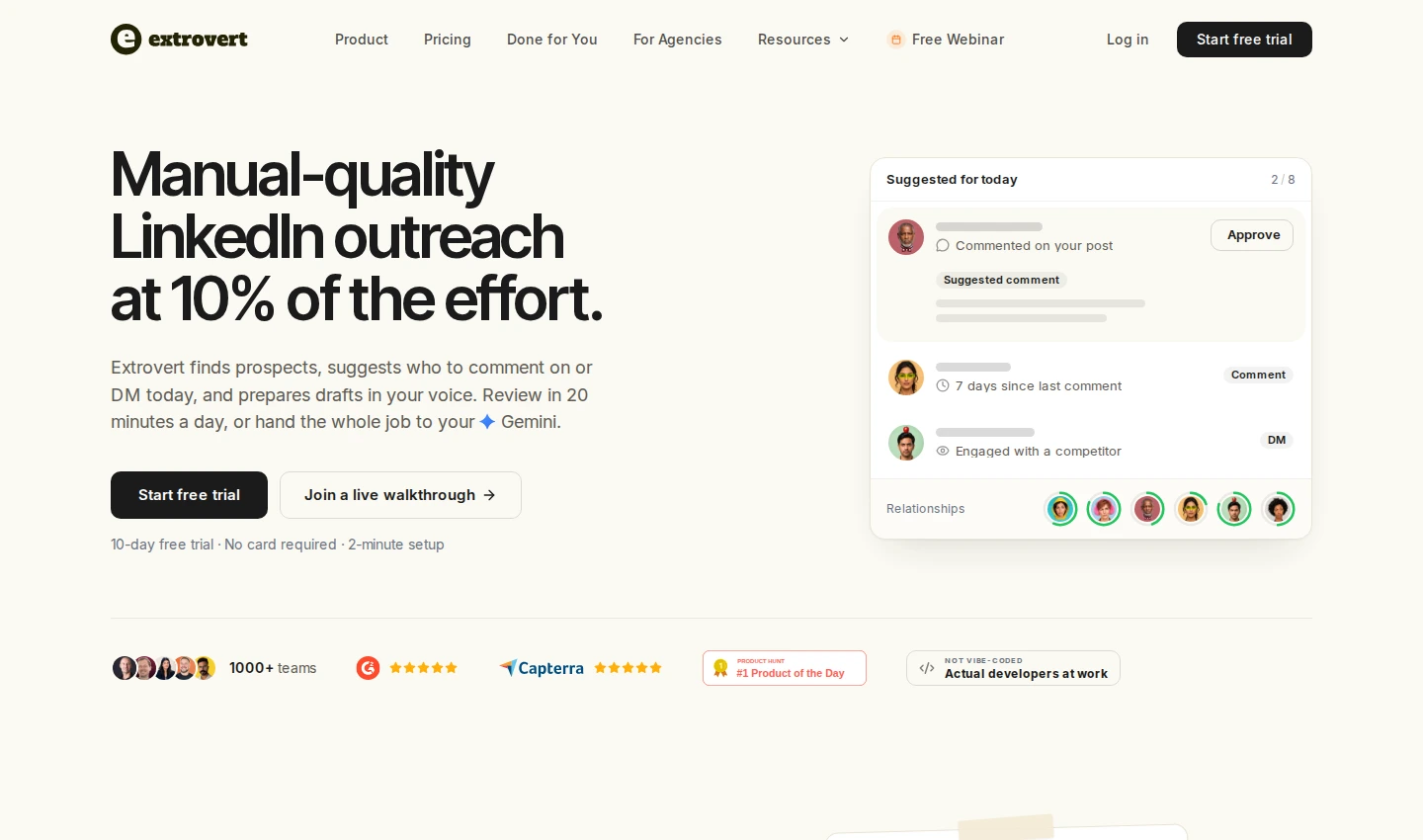
Extrovert's official homepage. Open the image for the full-size capture.
Find prospects showing relevant LinkedIn activity
Intent Signals finds people from activity you define: engagement with specific posts, people, companies, or topics, plus competitor-team activity and connections. Those signals help you build a relevant audience before a form fill. They indicate attention and context, not a confirmed purchase decision. Lead Finder is a separate search workflow for role, company, and location.
Illustration: a radar sweeping LinkedIn activity. Most of it is passed over; three people are found by what they did: commented on a post about your topic; engaged with a competitor's post; connected with a competitor's sales team.


A person joining a discussion about your category is useful context for deciding where to participate. Keep topic conversations educational; an engagement signal does not justify sending the same sales pitch to everyone.
Turn a prospect's post into a relevant conversation
Conversation Restarters connect a concrete post signal to a suggested DM. Recommended DMs explain why a conversation deserves attention, and smart follow-ups help keep it moving. Continue the relationship with context rather than restarting every contact with the same pitch.
Illustration: Extrovert reads the prospect's posts. hot take, thought leadership, motivation, promotion are skipped. One post, went to sf tech week, is a Restarter signal. Extrovert suggests the DM "Seen you went to SF Tech Week. How did it go?", and the prospect replies.

Extrovert's 90-day loop replaces the short two-week outbound push with a steady cadence of relevant touches. It also supports connection suggestions and reaching people who rarely post. Daily limits, working hours, and delayed posting help control execution; they are not a guarantee against LinkedIn restrictions.
Workflow and control:
- Review each comment, approve drafts in bulk, or automate a commenting campaign.
- Edit comments and DMs in your voice before approving them.
- Share campaigns and prospect lists across your team, including managed client accounts.
- Connect workflows through API, webhooks, Make, n8n, and Attio; use Extrovert from an MCP client such as Claude or ChatGPT.
Pricing: $49 per LinkedIn-account seat per month, billed monthly, with volume discounts and two months free on annual billing. Each seat includes 250 tracked prospects, one topic, and 300 monthly Credits, shared across the team. Lead Finder and Intent Signals use Credits; extra tracking capacity and Credit top-ups cost more. Review-only teammates are free. See Extrovert pricing for your team's total.
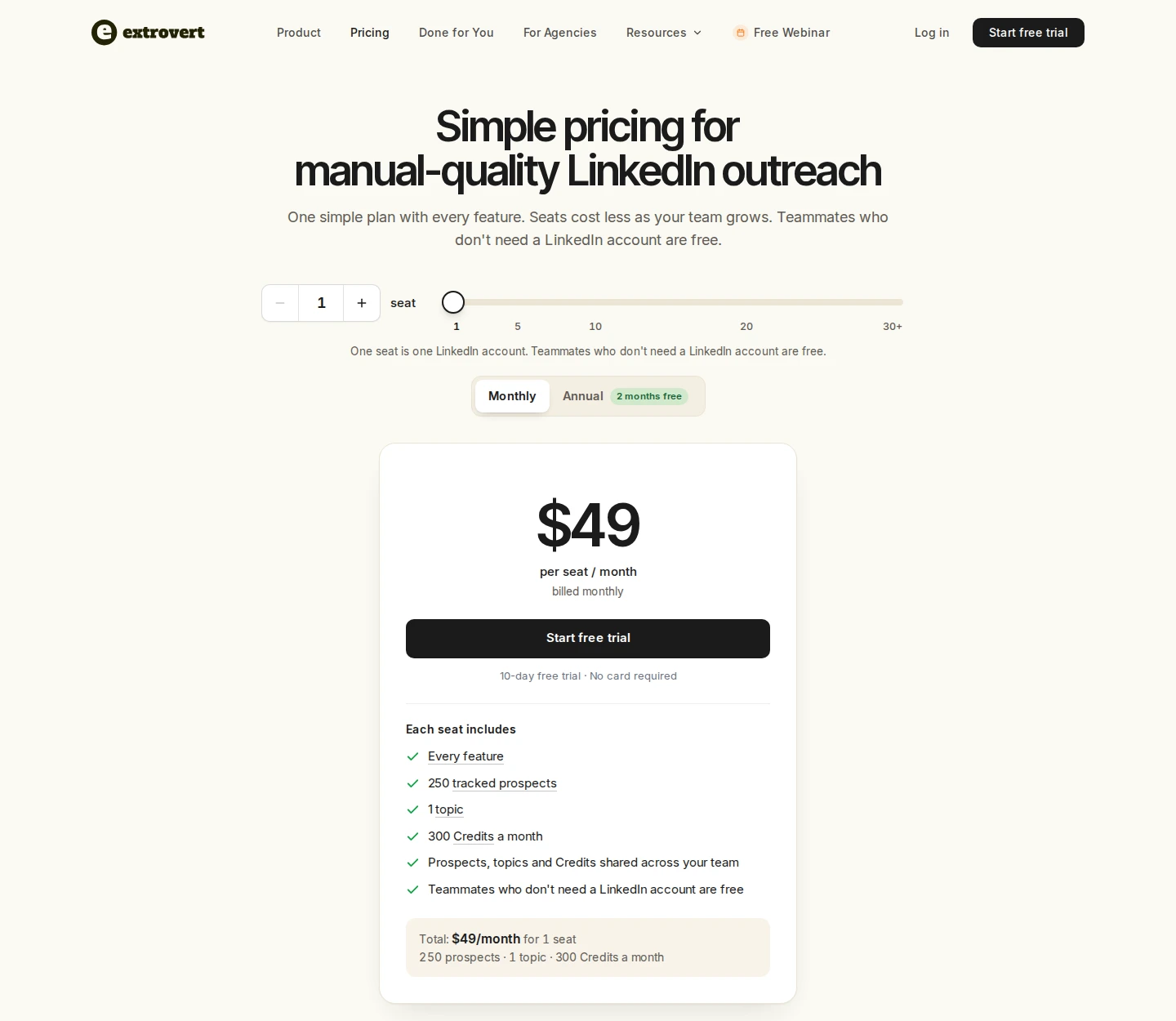
Monthly pricing for one LinkedIn account, with seat, billing, and capacity controls retained. Open the image for the full-size capture.
Scope: LinkedIn relationship building, discovery, and follow-up. Extrovert does not run your website forms, paid advertising, or email marketing program. A steady engagement cadence is central to this workflow.
2. Semrush for content planning and search visibility
Semrush helps a demand generation team find buyer questions, compare competing pages, and decide which content deserves attention. Keyword research and competitor analysis inform the editorial plan; Position Tracking and Site Audit show whether the pages are visible and technically accessible.
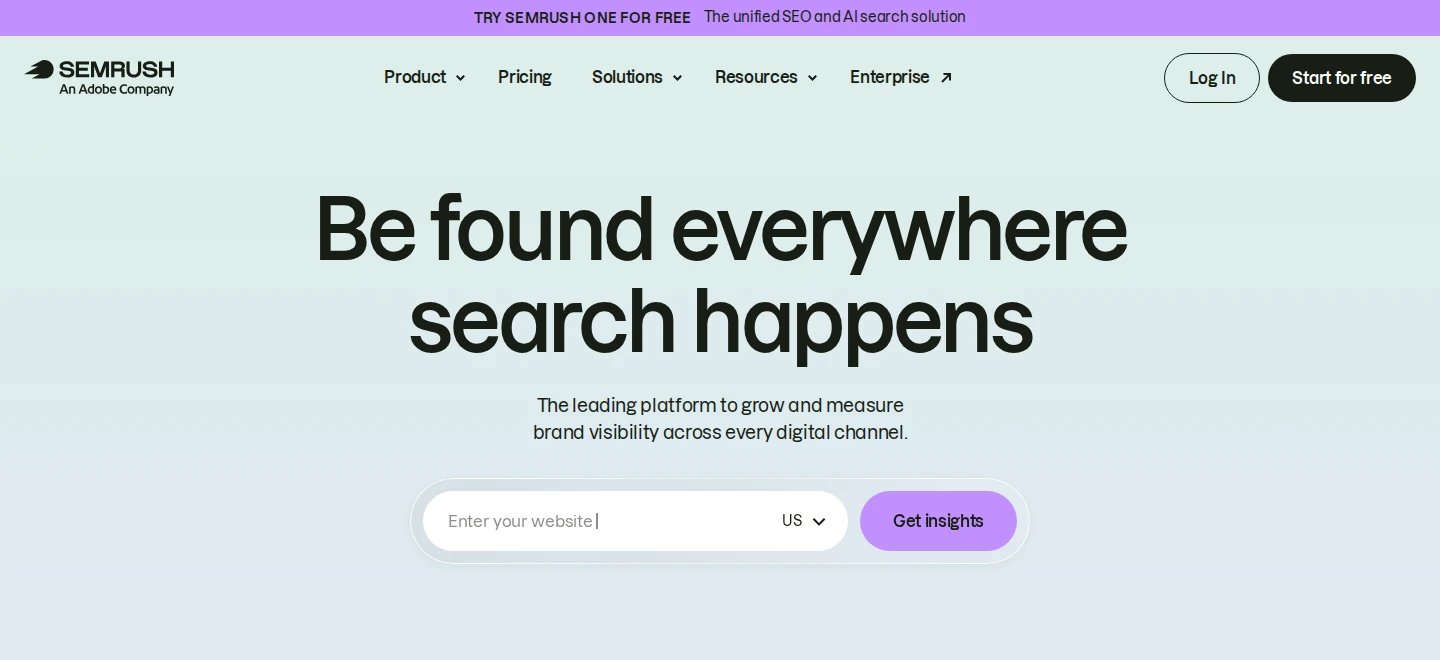
Semrush's official homepage. Open the image for the full-size capture.
The entry SEO plan covers keyword and competitor research, position tracking, and site auditing. Pro+ adds historical data, content optimization, and keyword cannibalization analysis. Higher AI-search allowances and other toolkits depend on the package. A content team still needs subject-matter expertise and a distribution plan; a keyword list is only the research input.
Pricing: the USD plans list SEO at $139/month on monthly billing, Starter at $199, and Pro+ at $299. The annual EUR selection below shows SEO at €112.52/month, Starter at €158.40, and Pro+ at €238, billed annually. SEO includes five monitored websites and 500 tracked keywords. Currency, billing period, and toolkit scope matter when budgeting.
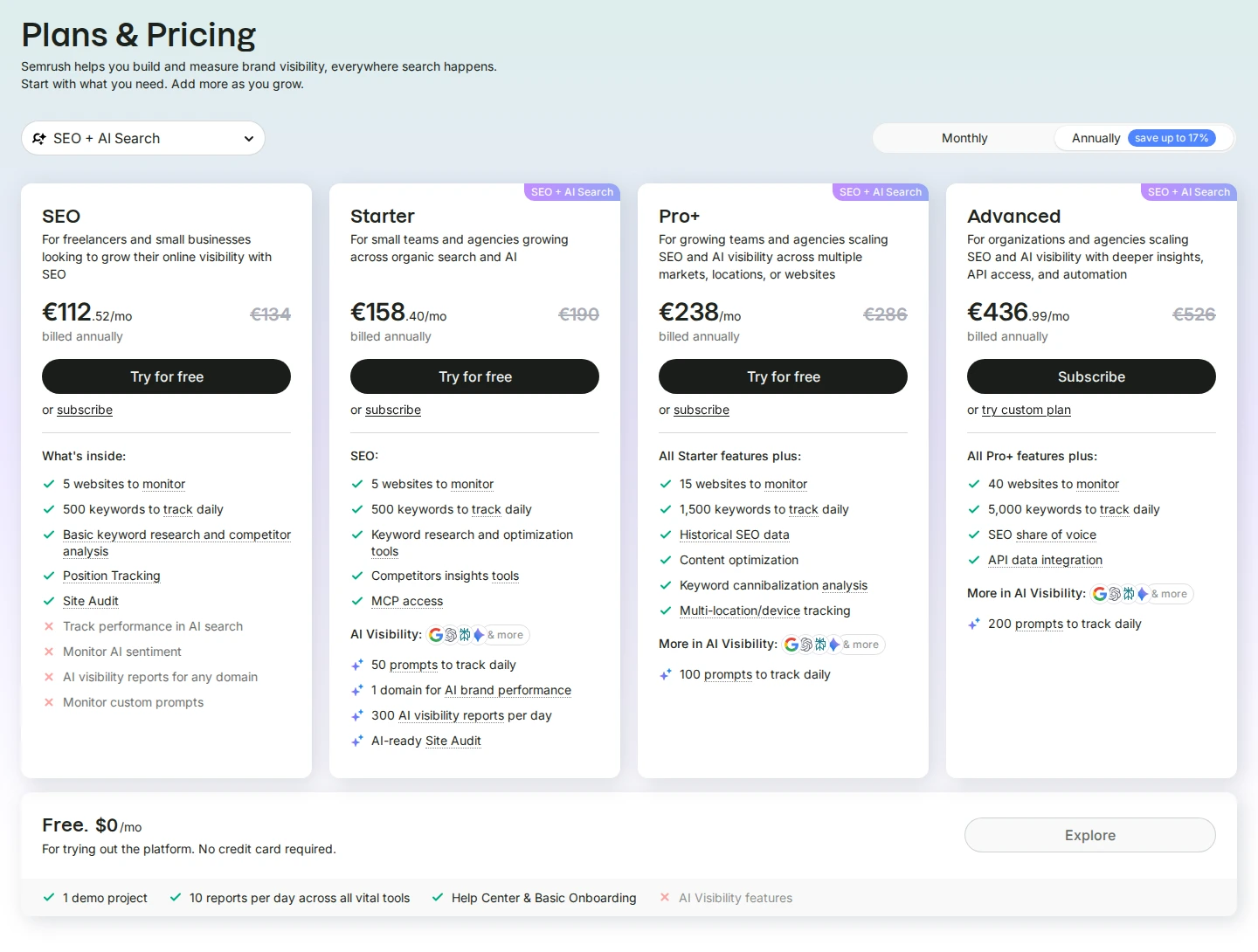
Annual EUR pricing, with the plan names and billing selector retained. Open the image for the full-size capture.
What to measure: visibility for relevant buyer searches, qualified traffic, and the conversations or opportunities that content supports. Rankings alone do not tell you whether the audience fits.
3. Livestorm for webinars and replay follow-up
Livestorm handles the event workflow around educational webinars: registration pages, reminders, browser-based live sessions, polls, Q&A, and recordings. On-demand replays let people learn after the live session, while UTM tracking and exports connect participation to campaign reporting.
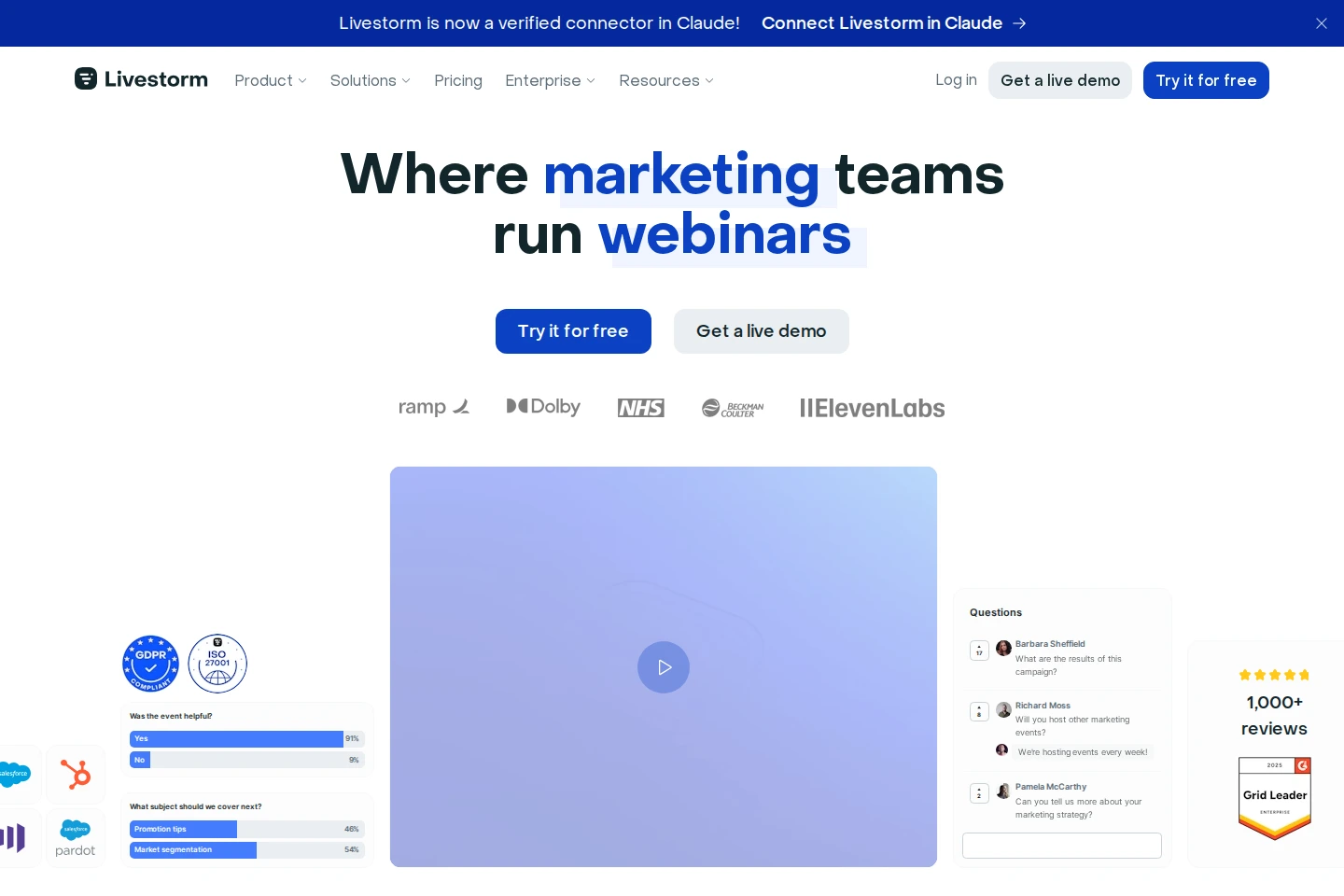
Livestorm's official homepage. Open the image for the full-size capture.
Use a topic that attracts the right audience, then follow up based on how people participated. Registration, attendance, questions, and replay viewing give the team different reasons to continue the conversation. HubSpot appears among standard integrations; Salesforce, Marketo, Pardot, and Microsoft Dynamics are listed with Enterprise integrations.
Pricing: at the 400-attendee-credit selection, Pro displays $3 per attendee credit. Credits are purchased as a yearly pack and used over 12 months. An external participant consumes one credit for each distinct session attended, live or on demand; live attendance plus replay of the same session counts once. No-shows and internal team members do not consume attendee credits. Enterprise is custom-priced.
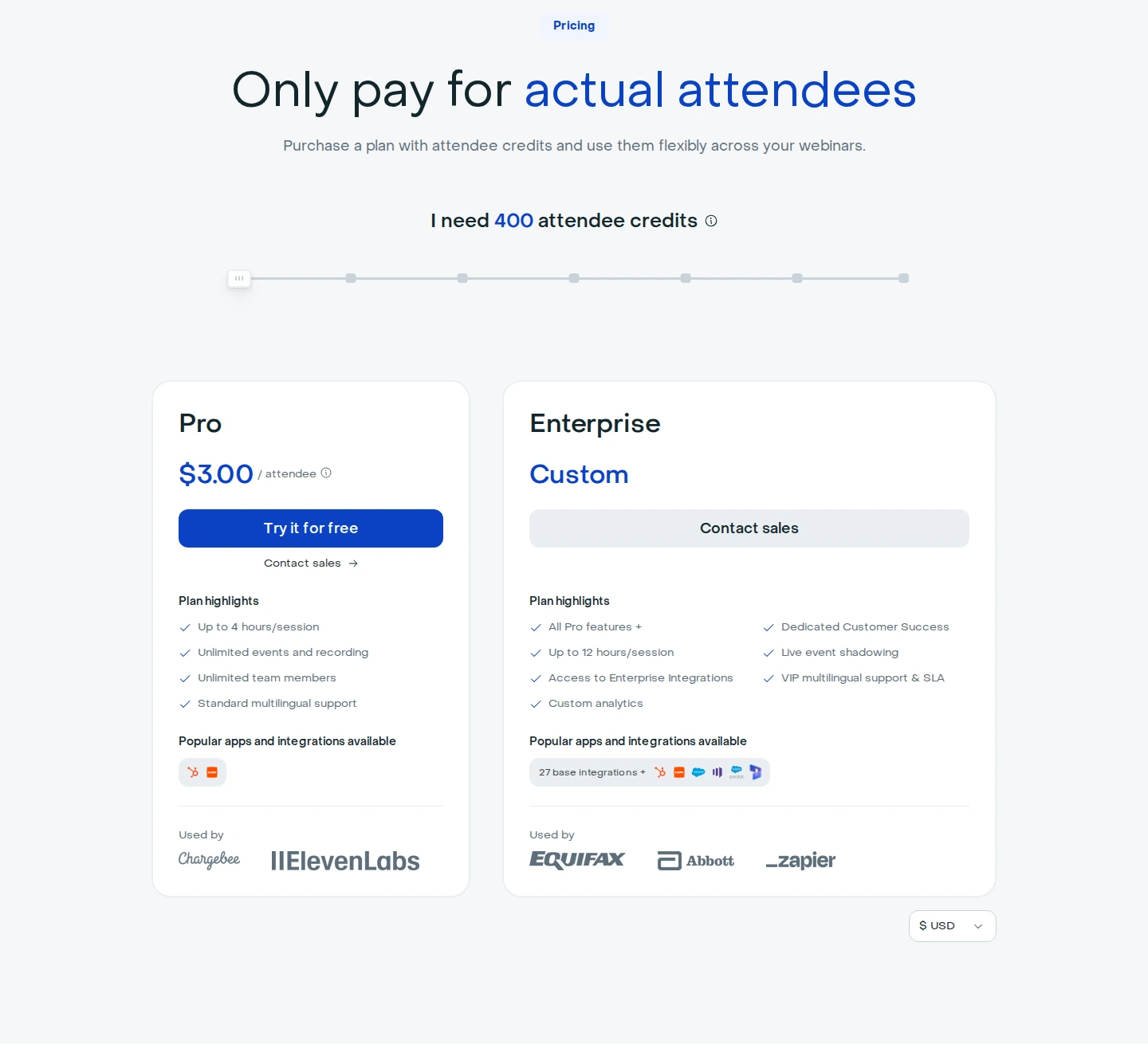
The attendee-credit selection matters: $3 is the displayed rate at 400 credits, not a universal monthly subscription price. Open the image for the full-size capture.
Operating requirement: forecast repeat participation across separate sessions and assign the replay and follow-up work. A registration total tells you less than who attended, what they asked, and what happened next.
4. Storylane for self-guided interactive demos
Storylane lets a SaaS team publish a clickable product tour on a campaign or product page. Buyers can explore a workflow before booking a meeting, and the team can see demo engagement rather than rely only on a page view.
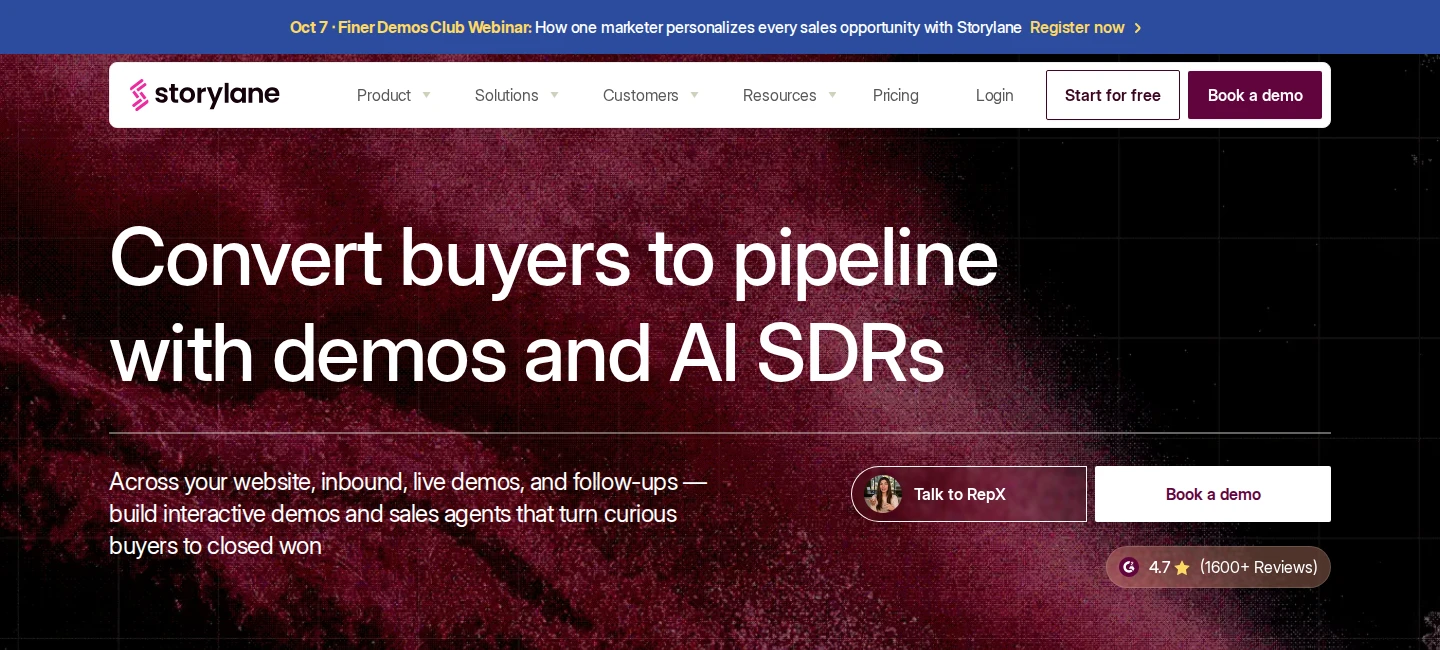
Storylane's official homepage. Open the image for the full-size capture.
Screenshot and video tours are available in its Demo Suite. Starter adds branding, HubSpot and Zapier integrations, alerts, and account reveal. Growth adds editable HTML demos, personalization tokens, and A/B testing. That distinction matters if you need an editable product experience rather than a guided sequence of captured screens.
Pricing: Free includes one seat, one published demo, and unlimited demo views. Starter is $50/month on monthly billing or $40/month billed annually, with one seat and unlimited published demos. Growth is $625/month monthly or $500/month billed annually, with five seats and HTML editing. These are Demo Suite prices; RepX is separate packaging.
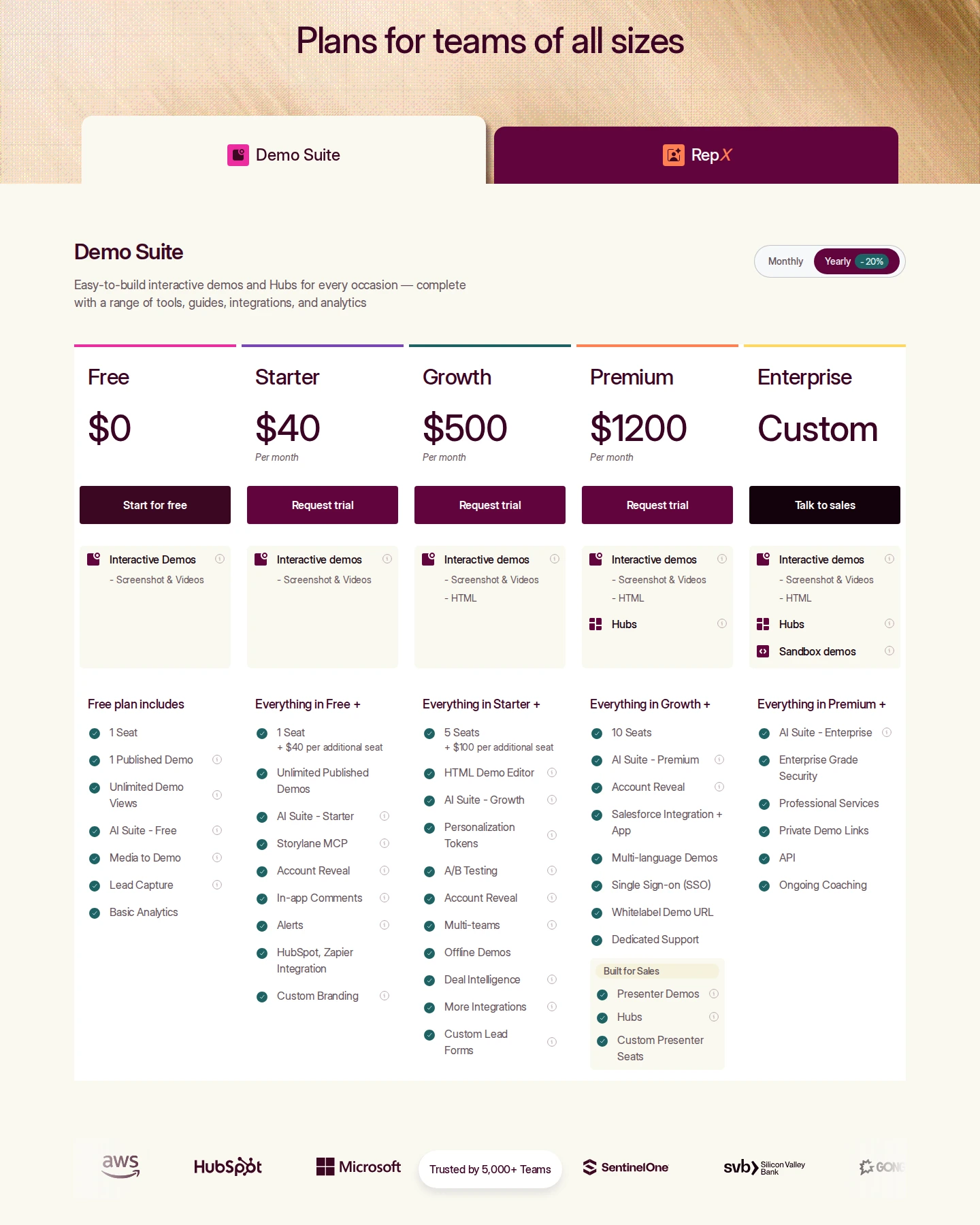
Demo Suite plans with annual billing selected; the displayed monthly rates reflect that commitment. Open the image for the full-size capture.
Operating requirement: keep tours current as the product changes. Track completion, useful interactions, and qualified next steps, not only total demo views.
5. HubSpot for CRM-connected marketing campaigns
HubSpot Marketing Hub connects forms, landing pages, email, ads, and automation to CRM records. Marketing and sales can work from the same contact history rather than maintain separate campaign and sales databases.
Capabilities include visual nurture workflows, lead scoring, ad audience sync, and reporting. Its enrichment and buyer-intent capabilities developed from the former Clearbit business within HubSpot's Breeze offering. Advanced attribution and automation depend on the tier and connected data. The platform supports integrations with other systems, including Salesforce; it is not limited to teams using HubSpot as their only CRM.
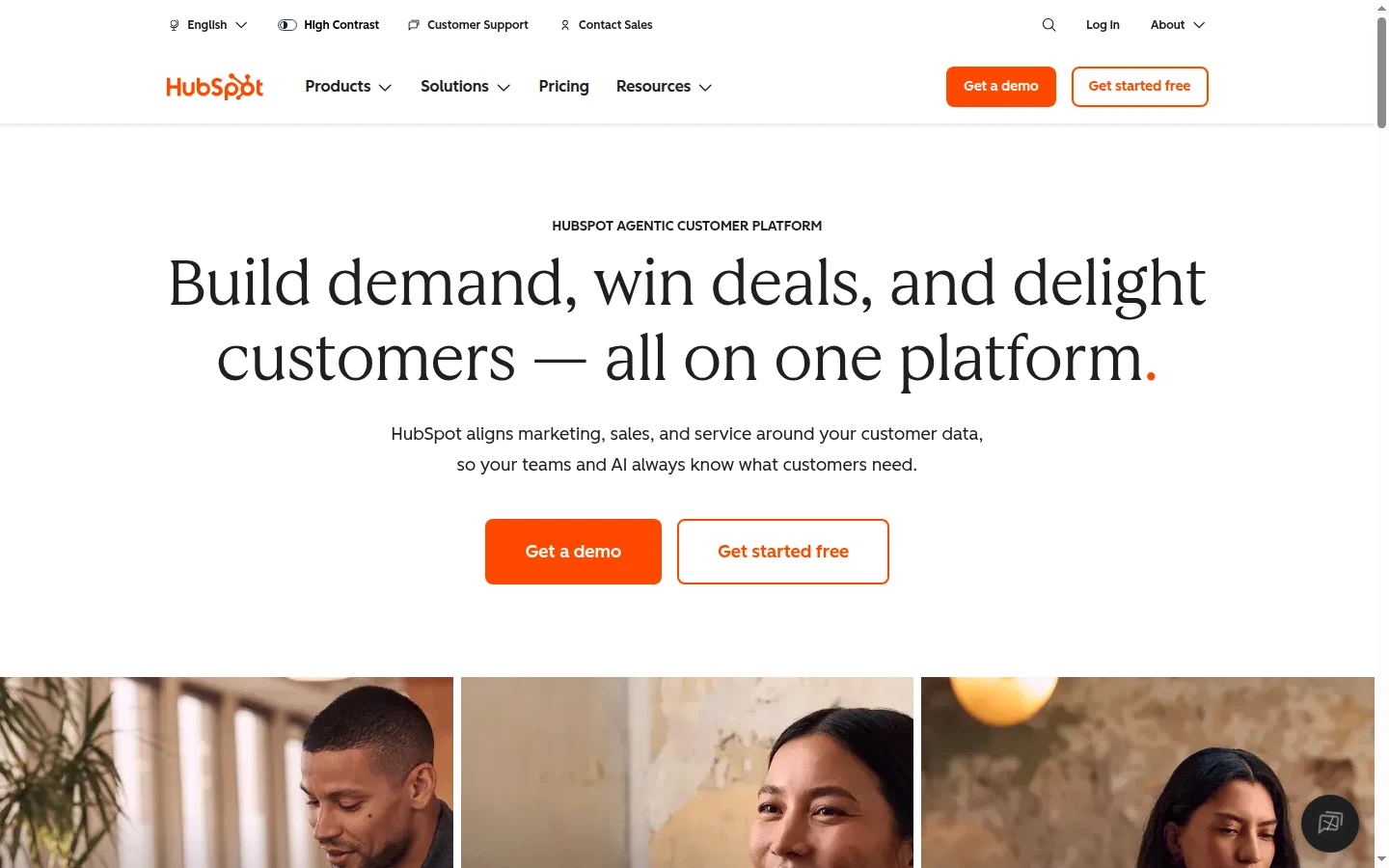
HubSpot's official homepage. Open the image for the full-size capture.
Pricing: the unified platform pricing below shows Free at €0/month, Starter at €7/seat/month under a limited-time offer, Professional at €90/seat/month, and Enterprise at €175/seat/month, with annual billing selected. Free supports up to two users. Package scope, marketing contacts, Credits, and any required onboarding affect the total; the entry seat rate is not a budget for every campaign capability.
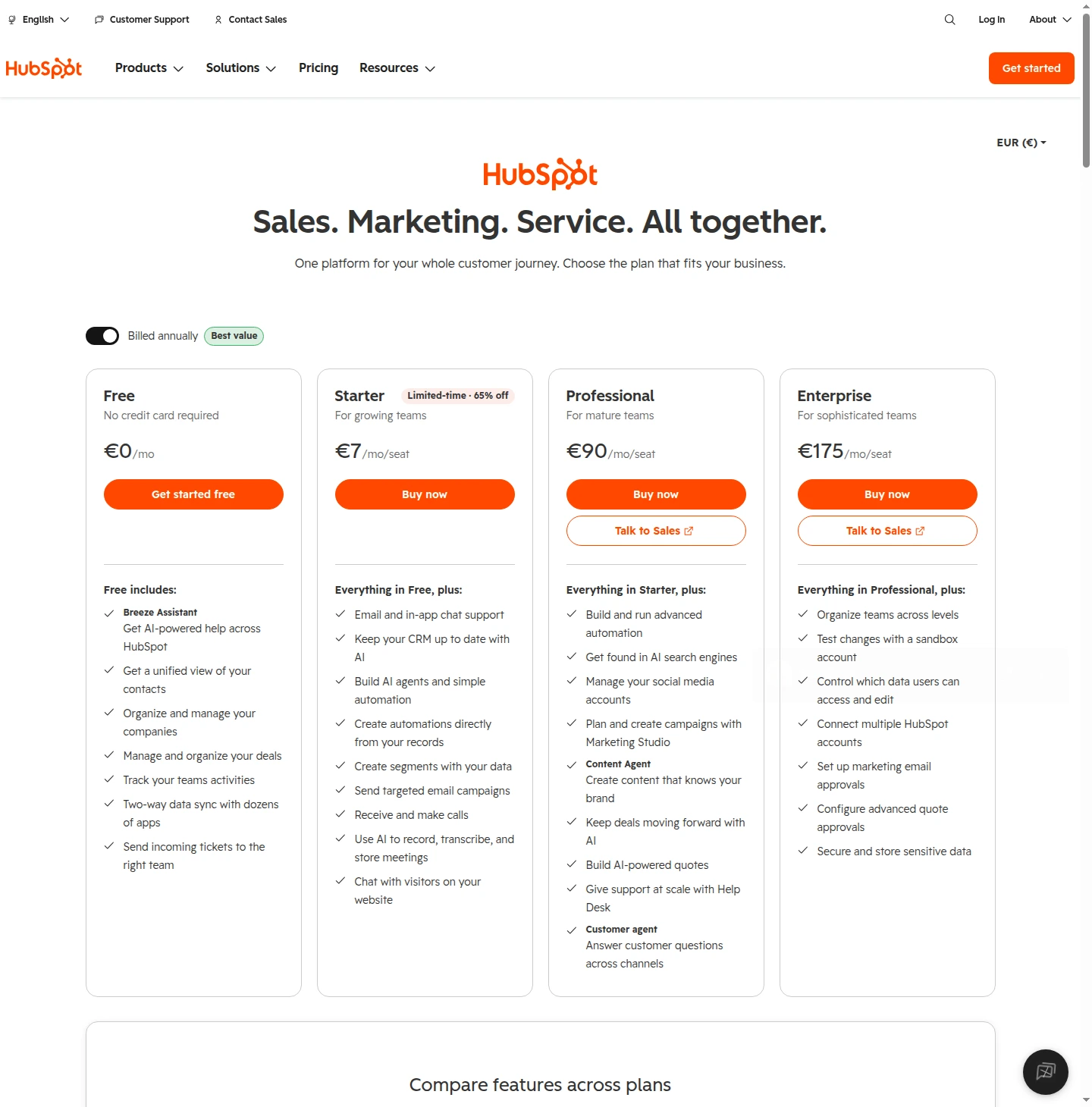
HubSpot's unified platform pricing in EUR, with annual billing selected. Open the image for the full-size capture.
Trade-off: compare the cost at your actual contact count, required reporting tier, and seat mix.
6. Mutiny for personalized ABM pages and campaign assets
Mutiny creates customer-facing assets from account context and approved messaging. Its ABM workflow includes one-to-one landing pages, one-to-many campaigns, personalized event invites, and account briefs with news and stakeholder context.
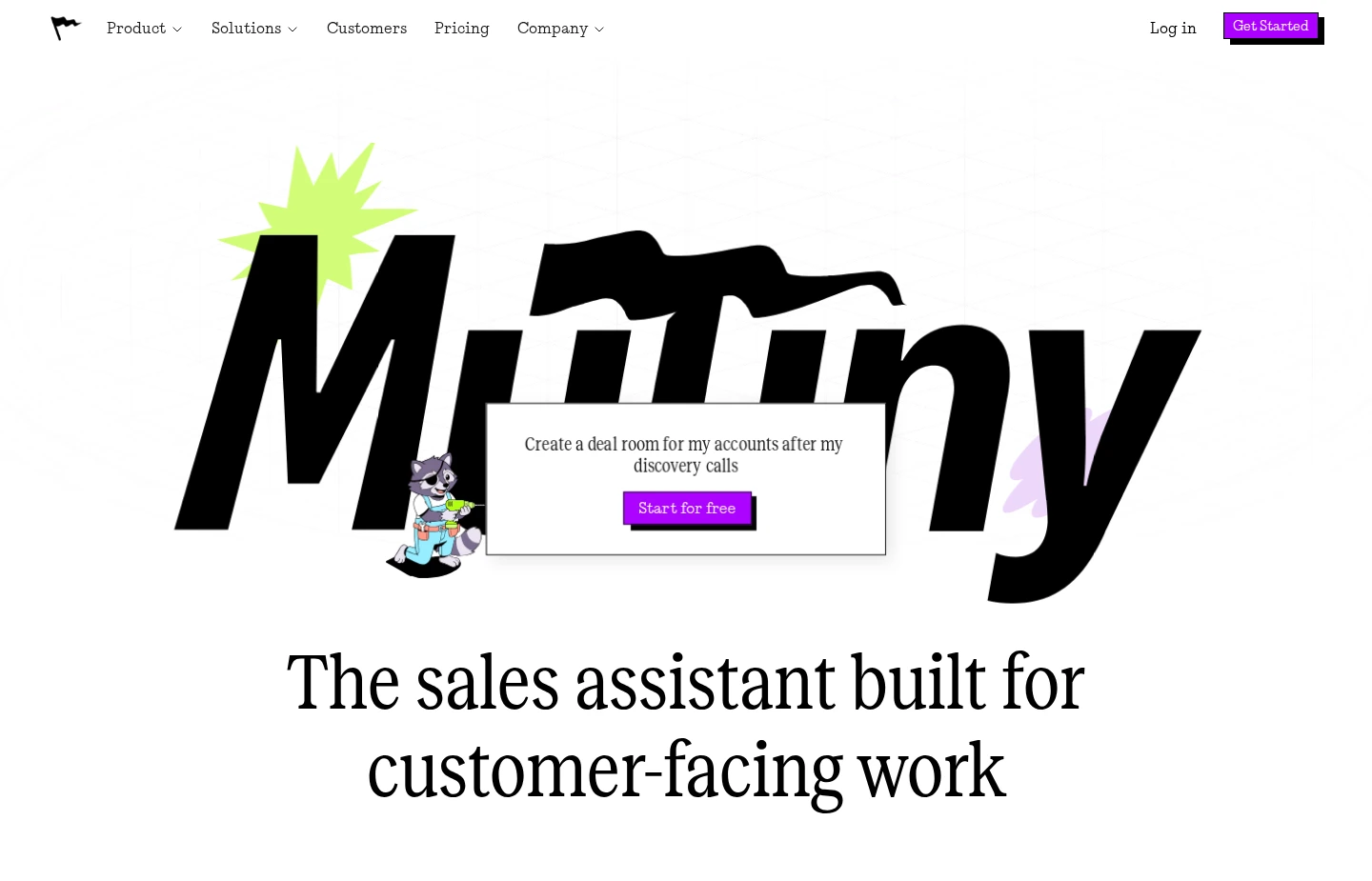
Mutiny's official homepage. Open the image for the full-size capture.
After selecting accounts, prepare a relevant page or asset, distribute it through the campaign, then review engagement. Its current product also covers personalized decks and deal rooms. Review the account inputs and message before distributing generated assets.
Pricing: Free is $0/month for up to five team members. Business displays $50/month at the 50-credits-per-month selection, with unlimited team members, integrations, a custom subdomain, and asset password protection. Enterprise starts at $40,000/year and adds SSO, dedicated onboarding and strategy support, and Salesforce integration. Business is credit-selected, not a $50-per-seat plan.
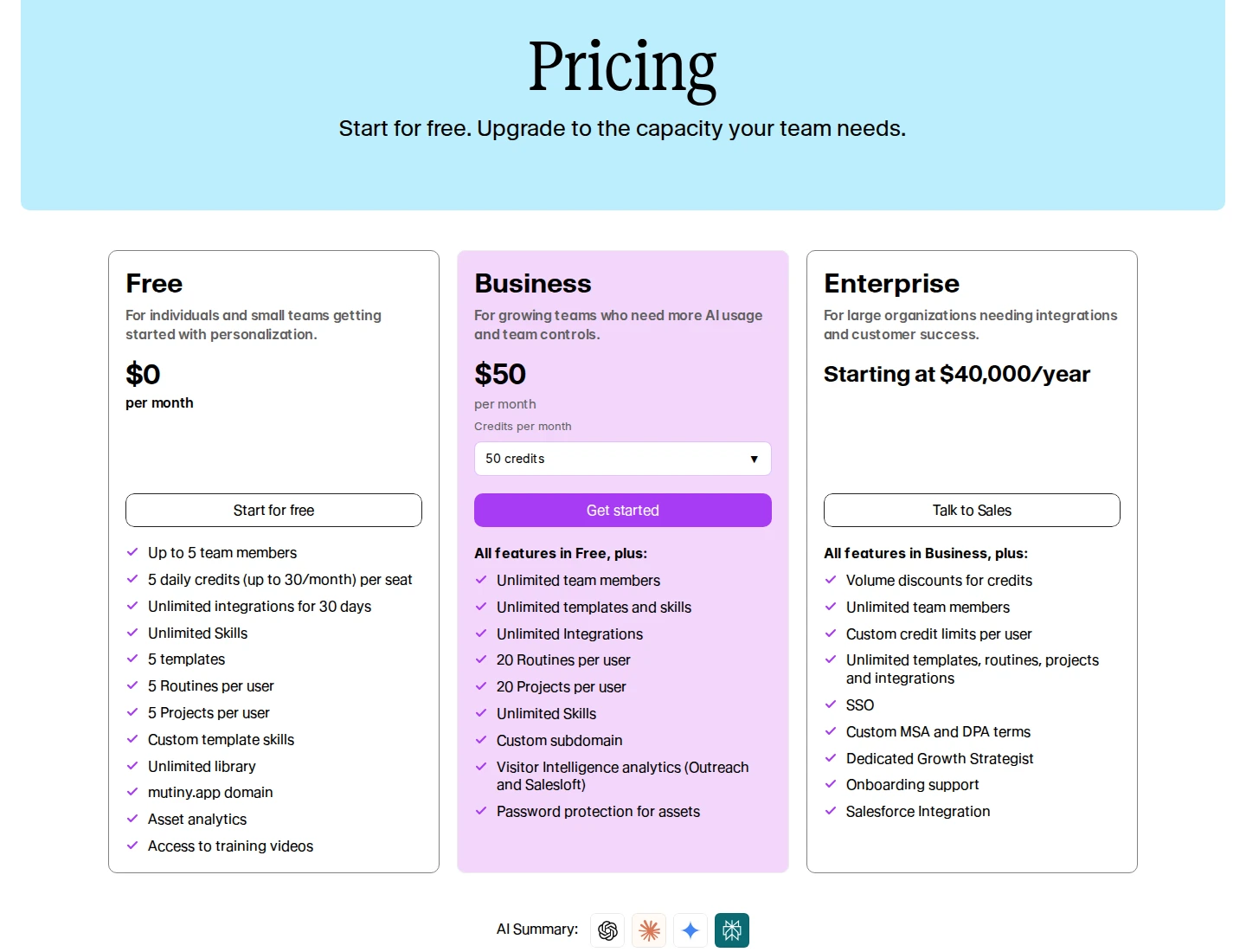
Mutiny pricing with the Business credit selector retained. Open the image for the full-size capture.
Scope: personalized campaign assets and engagement reporting. Do not assume the entry plan automatically rewrites an existing website for every anonymous visitor.
7. 6sense for enterprise account intent and predictive scoring
6sense combines first- and third-party signals with predictive account scoring. Its Signalverse is described as processing a trillion-plus daily intent signals, giving revenue teams account-level context before a buyer identifies themselves through a form.
Marketing and sales capabilities include intent data, account prioritization, email agents, audience building, advertising, workflow orchestration, and CRM integrations. The platform also offers conversational account intelligence and Salesforce-embedded insights. Explainable scoring helps teams understand why an account received priority.
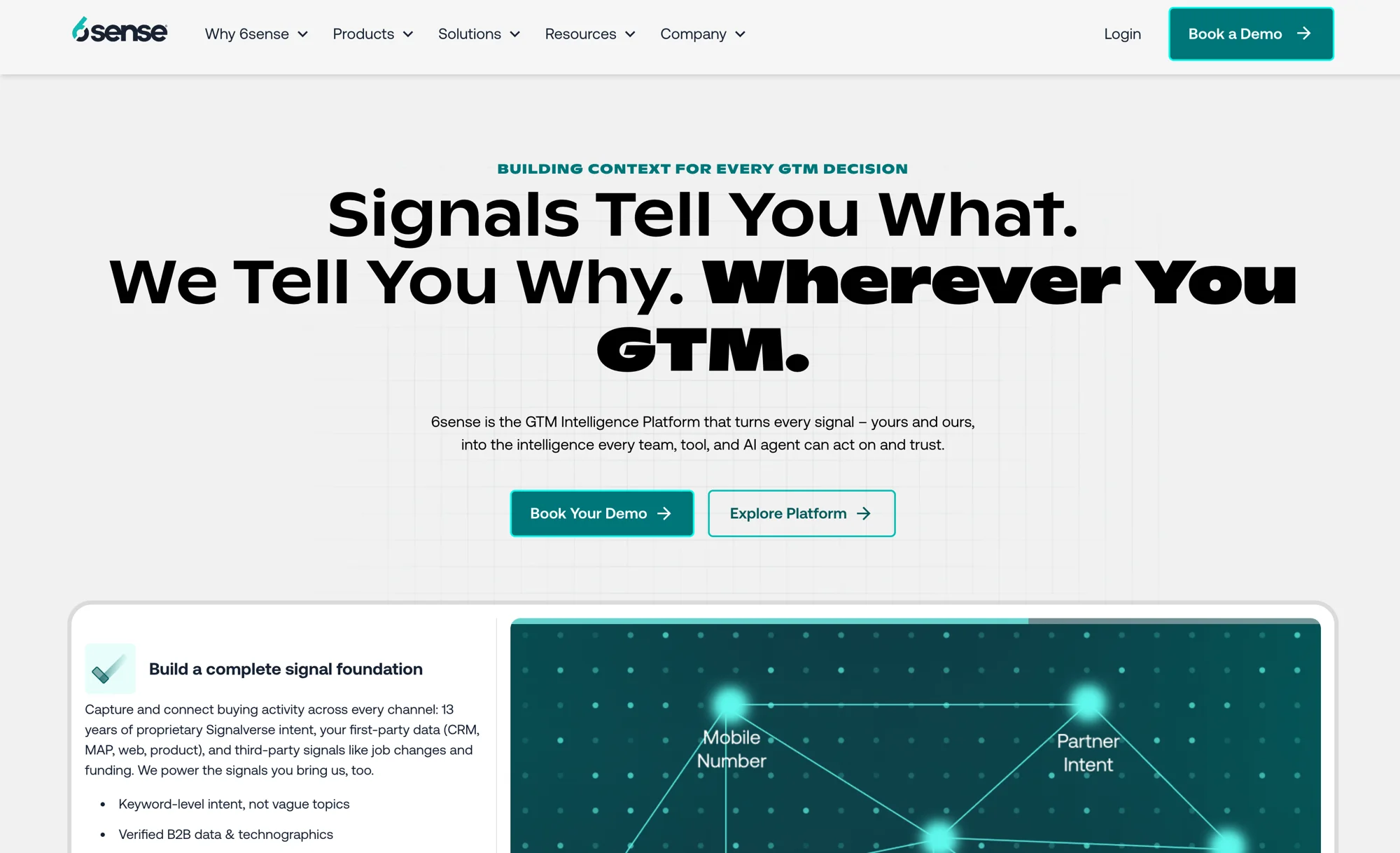
Pricing: custom enterprise contracts, with no public platform list price. Third-party contract trackers report annual commitments well into five figures; these are estimates, not a quote for your configuration.
Operating requirements: a structured ABM program and people to manage data, setup, training, and campaign design. Reviewers describe an ongoing learning curve. 6sense has reported Gartner Magic Quadrant leadership across five consecutive reports.
8. Demandbase for ABM, account data, and advertising
Demandbase brings intent data, sales intelligence, advertising, and account-level measurement into one platform. Its B2B-native demand-side platform uses account data for advertising rather than relying solely on a consumer-oriented targeting model.
The product covers account identification, buying-group intelligence, proprietary intent data, real-time account activity, cross-channel orchestration, and pipeline reporting. Demandbase describes its DSP as the only B2B-native demand-side platform.
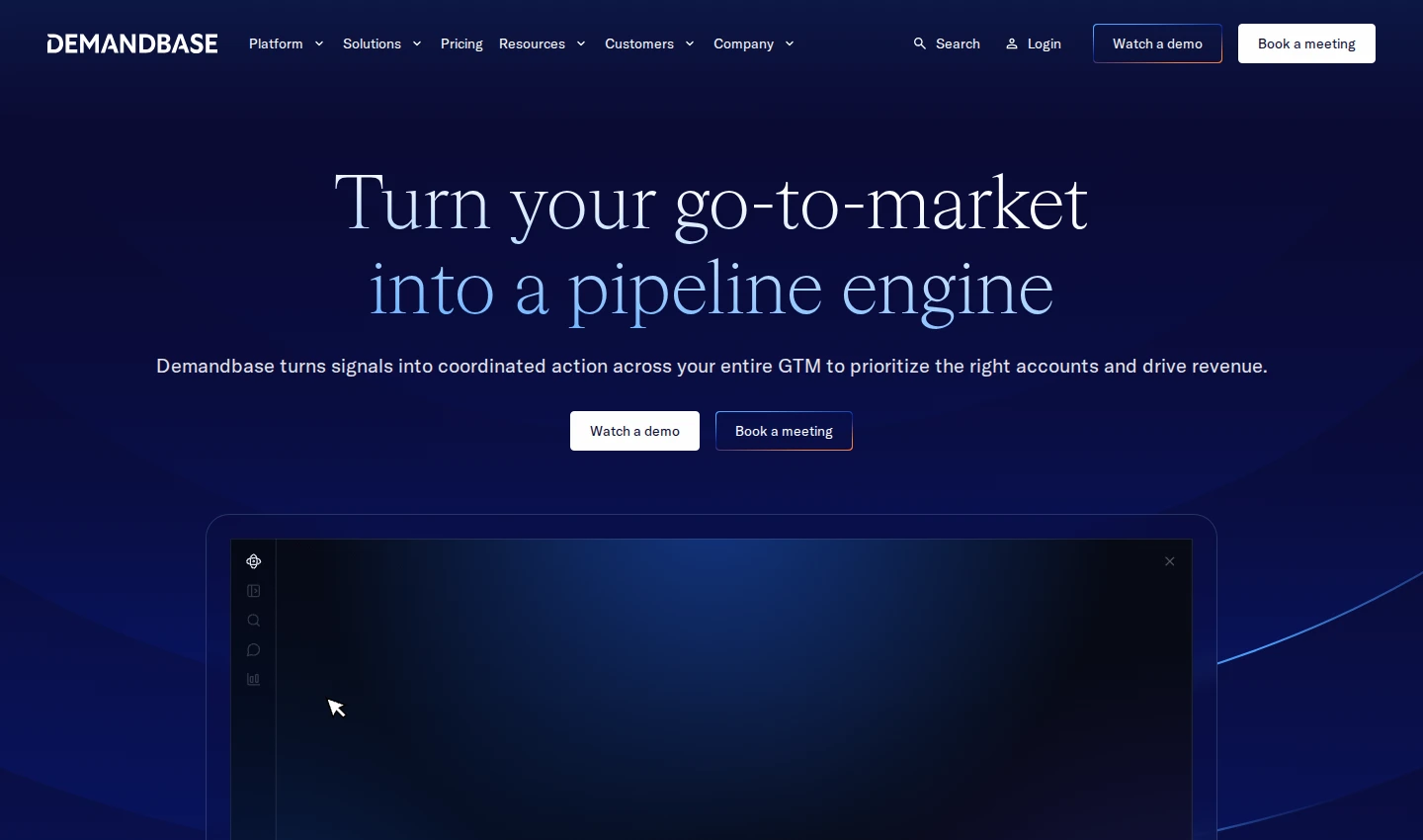
Demandbase's official homepage. Open the image for the full-size capture.
Pricing: sales-negotiated enterprise contracts. Third-party trackers have reported median annual contracts around $65,000; actual scope, services, and advertising budget determine the purchase price.
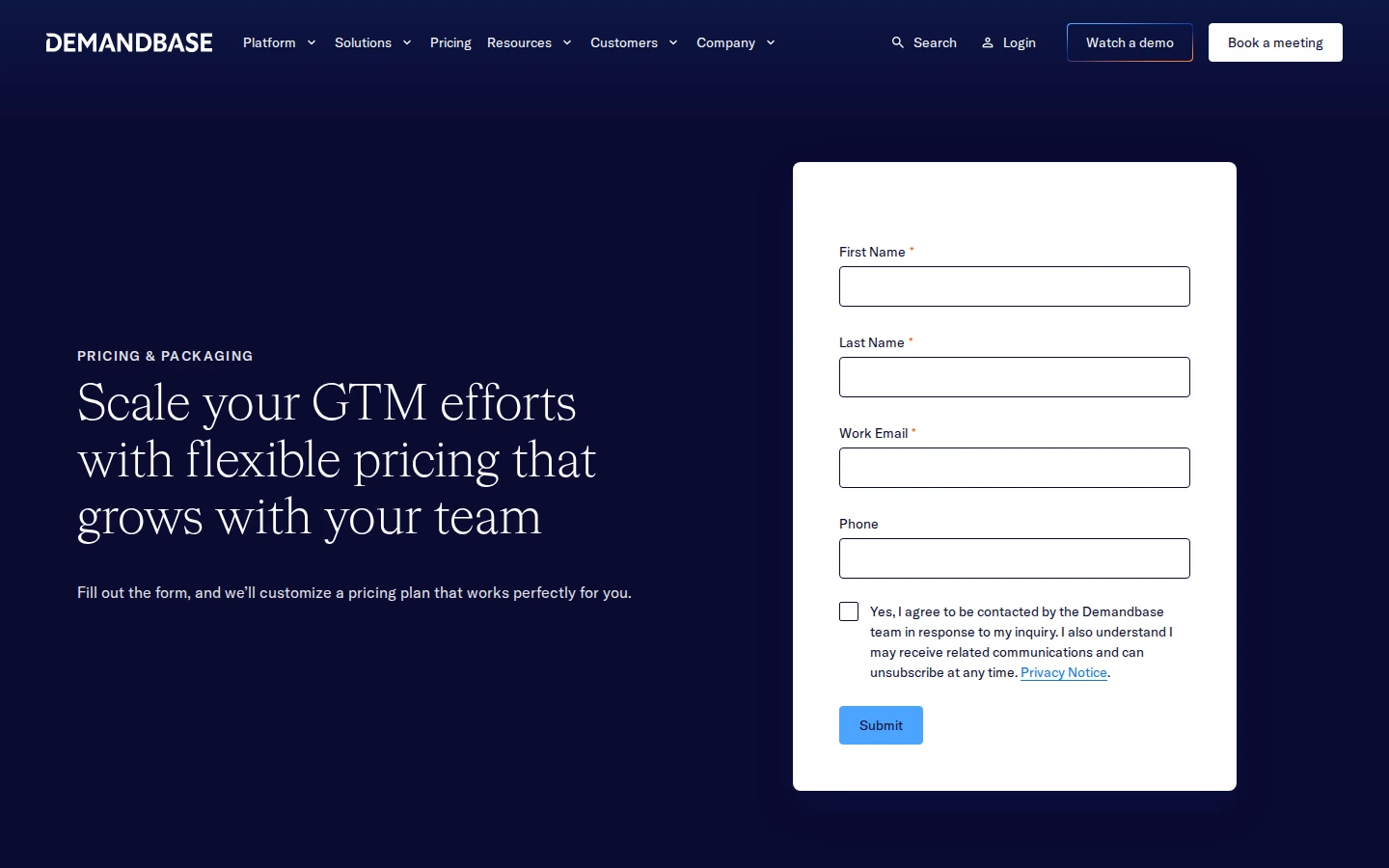
Demandbase's official pricing section. Open the image for the full-size capture.
Operating requirements: account definitions, connected CRM data, campaign ownership, and advertising operations. Public product tours exist, but they are not a self-serve production subscription.
9. ZoomInfo for contact data and account signals
ZoomInfo combines company and contact data, direct-dial numbers, firmographics, technographics, and intent intelligence. Hiring, funding, and leadership changes add context to account prioritization. Its extension, enrichment tools, routing, and workflow capabilities support high-volume prospecting and database maintenance.
For B2B sales teams, the distinction is between finding a contact and building a relationship with that person. Enriched records can feed your target list; Extrovert helps maintain relevant LinkedIn contact with the people on it.
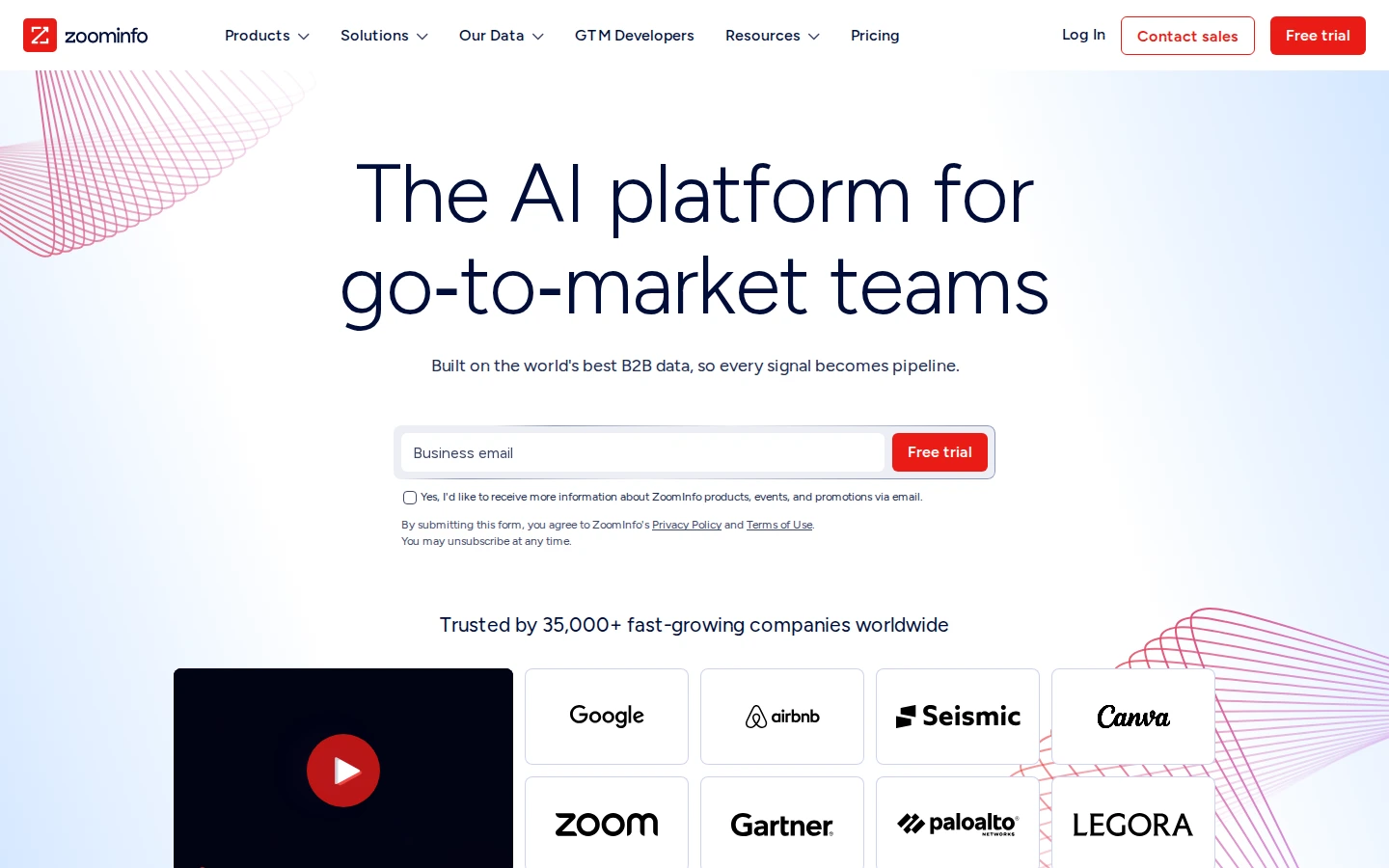
ZoomInfo's official homepage. Open the image for the full-size capture.
Pricing: a Lite offering and trial access exist; paid packages are custom-quoted. Third-party trackers estimate typical annual spend from roughly $15,000 to $30,000-plus, rather than a guaranteed entry price.
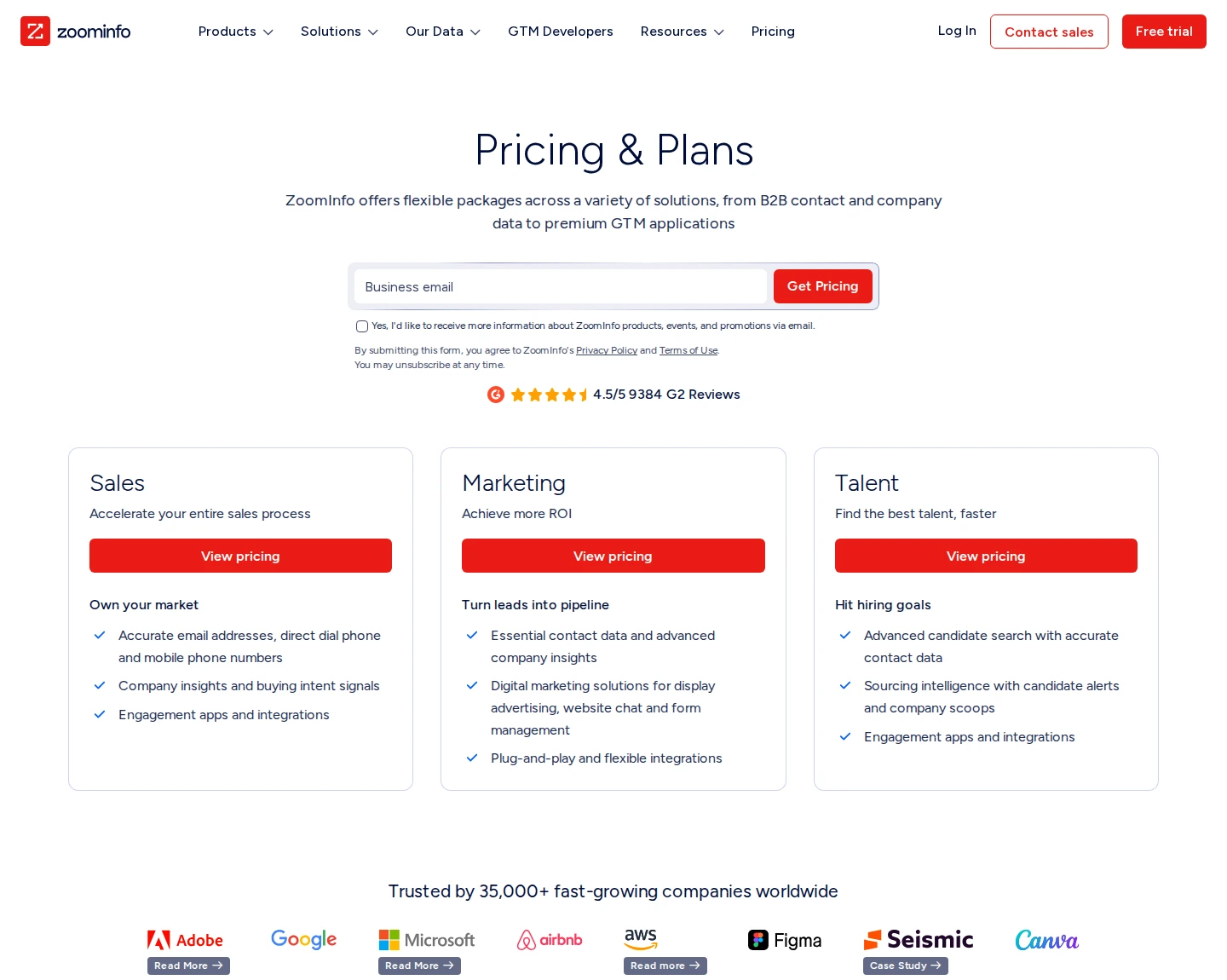
ZoomInfo's official pricing section. Open the image for the full-size capture.
Trade-off: contact information can lag after role changes, so a verified record should not be treated as permanently accurate. Its US coverage is a particular strength. Check your target geography, refresh process, access limits, and renewal terms before setting the budget.
10. Apollo for contact search, sequences, and calling
Apollo combines a contact database with prospecting filters, email sequences, intent topics, CRM enrichment, job-change enrichment, and calling. Its database includes 210 million-plus contacts across 60 million-plus companies, alongside a Bombora-powered intent layer.
Sequence testing, integrations, and phone workflows sit in the same workspace. Parallel dialing is part of the Advanced Dialer add-on, rather than an entitlement included in every entry subscription. Apollo's official pricing page reports a 4.7/5 rating based on more than 9,000 reviews.
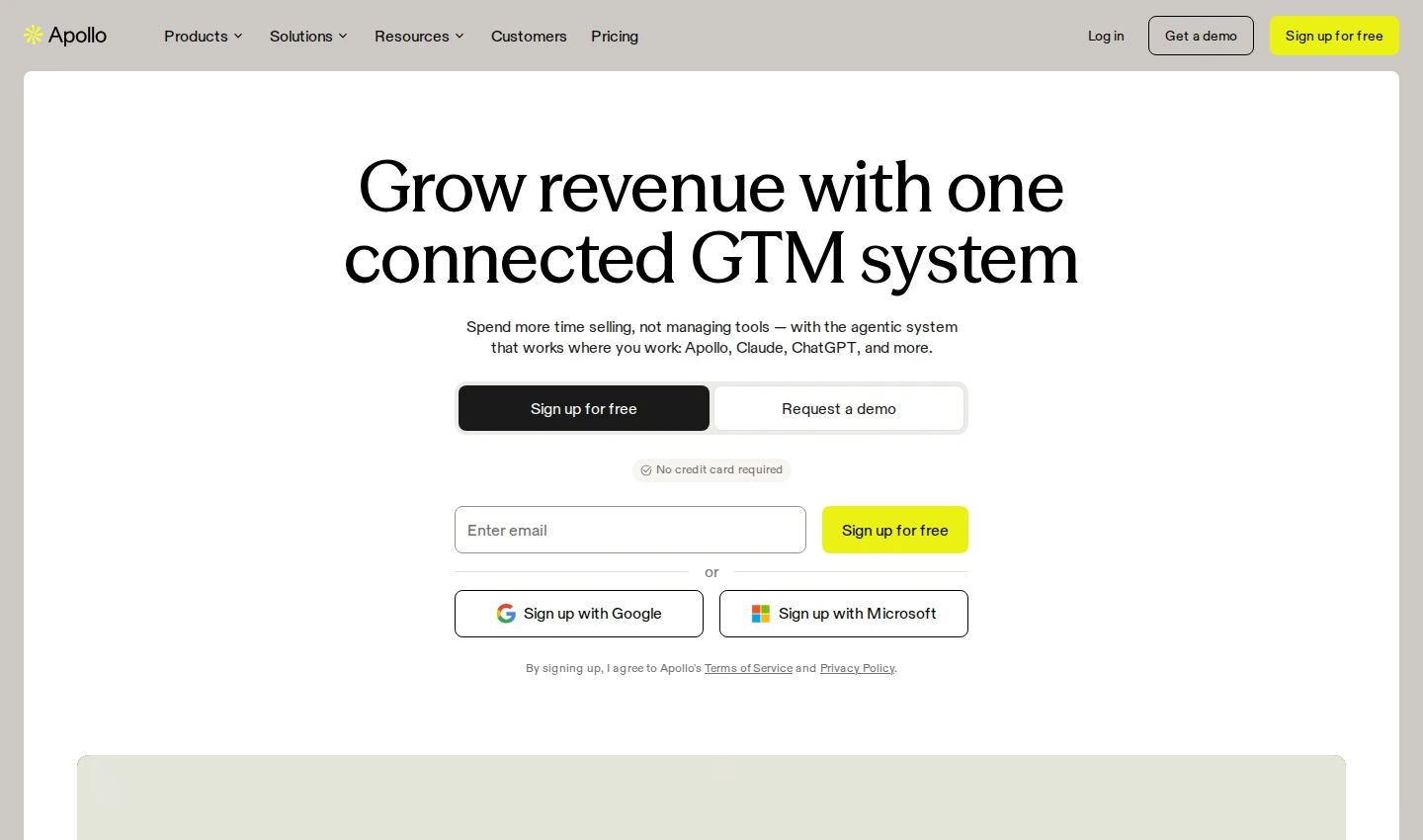
Apollo's official homepage. Open the image for the full-size capture.
Pricing: Free includes 900 Credits per seat per year, granted monthly. Annual plans list Basic at $49, Professional at $79, and Organization at $119 per seat per month; Organization has a three-seat minimum. Advanced Dialer is $119 per team per month with annual billing. Taxes are extra.
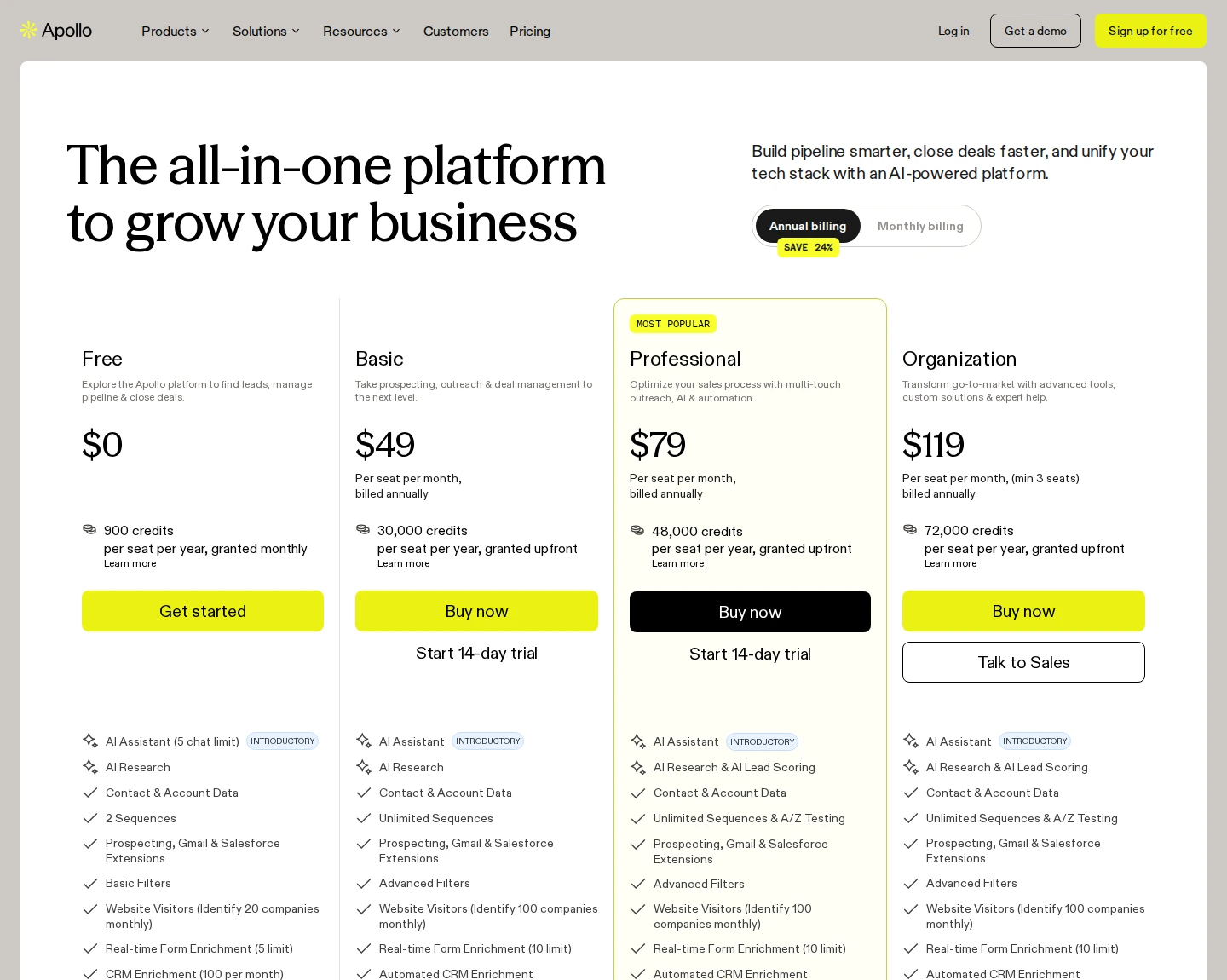
Apollo's official pricing section. Open the image for the full-size capture.
Trade-off: email access, phone numbers, enrichment, research, and calling consume Credits differently. The free tier does not offer unlimited email Credits. Data accuracy can be weaker outside North America, and unused Credits do not roll over; validate coverage and credit terms for the package you buy.
11. Clay for enrichment and AI account research
Clay chains data providers in waterfall enrichment and uses Claygents to research people and companies. Its spreadsheet-like workspace supports CRM sync, company and job-change signals, research, native email sequencing, and workflow automation.
The 150-plus provider ecosystem lets a team combine multiple sources instead of committing to one database. Waterfall enrichment can improve coverage, and AI research can reduce manual lookup work. Those outcomes depend on the providers and workflow you configure.
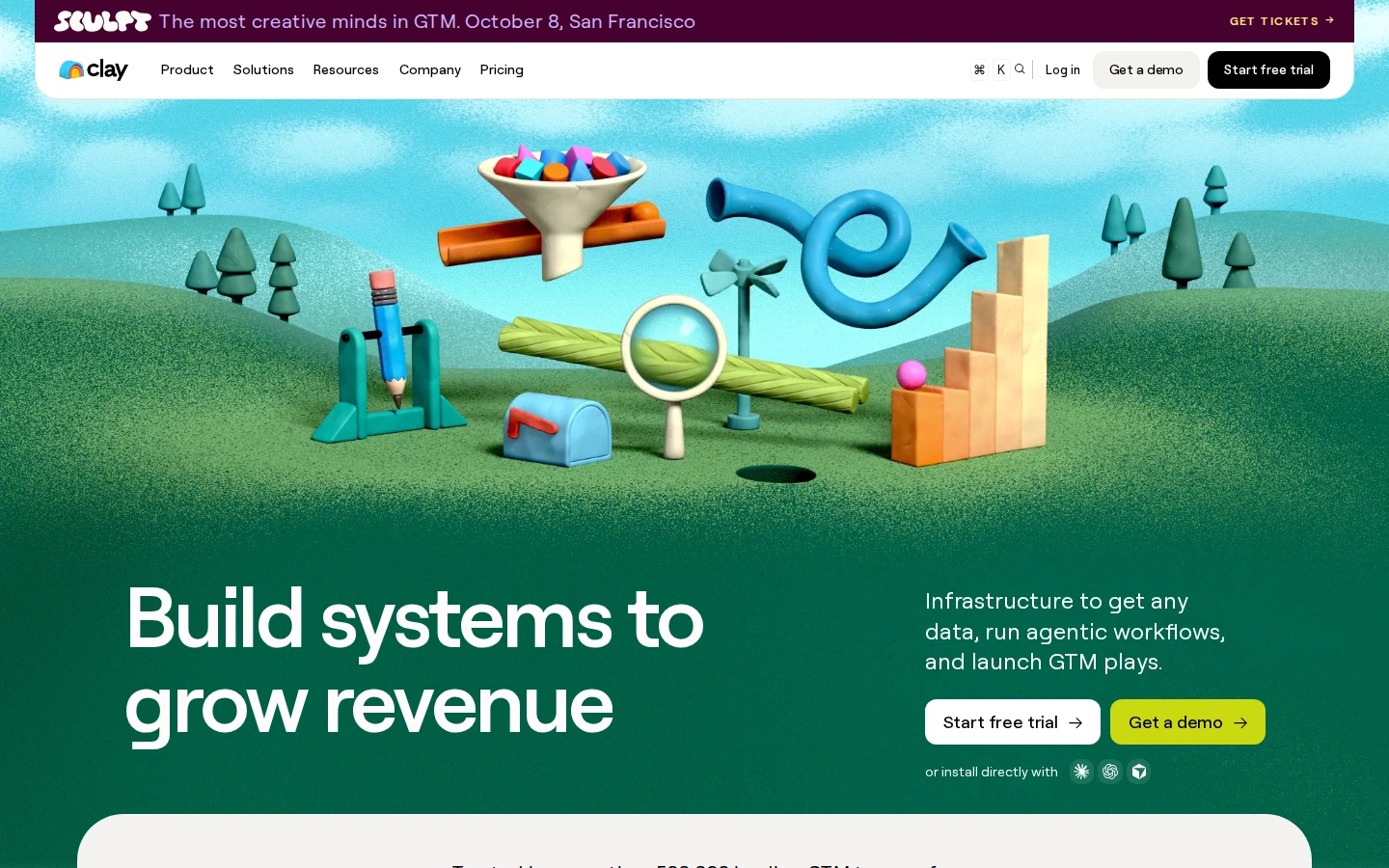
Clay's official homepage. Open the image for the full-size capture.
Pricing: Free includes 500 Actions and 100 Data Credits per month. Monthly Launch starts at $185 and Growth at $495; annual billing shows discounted starting prices. Actions pay for platform work; Data Credits pay for data and applicable AI use. Enterprise is custom-priced.
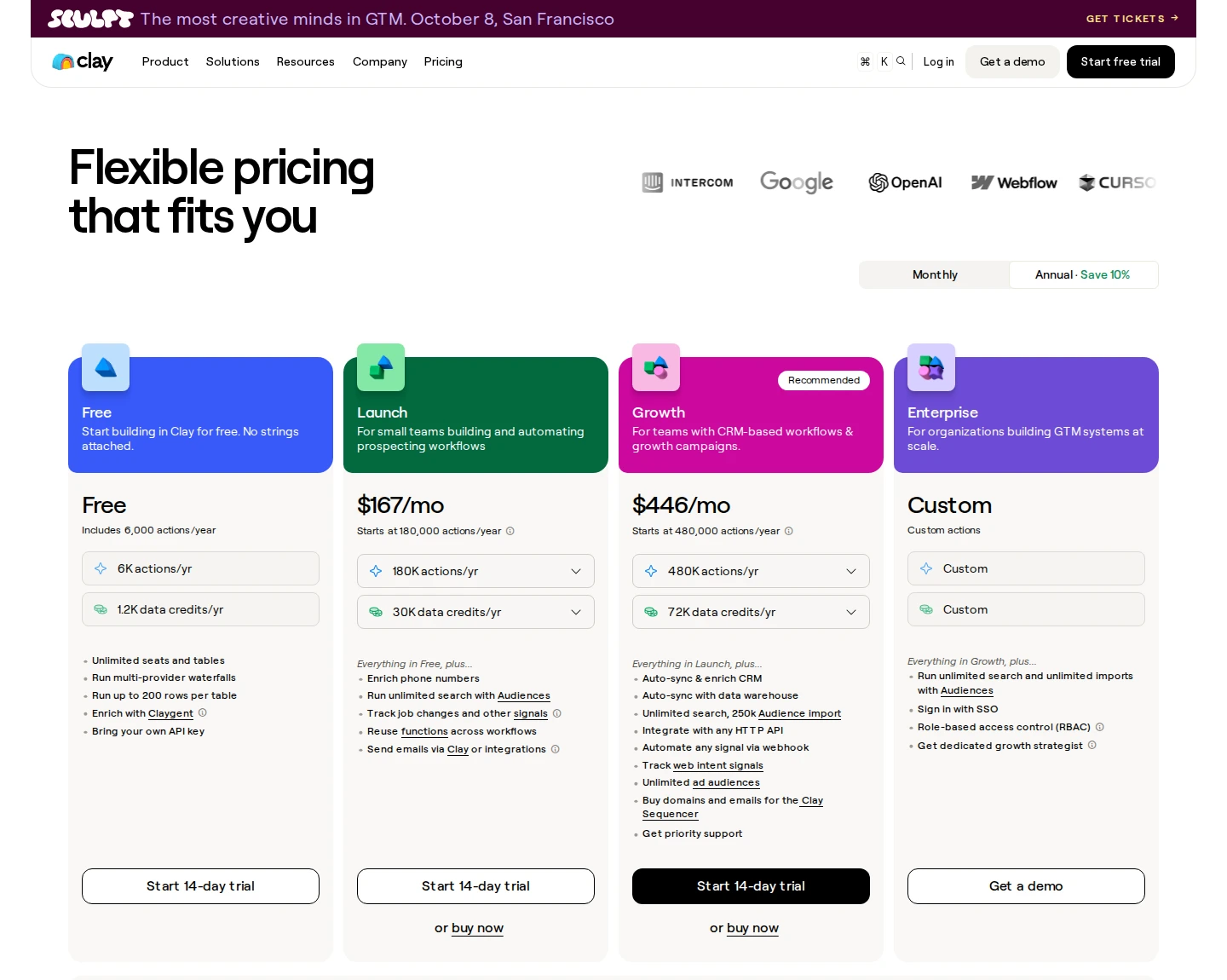
Clay's official pricing section. Open the image for the full-size capture.
Trade-off: this is a workflow-building platform, so someone needs to own provider selection, qualification logic, and usage costs. Unlimited seats do not mean unlimited enrichment.
12. Warmly for identified website visitors and inbound follow-up
Warmly identifies website visitors and combines that context with ICP scoring, buying-committee discovery, Slack and CRM alerts, routing, chat, and follow-up orchestration. Higher packages add AI chat and inbound automation; these are distinct from the entry visitor-identification package.
Its website announces that HubSpot is acquiring Warmly. Person-level identification, coverage, and follow-up permissions should be checked for your geography and traffic source.
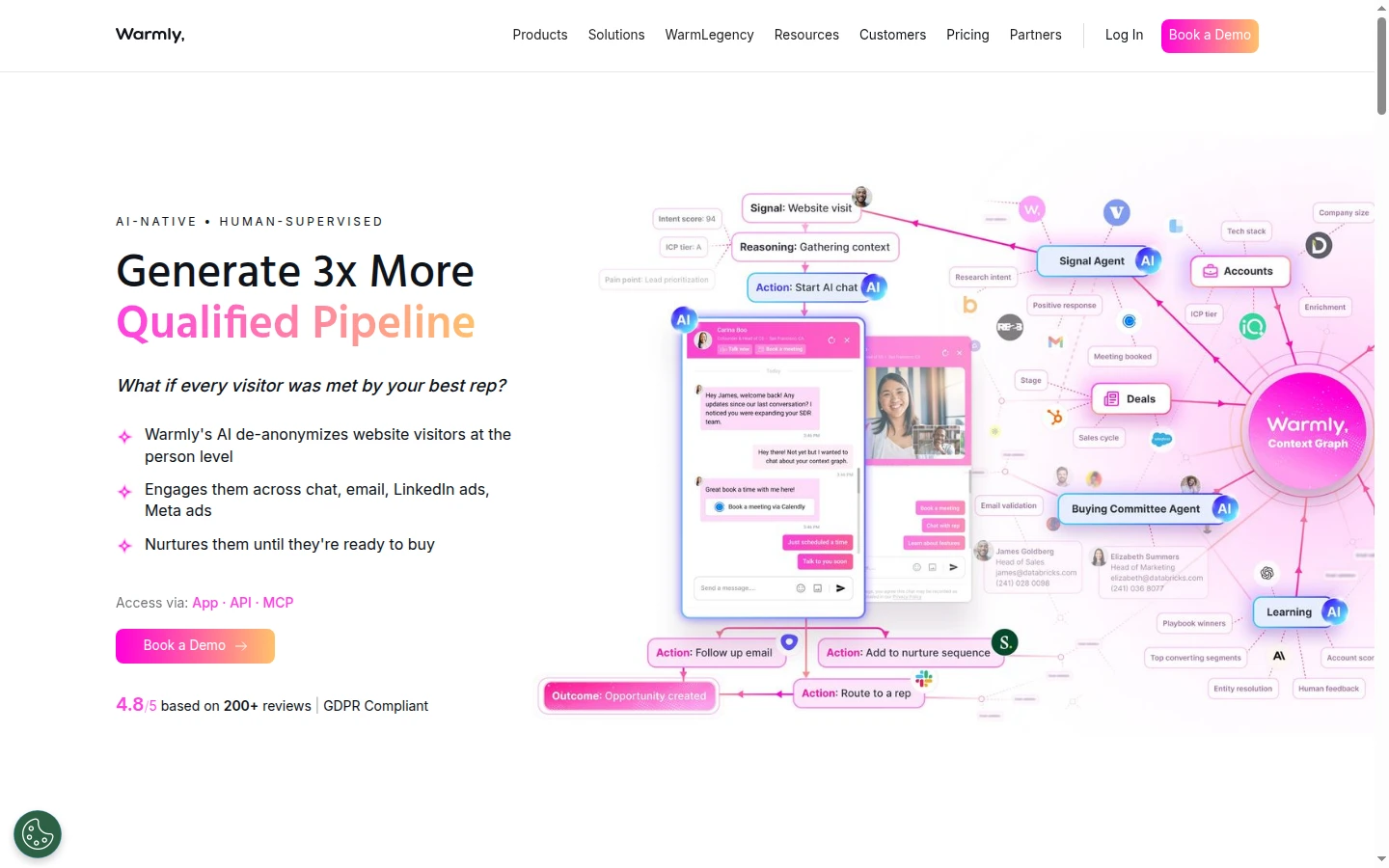
Warmly's official homepage. Open the image for the full-size capture.
Pricing: AI Web-Deanonymization starts at $10,000 per year, Inbound Chat at $20,000 per year, and AI Inbound Autopilot at $30,000 per year. Package allowances and commitment matter; a permanently free tier is not advertised.
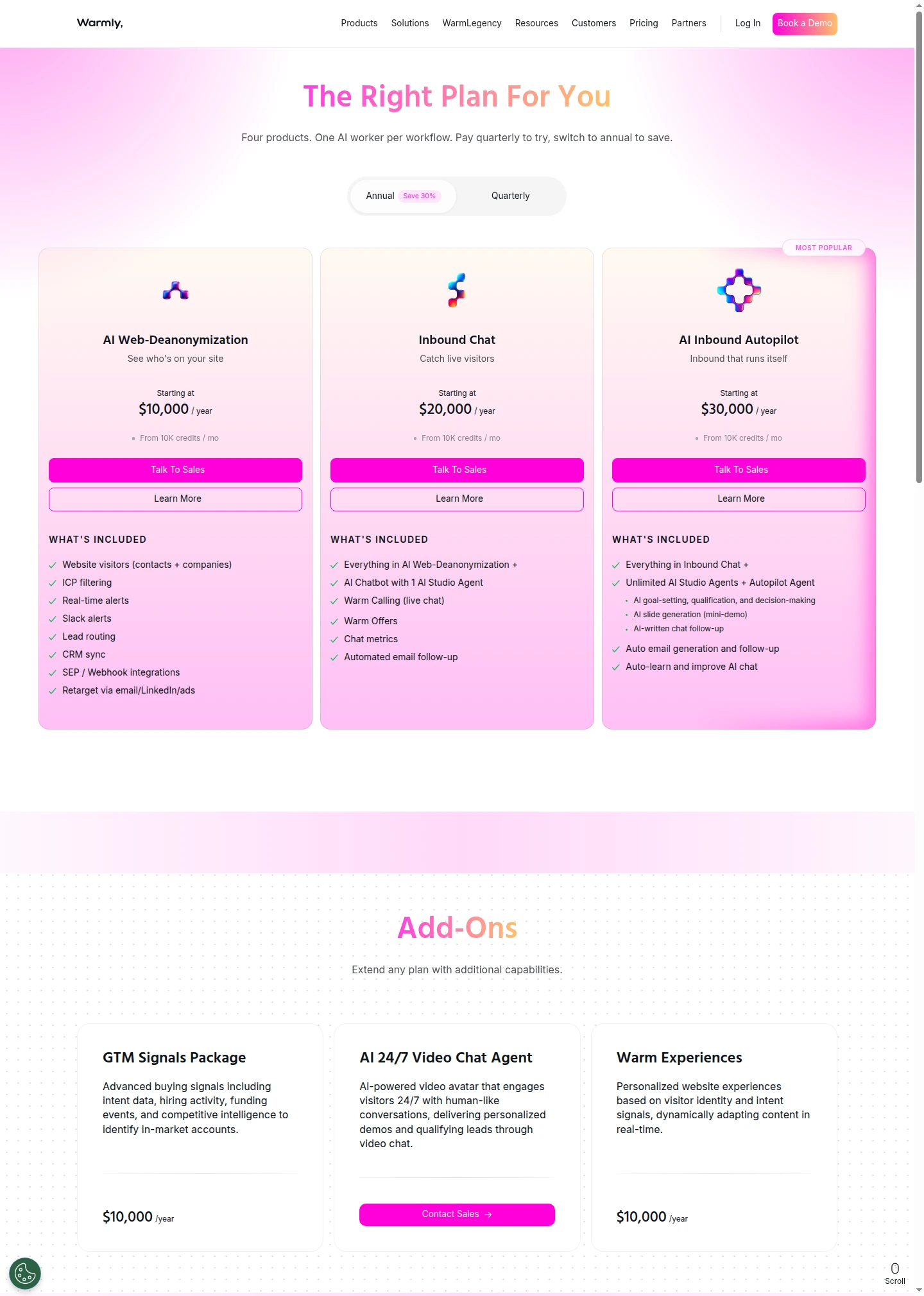
Warmly's official pricing section. Open the image for the full-size capture.
Trade-off: visitor identification works on traffic you already have. It cannot identify every buyer researching your category elsewhere. Warmly has been rated around 4.6 stars on G2.
13. RB2B for website visitor identification and routing
RB2B uses a website pixel to identify visitors and route information to your team. Person-level identification is limited to US visitors; company-level identification has global coverage. Its workflows include Slack or Teams alerts, Hot Leads filtering, Hot Pages tagging, and CRM integrations on eligible plans.
Setup takes about five minutes and its ecosystem includes more than 50 integrations, including HubSpot, Salesforce, and Clay. Compare which data each plan supplies.
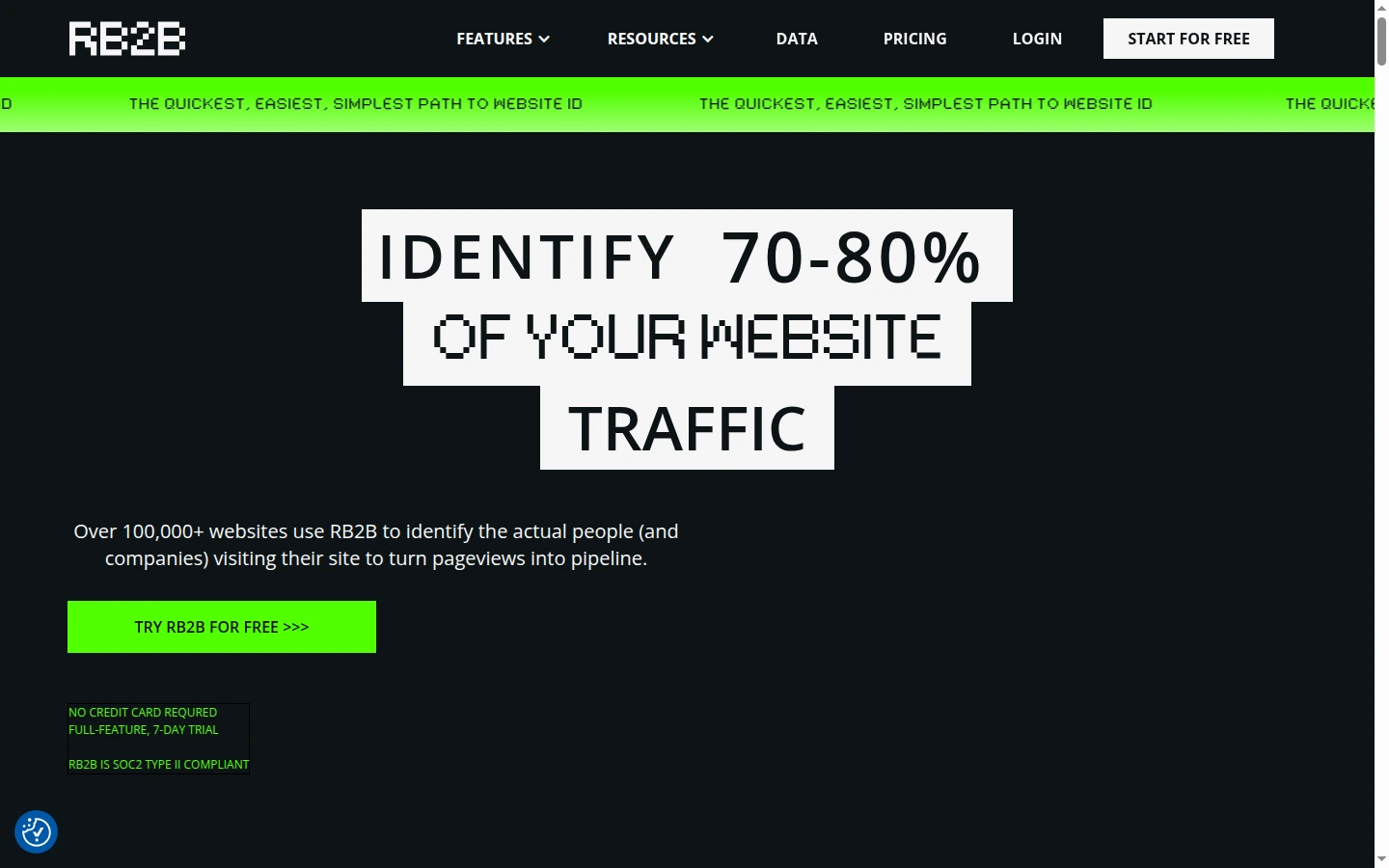
RB2B's official homepage. Open the image for the full-size capture.
Pricing: Free includes 150 monthly company-level resolutions pushed to Slack, with no person-level ID or email addresses. Starter is $79 per month for 300 resolutions and LinkedIn URLs to Slack or Teams, but no business email addresses or other integrations. Pro starts at $149 and Pro+ at $199 per month, adding email and broader integrations. A seven-day trial is advertised.
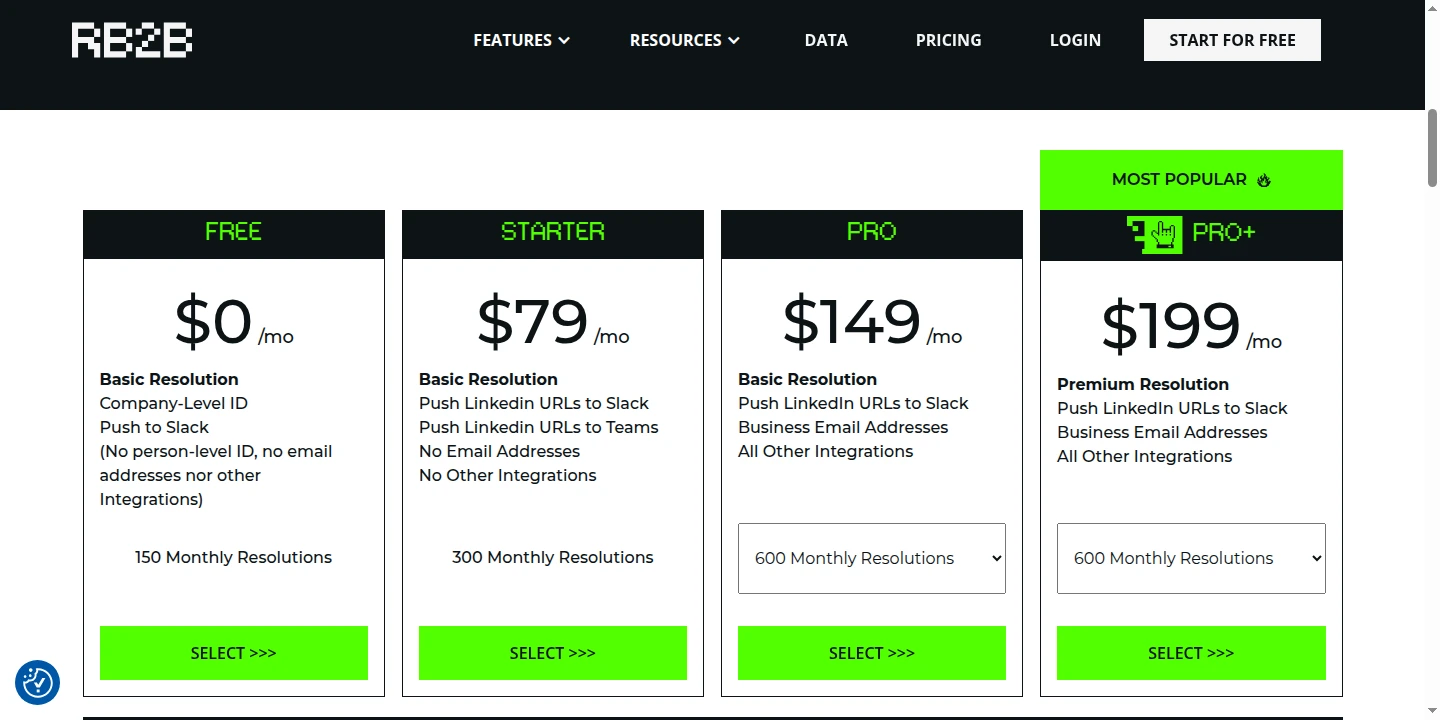
RB2B's official pricing section. Open the image for the full-size capture.
Trade-off: resolution rates, included volume, overages, and geography affect usefulness. The free plan is not a free individual-contact feed.
14. Dreamdata for account journeys and revenue attribution
Dreamdata connects marketing and sales touchpoints to B2B account journeys and revenue reporting. A demand generation leader can examine which content and campaigns appear along the path to an opportunity, rather than compare channels using separate platform conversion totals.
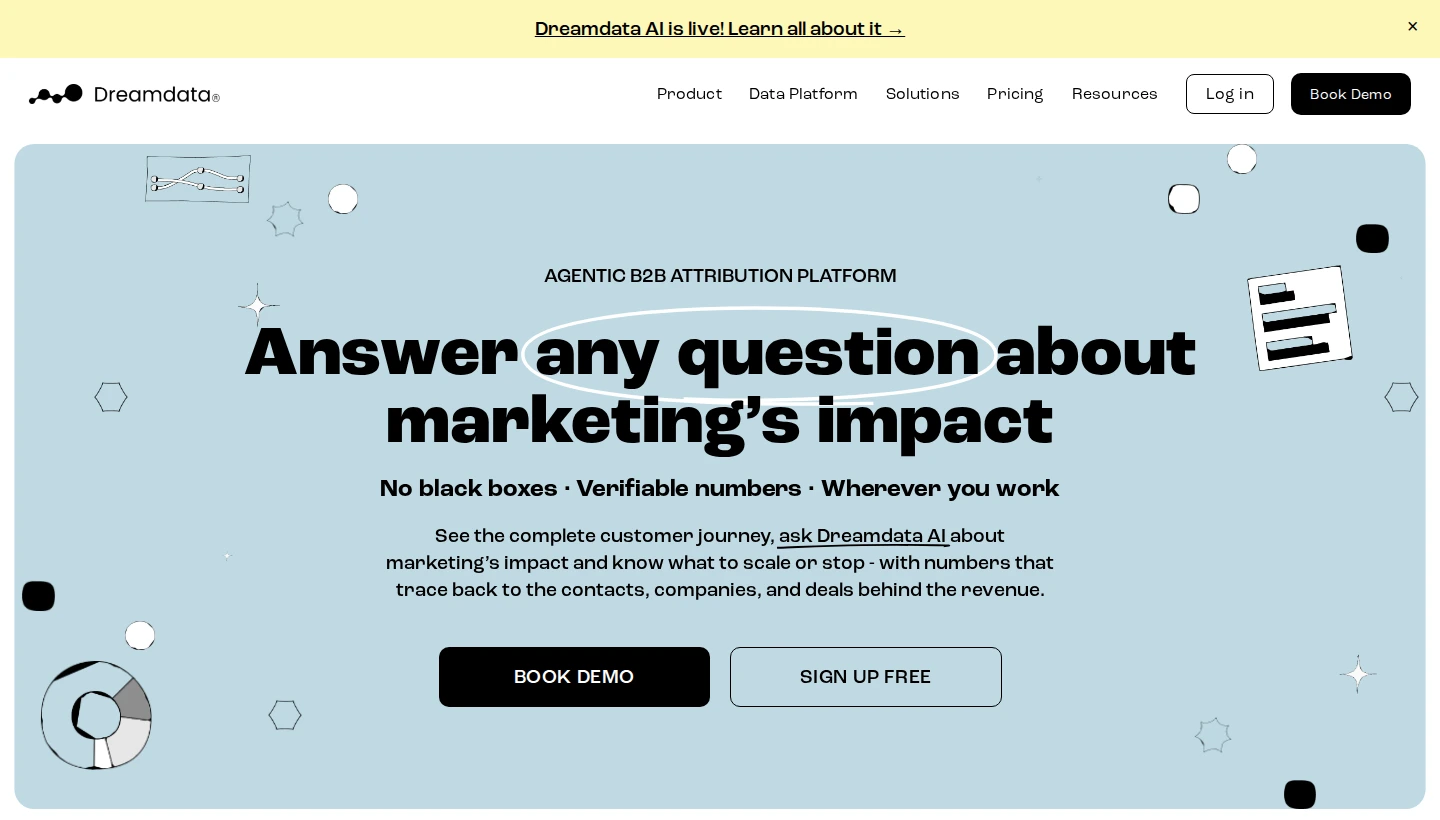
Dreamdata's official homepage. Open the image for the full-size capture.
Advanced Attribution includes AI and custom attribution models, revenue and content analytics, and ROI or ROAS reporting. Activation adds advertising audiences and engaged-account notifications. Those capabilities answer different questions from a CRM's campaign-send report or a visitor-identification alert.
Pricing: Starter Free is $0/month with foundational B2B web analytics, company identification, audience building, ad-spend reporting, five seats, and two months of user history. Advanced Attribution & Activation is custom-priced. Activation and the data warehouse are add-ons; the free analytics plan is not the full paid attribution product.
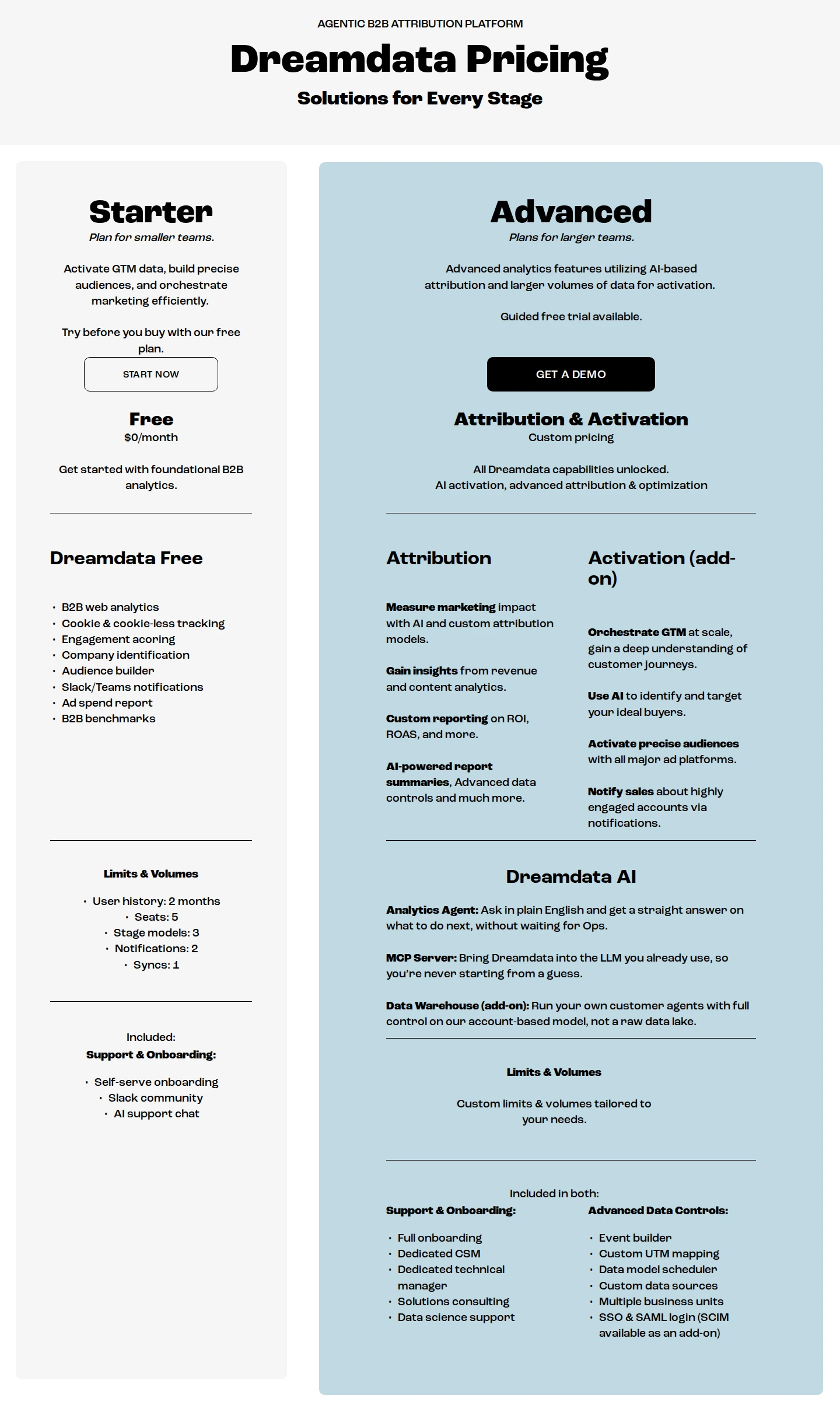
Free analytics and the paid attribution package have different scope. Open the image for the full-size capture.
Operating requirement: connect CRM events, use consistent campaign tags, and agree on lifecycle stages and the attribution model. Attribution assigns credit to observed touchpoints; a causal claim about incremental lift still needs an experiment.
Build a demand generation stack around a specific gap
Choose the gap first, then the tool. Decide which audience, campaign, and next action the team will own before adding a subscription. Avoid paying for another feed of signals without assigning someone to act on it.
Match the stack to the campaign
A lean content-led team needs buyer-question research, a publishing process, CRM capture, and a way to stay visible in relevant conversations. Semrush, HubSpot, and Extrovert cover those distinct jobs; start with the ones your campaign needs.
An education-led program needs registration and replay follow-up for webinars, or a self-guided product experience. Livestorm and Storylane cover different forms of buyer education. Define the next useful step after attendance or demo engagement, and use your lead nurturing workflow to continue it.
An enterprise ABM program needs account selection, coordinated distribution, and reporting. 6sense or Demandbase provides account context and orchestration; Mutiny supplies personalized assets. Dreamdata addresses journey and attribution questions across connected sources. Ad platforms, creative production, and partner programs may also belong in the plan; this shortlist does not replace those operating decisions.
Separate awareness, intent, and demand capture
Demand generation builds awareness and interest through content, communities, events, and relevant engagement. Demand capture converts existing interest through search, site visits, forms, and sales conversations. The tools above span both jobs, so a visitor-identification pixel alone should not be your entire demand generation plan.
Market-wide intent tools look for account activity beyond your site. Visitor-ID tools only see visitors to your site. A database supplies records, while an enrichment workflow fills gaps in records you already have. See our buying-signal tools overview for the signal-data side of the stack.
Connect signals to a person-level engagement plan
Use account context to prioritize the people you track in Extrovert. Join relevant conversations, keep your voice consistent, and follow up when there is a concrete reason. Engagement-led outreach gives a named-account campaign a regular relationship-building step instead of waiting for a form fill.
For SDRs, define who owns each prospect and how comments, connections, DMs, and follow-ups fit the broader campaign. Keep channel scope clear: a dedicated AI BDR tool may run email or calling workflows that Extrovert does not replace.
Budget for the work, not only the advertised subscription
Compare seats, annual commitments, marketing contacts, enrichment allowances, ad spend, onboarding, and overages. Prices span free tiers, tens to hundreds of dollars a month for seat-based or enrichment tools, and $10,000 to well over $60,000 a year for some enterprise platforms. Those units are not interchangeable.
For an Extrovert pilot, use your actual account list and measure relevant conversations, replies, accepted connections, meetings, and qualified opportunities. Keep site identification and signup clicks separate from those outcomes. The 10-day trial lets your team check the daily workflow before choosing a paid seat count.
FAQ
What is demand generation?
Demand generation builds awareness and buying interest before a sales conversation. Lead generation focuses on capturing contact information. A list of contacts is useful input, but it does not show that those people know your company or want to speak with you.
How is demand generation different from demand capture?
Demand generation creates interest through content, communities, events, and engagement. Demand capture converts interest buyers already have through channels such as search ads, website forms, and sales requests. B2B teams need a plan for both.
Is LinkedIn engagement part of demand generation?
Yes. Relevant comments and conversations make your team and expertise visible to buyers before they fill out a form. Extrovert prepares that work around prospects, customers, and topics, with individual review, bulk approval, or optional commenting automation.
What can a lean team start with?
Start with a defined audience and one campaign gap. A content-led team needs research and a publishing process; a webinar-led team needs participation and follow-up. For LinkedIn visibility and relationship building, use an engagement cadence your team can maintain. Extrovert offers a 10-day free trial with no card required; one paid LinkedIn-account seat is $49 per month on monthly billing, with annual and team discounts. Free CRM or data tiers can support other parts of the workflow, but their allowances do not replace relationship building.
Do visitor-identification tools replace intent platforms?
No. Visitor-identification tools observe your own site traffic. Market-wide intent platforms can surface activity before an account visits your site. Neither type proves that a specific person is ready to buy.
Does a CRM replace an ABM or engagement platform?
A CRM stores contacts, campaigns, and sales activity. ABM platforms add account-level targeting and orchestration. Extrovert adds LinkedIn discovery, comments, DMs, and follow-up. Connect only the layers your campaign needs; these products do not all perform the same job.
Can these tools work together?
Yes. Content, webinars, demos, and account campaigns can create different paths to a useful conversation. A CRM can store the shared record, and Extrovert can prepare LinkedIn engagement with relevant people. Give every handoff an owner and measure qualified conversations and pipeline, rather than count the same contact as a new lead in each tool.