On this page
Meta's Muse agent has no built-in connection to LinkedIn. LinkedIn isn't one of Muse's connectors, and LinkedIn doesn't offer one for Muse. On its own, Muse can't see your feed, comment on posts or answer your DMs.
To let Muse do this, connect it to Extrovert. Extrovert is a LinkedIn engagement and outreach tool with its own MCP server. You connect your LinkedIn account to Extrovert once, and Muse works through it:
Muse → Extrovert → your LinkedIn account
Setup takes a few minutes in a Muse chat. You send Muse one message asking it to create a custom connector for https://mcp.goextrovert.com, sign in to Extrovert and click Allow. You don't need an API key. Then you can ask Muse, "What's worth commenting on today?"
How to connect Muse to LinkedIn
Before you start
You need three things:
- An Extrovert account. The trial lasts 10 days and needs no card. At sign-up, Extrovert uses your LinkedIn profile URL to prepare a starting setup: a Voice (the tone, background and examples Extrovert uses to write your drafts), a topic campaign and an outreach campaign. Both campaigns are off at first.
- Your LinkedIn account connected in Extrovert. The profile URL alone doesn't connect it. Open Settings → LinkedIn account and connect with the Chrome extension or with your LinkedIn email and password.
- Muse. It runs on iPhone, Android, the web at muse.ai and the Mac app, for people 18 and over in the countries where Meta has launched it, including the US and Canada. The free plan has a usage limit; the paid plans add more usage.
Connect in a Muse chat
Extrovert shows these same steps under Connect AI → Muse in the left menu, with Copy buttons for both messages.
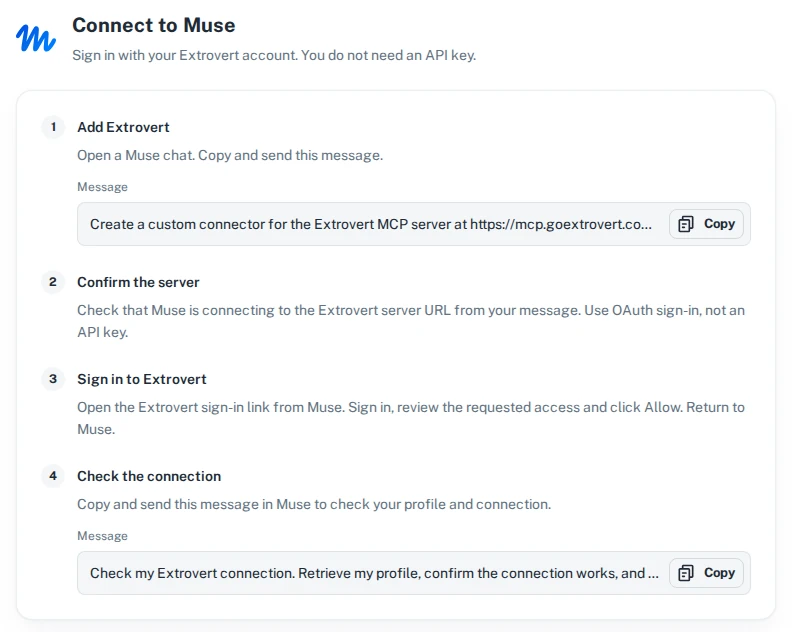
Extrovert's Connect to Muse page. Copy both messages from here.
Ask Muse to add Extrovert. Open a Muse chat and send this message:
Create a custom connector for the Extrovert MCP server at https://mcp.goextrovert.com. It is a remote MCP server (streamable HTTP) that uses OAuth sign-in.Confirm the server. Muse tells you what it's about to set up. Check that it uses
https://mcp.goextrovert.comand OAuth sign-in, then confirm. If Muse asks for an API key, say no: Extrovert uses a browser sign-in.Sign in to Extrovert. Open the sign-in link Muse gives you. Sign in with your Extrovert account, not your LinkedIn login, review the access Muse requests and click Allow. Go back to Muse.
Check the connection. Send this message: "Check my Extrovert connection. Retrieve my profile, confirm the connection works, and get ready to help me use the app." Muse replies with your profile from Extrovert.
Switch your campaigns on. Ask Muse, "Use Extrovert to show my campaigns." Look over the Voice and campaigns Extrovert prepared, ask Muse to change what doesn't fit, then ask it to start them. New posts and drafts show up once a campaign runs.
Muse saves your Extrovert sign-in in its Secure Credentials Store, so it uses the connection without seeing your password. To remove it later, ask Muse to remove the Extrovert connector, or disconnect it in Settings → Connectors.
You sign in to Extrovert, much like "Sign in with Google." Muse never sees your LinkedIn password or session cookies. Each teammate connects with their own Extrovert account. Muse uses the team you selected in Extrovert, unless you ask it to use another team you belong to.
Using Muse Code instead
Muse Code is Meta's coding agent for the terminal. It is a separate app from the Muse chat. Install it and sign in first, then connect Extrovert through its settings file.
Add Extrovert. Open
~/.config/muse/settings.json. If the file doesn't exist, create it with this content. If it does, add only theextrovertentry insidemcp_servers, and keep"schema_version": 1.{ "schema_version": 1, "mcp_servers": { "extrovert": { "transport": "streamable_http", "url": "https://mcp.goextrovert.com", "mode": "optional" } } }Sign in to Extrovert. Run
muse mcp login extrovert. In the browser, sign in to Extrovert and click Allow.Check the connection. Start
muse, type/mcpto see that extrovert is connected, then send the same check message as above.
What Muse can do on LinkedIn through Extrovert
In Extrovert you choose whose posts to follow (prospects, clients, peers, people in your industry) and which topics to watch, grouped into campaigns. Extrovert finds their new posts, drafts comments and DMs in your Voice, and tells you when a message is due.
With Extrovert connected, Muse does that work from your chat:
- Go through today's comment drafts. It shows what's waiting, rewrites a draft that doesn't fit ("shorter, and ask about their pilot"), approves the good ones and skips the rest.
- Answer your DMs. It reads a conversation, drafts a reply, edits it when you ask and sends it when you say so. Before you write to someone, it can read their profile, recent posts or recent comments.
- Set Extrovert up for you. It can write your Voice from what you tell it and from your recent posts, add a topic to watch, and start a campaign for people you want to stay visible to.
- Find new people. It searches Extrovert's B2B database by job title, seniority, company, location, industry or the tools a company uses. It can also set up an Intent Signals campaign, which finds people based on what they do on LinkedIn.
Muse also keeps working after you close the app. Ask it to check your Extrovert drafts every weekday morning, and it messages you when something needs your attention. Its scheduled tasks are listed under Upcoming when you tap your assistant icon.
Publishing posts to your own feed isn't part of Extrovert, which handles comments, DMs and finding people. Muse can't change your Extrovert billing or teammates through it.
Choose what Muse can do without asking
Muse asks before important actions by default. Reading your drafts doesn't change anything, but approving a comment or sending a DM does, so Muse checks with you first. When it asks, you can allow the action once, for the current task, or always.
To change this for all your connectors, open Settings → Permissions → Connectors. Ask for some actions means Muse asks before every action that changes something and before important reads. Always ask means it asks before every action.
A good start is to let Muse read freely and require approval for comments and DMs. Choose Always allow for those actions once Muse's choices match yours.
What to ask Muse first
In your first week with Muse, focus on being seen in the right conversations: the topics your buyers talk about and the people whose posts they read. Start with requests that only read, so you can see how Muse judges posts and drafts before you let it approve anything.
| Ask Muse | What happens |
|---|---|
| "Use Extrovert to add a topic to watch: posts about [your buyers' problem]. Leave out job ads and hiring posts." | Adds the topic in Extrovert, so new posts on it start coming in. |
| "Show me the posts in my topic campaign where I have something useful to add. Don't approve anything." | Reads the drafts waiting for you and picks the discussions worth joining. |
| "Read my recent LinkedIn posts and suggest talking points for my Voice." | Reads your posts and suggests points to use in your comments. |
| "Rewrite the second draft: shorter, and add the number from our pilot. Then approve it." | Edits the comment the way you'd brief a colleague and approves it. |
| "Here are profile URLs for six founders whose audience I want to reach. Put them in a new campaign that uses my Voice." | Creates the campaign with those people, and starts it when you say so. |
| "Which of my DM conversations need a reply? For anyone who fits my buyers, draft a short reply that continues the conversation. Show me before you send." | Reads the conversations, drafts replies and waits for your go-ahead. |
| "Find VPs of Sales at US SaaS companies with 50 to 200 employees that use HubSpot." | Runs a Lead Finder search and shows a free preview of up to 20 matches. |
| "Every weekday at 9:00, check my Extrovert comment drafts and the DMs that need a reply, and message me a short list of what needs me. Don't approve or send anything." | Sets up a scheduled task. Muse prepares the list in the background each morning, and comments and DMs wait for your approval. |
Adding people from a search costs 1 Extrovert Credit per person. Before Muse adds anyone, it tells you how many people, which campaign they're going into and what it costs, then waits for your approval.
Inside Extrovert, a people or topic campaign and the posts it collects look like this:
When someone you've been commenting on posts something new, that's a natural reason to write. Extrovert suggests a DM based on their post:
Extrovert reads the prospect's posts and skips the generic ones: opinion, industry advice, motivational post, promotional post. One post, "Went to SF Tech Week", is a Restarter signal. The next follow-up comes early and mentions it: "Seen you went to SF Tech Week. How did it go?" The prospect replies.


What happens after Muse approves or sends
Everything Muse approves or sends through Extrovert follows the same rules as an approval you make in the Extrovert dashboard.
- Comments go out within your limits. An approved comment waits its turn and goes out during your working hours and under your daily limit, with gaps between actions. Until it posts, you can cancel it, or ask Muse to.
- DMs wait for your working hours. A DM Muse sends joins a queue and goes out during your working hours. If a reply can't wait, ask Muse to send it now.
- Auto campaigns skip the approval list. Muse's approval list covers campaigns that wait for your review. Campaigns on Auto comment without asking, so their comments never show up there.
- Muse stays inside your account. It works within your permissions, daily limits and credit balance, and can't do anything you couldn't do yourself in Extrovert.
If Muse can't see Extrovert
| What you see | What to do |
|---|---|
| Muse asks for an API key | Say you want OAuth sign-in, and send the setup message again. Extrovert doesn't use API keys for this. |
| Muse says it can't access your campaigns | Ask it to use the Extrovert connector, or start a new chat. If you skipped Allow, open the sign-in link again. |
| Muse shows another team's campaigns | Muse uses the team selected in Extrovert. Switch it there, or name the team in your message. |
| Muse finds nothing to approve | Check that at least one campaign is running and set to manual review. |
If it still doesn't work, open Guides and support → Chat with support in Extrovert, and we'll help.
FAQ
Does Muse have an official LinkedIn integration?
No. LinkedIn isn't one of Muse's connectors, and LinkedIn doesn't offer a connection for Muse. Muse accesses your LinkedIn account through a tool you connect, such as Extrovert. Our LinkedIn MCP guide explains how these connections work.
Is it safe for my LinkedIn account?
Extrovert keeps activity within your daily limits and follows your working hours. It spaces out actions, and anything over the limit waits for the next day. You choose what to review and what to automate. Muse never sees your LinkedIn password or cookies, and the same limits apply to everything it approves or sends through Extrovert.
Does this work with Muse Code?
Yes. Muse Code, Meta's terminal agent, connects through its settings file and muse mcp login extrovert. The steps are above.
Can Muse post on LinkedIn for me?
Not through Extrovert. Extrovert handles comments on other people's posts, DMs and finding people. Muse can help you write a post, and you publish it yourself.
How much does it cost?
The connection is included in Extrovert's plan. One seat costs $49 a month on monthly billing, and seats get cheaper as your team grows. Each seat is one LinkedIn account and includes 300 Credits a month. The 10-day trial needs no card, and the pricing page has the team rates. Muse is billed separately by Meta. Its free plan has a usage limit, and the Power ($20 a month) and Maximum ($100 a month) plans add more usage.