Cold email reply rates fell to 3.43% in 2026, down from 8.5% in 2019, and a wave of AI BDR tools promises to reverse that slide by running outbound for you (Cleanlist). The pitch is seductive: a software agent that prospects, writes, sends, and books meetings while you sleep.
The reality is more complicated. AI generated outreach now gets flagged as spam more than twice as often as human-sent mail, and LinkedIn restricted one of the most heavily marketed AI BDR platforms at the start of 2026.
This guide explains what an AI BDR actually is, what it automates, how the autonomous agents perform against real humans, and the specific places they fall down. You will also see when an AI BDR is the wrong tool, and what works better when the goal is replies, not volume.
What is an AI BDR?
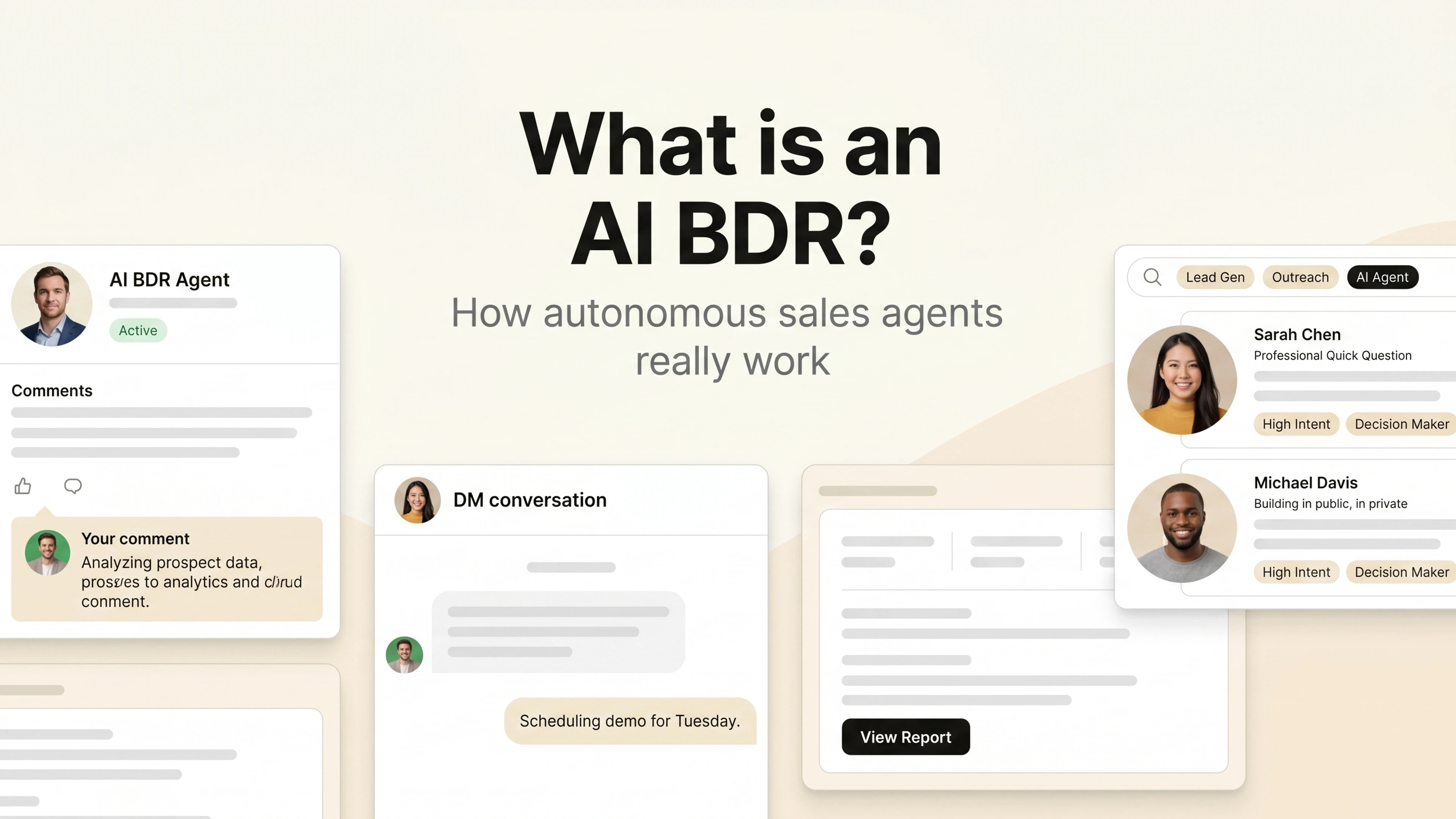
An AI BDR (Business Development Representative) is a software agent that performs the outbound prospecting job autonomously: it researches accounts, builds lists, writes personalized messages, sends them across email and social channels, handles early replies, and books meetings, with little or no human in the loop.
The term borrows from the human role. A BDR is the rep who sits at the top of the sales funnel, finding and qualifying new prospects before handing them to an account executive. An AI BDR aims to replace or augment that person with a model that runs the same workflow at machine speed.
Vendors market these agents as near-complete replacements for an entry-level rep. Artisan positions its product Ava as an AI BDR; 11x markets Alice as an AI SDR (Amplemarket). The labels differ, but the promise is the same: outbound on autopilot.
An AI BDR goes beyond a chatbot or a writing assistant. It is an autonomous system that takes actions on your behalf: it decides who to contact, what to say, and when to follow up, then does it without waiting for your approval on each step.
What does an AI BDR actually do?
An AI BDR automates the full top-of-funnel workflow, from finding a prospect to booking a meeting. Most platforms chain together the same set of jobs that a human BDR would run manually.
The typical pipeline looks like this:
- Sourcing: pulls prospects from data providers and intent signals, then filters them against your ideal customer profile.
- Research: scrapes public profiles, company news, and recent posts to find a hook for personalization.
- Writing: generates the email or message, usually with a templated structure and a model-written opening line.
- Sending and sequencing: fires the first touch and schedules follow-ups across email and, where allowed, social channels.
- Reply handling: reads responses, answers basic questions, and routes interested leads toward a booked meeting.
For elite teams, AI now handles roughly 80% of the research and sequencing work (Digital Applied). That is the part of the job that is genuinely repetitive, and it is where the tools earn their keep.
| Task | Human BDR | AI BDR |
|---|---|---|
| Build a prospect list | Hours per week | Minutes, automated |
| Research each lead | Manual, inconsistent | Automated at scale |
| Write first-touch message | Slow, on-brand | Instant, templated |
| Judge tone and timing | Strong | Weak |
| Handle a nuanced reply | Strong | Mixed |
AI BDR vs AI SDR: what is the difference?
There is no meaningful technical difference between an AI BDR and an AI SDR; the terms are used interchangeably. Both describe an autonomous agent that runs outbound prospecting, and vendors pick whichever acronym fits their positioning.
The distinction, where one exists at all, mirrors the human roles. A BDR traditionally focuses on outbound to brand-new accounts, while an SDR often handles a mix of outbound and inbound lead qualification. In practice, most AI tools do both, so treat the two labels as synonyms when you compare products.
How well do AI BDRs actually perform?
AI BDRs close part of the performance gap with humans but still trail them on the metrics that matter, and they carry a deliverability penalty that human reps do not. The honest numbers tell a clearer story than the marketing does.
In a 100,000-email analysis, AI-sent outreach replied at 4.1% against 5.2% for humans, and booked meetings at 0.7% versus 1.1% (Digital Applied). The gap is narrowing, down from 2.0 points in 2024 to 1.1 points in 2026, but it has not closed.
The bigger problem is deliverability. AI-sent mail was flagged as spam 8% of the time against 3% for human-sent mail, because filter heuristics still penalize the statistical fingerprint of generated text. Roughly 17% of cold emails never reach an inbox at all, and Gmail now enforces a 0.1% spam-complaint threshold that punishes high-volume senders hard.
Where do AI BDRs fall short?
AI BDRs fall short anywhere the job needs judgment, trust, or a channel that bans automation. Speed and scale are real, but they come with costs that the demos skip over.
- List building and enrichment at scale
- Drafting a competent first version fast
- Never forgetting a follow-up
- Higher spam-flag and bounce rates
- Banned or restricted on LinkedIn
- Add to the inbox saturation buyers resent
- Miss nuance in a real conversation
The channel risk is concrete. LinkedIn restricted Artisan's automated outreach at the start of 2026, removing a core channel from a flagship AI BDR (Amplemarket). Any tool whose model is unattended automation on LinkedIn is one policy change away from losing its reach, or getting your account flagged.
There is also a trust problem the tools created themselves. Years of low-effort, AI-generated outreach trained buyers to ignore the inbox, which is part of why reply rates keep falling. Adding more automated volume to a saturated channel does not fix that; it deepens it.
[Extrovert](https://goextrovert.com) tracks your prospects and topics, then suggests on-brand comments and DMs from your playbook. You stay in the loop, so outreach lands warm and human-reviewed, in about 15 minutes a day.
See the human-in-the-loop approachWhat is the alternative to a fully autonomous AI BDR?
The alternative is human-in-the-loop AI: software that does the heavy lifting while a person approves every message that goes out. This keeps the speed of automation without the spam-flag penalty and ban risk that come with unattended sending.
The difference is who pulls the trigger. A fully autonomous AI BDR decides and acts on its own. A human-in-the-loop tool researches, drafts, and prioritizes, then waits for you to approve, which is what keeps the output on-brand and inside platform limits.
| Dimension | Autonomous AI BDR | Human-in-the-loop AI |
|---|---|---|
| Who sends | The agent, unattended | You, after review |
| Spam-flag risk | Higher (8% range) | Lower (human range) |
| LinkedIn ban risk | High | Low |
| Personalization quality | Templated | On-brand, checked |
| Best for | Raw top-of-funnel volume | Warm, trust-led pipeline |
This is the model behind warm outreach: engaging the right people through comments and conversation before any pitch, so your name is familiar by the time you reach out. It trades raw volume for reply rate, and it sidesteps the deliverability tax that sinks autonomous cold sending. The same behavior also lifts your LinkedIn SSI, the score that tracks how well you build trust on the platform.
An AI BDR is great at the work humans hate and bad at the trust humans require. Automate the research and drafting; keep a person on the send.
FAQ
What is an AI BDR?
An AI BDR is a software agent that runs the outbound business development role autonomously, from sourcing and researching prospects to writing, sending, and following up on outreach. It aims to replace or augment a human business development representative by automating the top of the sales funnel.
Is an AI BDR the same as an AI SDR?
Yes, the terms are used interchangeably. Both describe an autonomous agent that automates outbound prospecting, and the difference is mostly vendor positioning rather than capability. Some teams reserve BDR for outbound-only and SDR for a mix of outbound and inbound, but most AI tools do both.
Do AI BDRs work better than human reps?
No, not yet on the metrics that matter most. A 2026 analysis of 100,000 emails found AI outreach replied at 4.1% versus 5.2% for humans and booked fewer meetings, while getting flagged as spam more than twice as often. AI is strongest at research and list building, which is why the best teams pair it with a human who handles the sending and the conversation.
Will an AI BDR get my LinkedIn account banned?
It can. LinkedIn restricts unattended automation, and it limited a major AI BDR platform's automated outreach in early 2026. A human-in-the-loop approach that keeps a person approving each action stays inside platform limits and avoids the flags that come with bulk automated sending.
How much do AI BDR tools cost?
AI BDR platforms typically run from several hundred to a few thousand dollars per month, depending on send volume and seats. Before committing, compare that against the reply rate you actually get, since high-volume automated sending often underperforms a smaller warm approach. See Extrovert pricing for a human-in-the-loop alternative.
When does an AI BDR make sense?
An AI BDR makes sense when you need to automate genuinely repetitive top-of-funnel work like list building, enrichment, and research at scale. It makes less sense as a full replacement for human judgment in messaging and replies, where a B2B prospecting toolkit paired with human review tends to win on reply rate.
How do I get replies without spammy automation?
Earn recognition before you pitch by engaging your prospects' content consistently, then reach out warm. Smaller, targeted campaigns of 50 recipients or fewer average a 5.8% response rate versus 2.1% for large lists, so focus beats volume. A free LinkedIn post idea generator helps you stay visible to the right people.
Sources: Digital Applied: AI SDR Real Performance, Cleanlist: 2026 Cold Email Response Rates, Amplemarket: Best AI Sales Agents