Your LinkedIn SSI is a live score out of 100 that grades how well you sell on the platform, and most reps have never looked at it. It updates every day, reflects your last 90 days of activity, and LinkedIn says people who score well generate 45% more opportunities than those who do not (LinkedIn Sales Solutions).
The score reflects something real. The four things it measures are the same four things that decide whether a prospect recognizes your name before you ever pitch them.
This guide breaks down what the Social Selling Index is, how each of its four pillars is scored, what counts as a good number, and the specific moves that raise it. You will also see where chasing the score blindly goes wrong, and which input actually predicts pipeline.
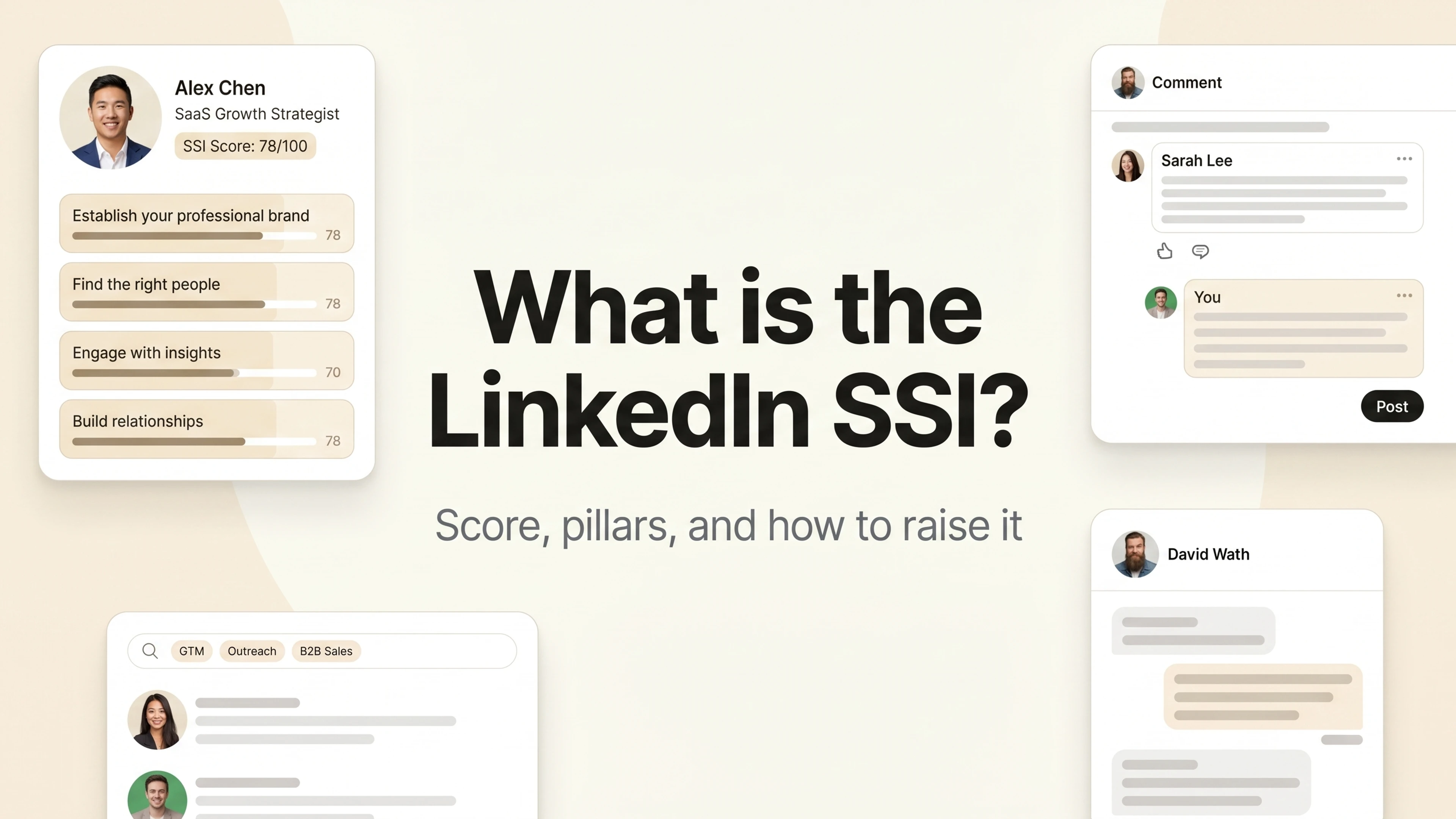
What is the LinkedIn SSI?
The LinkedIn SSI (Social Selling Index) is a score from 0 to 100 that measures how effectively you use LinkedIn to build a brand, find prospects, share insight, and grow relationships. LinkedIn calculates it from four pillars, each worth up to 25 points, and refreshes it daily based on your trailing 90 days of activity.
LinkedIn built the SSI as an internal benchmark for its own Sales Navigator users, then exposed it as a free score anyone can check. It was designed to quantify social selling: the practice of earning attention and trust on the feed instead of cold-calling strangers.
The number you see today is not permanent. Because it only counts the last 90 days, a great quarter of activity can be erased by two quiet months. That rolling window is the single most misunderstood part of the score, and it maps almost perfectly onto how buyers actually remember you.
The SSI scores a rolling 90-day window, not your all-time effort. Show up for three months and stop, and the score fades right as the prospects you warmed start to forget you. Consistency beats intensity here, which is exactly why a steady routine outperforms a one-week sprint.
How is the LinkedIn SSI score calculated?
LinkedIn does not publish the exact formula behind each pillar, but the four categories are clearly named and the behaviors that move them are well documented. Each pillar is worth a maximum of 25 points, and your total SSI is the sum.
Here is what each of the four pillars rewards.
Establish your professional brand
This pillar measures whether your profile is complete and whether you publish content that builds authority. A finished profile with a clear headline, a real photo, a filled-out about section, and regular posts that earn engagement all push this number up. An abandoned profile with a default banner and zero posts caps it fast.
Find the right people
This pillar rewards prospecting activity: using search, filters, and Sales Navigator to identify the specific people and accounts you want to reach. Profile views, saved leads, and search usage all signal that you are actively looking for the right buyers rather than waiting for inbound.
Engage with insights
This is the pillar most reps ignore, and the one that compounds. It measures whether you share and interact with content in ways that start conversations: posting, but mainly commenting, reacting, and joining discussions on other people's posts. Broadcasting alone moves it less than two-way engagement does.
Build relationships
This pillar tracks whether you grow and nurture your network: sending connection requests that get accepted, connecting with senior people, and maintaining a healthy acceptance rate. A high request-to-accept ratio matters more than raw volume, which is why blasting strangers actually works against you here.
| Pillar | What it rewards | Biggest lever |
|---|---|---|
| Establish your professional brand | Complete profile, authority content | Post and publish consistently |
| Find the right people | Search and prospecting activity | Use filters and Sales Navigator |
| Engage with insights | Posting plus two-way engagement | Comment on prospects' posts |
| Build relationships | Accepted, senior connections | Earn a high acceptance rate |
How do you check your LinkedIn SSI?
You can check your LinkedIn SSI for free at linkedin.com/sales/ssi while logged into your account. The page shows your total score out of 100, a breakdown across all four pillars, your rank within your industry, and your rank within your own network.
There is no cost and no Sales Navigator subscription required to view it. The dashboard also shows the average SSI for your industry and network, so you can see the gap between you and your peers at a glance. If you want a faster read on where you stand, the LinkedIn engagement rate calculator gives you a quick benchmark and the levers to pull next.
Check it once a week, not once a day. Daily swings are noise; the trend over a month tells you whether your routine is working.
What is a good LinkedIn SSI score?
A good LinkedIn SSI score is generally considered 70 or above, with anything past 80 placing you in the top tier of social sellers. The average user sits well below that, which means a modest, consistent routine can move you into the top quartile faster than most reps expect.
Practitioners tend to read the bands like this:
| SSI range | What it signals |
|---|---|
| 0-40 | Mostly inactive or profile-only; little social selling |
| 41-60 | Occasional activity; profile is decent but engagement is thin |
| 61-75 | Consistent presence; you show up and interact regularly |
| 76-100 | Top-tier social seller; visible, networked, and trusted |
Treat these as orientation, not gospel. LinkedIn does not hand out badges at 70, and a 90 SSI does not close deals by itself. The score is a proxy for behavior, and the behavior is what produces pipeline. A rep at 65 who comments thoughtfully on ten target accounts every week will out-sell a 90 who games the metric with low-value activity.
Does the LinkedIn SSI actually matter?
The LinkedIn SSI matters because the behaviors it rewards correlate with real sales outcomes, not because the number itself is magic. LinkedIn's own data is the headline case for paying attention.
Those figures come from LinkedIn (LinkedIn Sales Solutions), and there is a clear reason behind them. The pillars reward showing up, sharing useful perspective, and building a network of the right people. Reps who do those things consistently stay top of mind, and staying top of mind is what shortens a sales cycle.
The honest caveat: the SSI is correlation, not a causal lever you pull. Raising the number by mechanically viewing profiles and firing connection requests will not build pipeline. Raising it by genuinely engaging with the people you want to sell to will. The score is useful precisely when you stop optimizing it directly and start optimizing the behavior underneath it. That behavior is engagement-led prospecting: getting known through comments and conversation before you ask for anything.
[Extrovert](https://goextrovert.com) tracks your prospects and topics, then suggests on-brand comments and DMs from your playbook so you engage the right people every day. You stay in the loop, so every comment and DM lands warm and human-reviewed, in about 15 minutes a day.
See how it works for B2B salesHow do you improve your LinkedIn SSI?
You improve your LinkedIn SSI by working all four pillars at once, with the heaviest weight on engagement and relationships, since those are where most reps leave points on the table. None of it requires automation, and trying to fake it with bulk tools usually backfires on the relationships pillar.
Here is where to spend your effort, pillar by pillar:
- Finish your brand once, then publish. Complete every profile field, write a headline that names who you help, and post something useful one to three times a week. The profile is a one-time fix; the publishing is the ongoing lever.
- Prospect with intent, not volume. Build a list of target accounts and the people inside them. Use search filters to find them, view their profiles, and save the ones that fit. The activity that raises this pillar is the same activity that fills your pipeline.
- Comment before you connect. Spend ten minutes a day leaving substantive comments on posts from your target prospects. This single habit moves the engagement pillar more than any amount of your own posting, and it warms the prospect at the same time. A free LinkedIn post idea generator helps you get past the blank box.
- Earn acceptances, do not chase them. Send fewer, better connection requests to people who already recognize you from your comments. A request from a familiar name gets accepted; a cold one from a stranger gets ignored and quietly drags your score down.
Notice the pattern: the moves that raise your SSI are the moves that build warm outreach relationships. The score and the pipeline rise together because they are powered by the same actions.
You can't fake the SSI for long. The fastest way to raise it is also the simplest: engage the right people consistently, before you pitch.
SSI vs reply rate: which should you chase?
If you can only watch one number, watch your reply rate, not your SSI. The SSI is a useful leading indicator of habit, but reply rate is the outcome that pays your bills, and the two do not always move together.
The trap is optimizing the SSI as a goal. You can inflate the score with low-value activity that produces zero conversations. Reply rate is harder to game because a human has to choose to respond, which only happens when you have earned recognition first.
| Metric | What it measures | Gameable? | What it predicts |
|---|---|---|---|
| LinkedIn SSI | Breadth of social selling activity | Partly, with low-value actions | Whether you have the right habits |
| Reply rate | Conversations your outreach earns | No, a human must respond | Pipeline and revenue |
Use the SSI as a diagnostic. If your engagement pillar is low, that explains a weak reply rate, and fixing one fixes the other. The healthiest approach treats the SSI as a dashboard light and reply rate as the destination. Both improve when you trade cold volume for the steady, recognizable presence that the LinkedIn algorithm and your buyers both reward.
FAQ
What is the LinkedIn SSI?
The LinkedIn SSI (Social Selling Index) is a score from 0 to 100 that measures how effectively you use LinkedIn to build a brand, find prospects, share insights, and grow relationships. It is calculated across four pillars worth 25 points each and updates daily based on your last 90 days of activity.
How do I check my LinkedIn SSI score?
Go to linkedin.com/sales/ssi while logged into your LinkedIn account. The page is free, requires no Sales Navigator subscription, and shows your total score, your four pillar breakdowns, and your rank within your industry and network.
What is a good LinkedIn SSI score?
A good LinkedIn SSI score is 70 or higher, and anything above 80 puts you among the strongest social sellers on the platform. Because the average user scores well below 70, a consistent weekly routine can lift you into the top quartile relatively quickly.
How is the LinkedIn SSI calculated?
LinkedIn calculates the SSI from four pillars, each worth up to 25 points: establish your professional brand, find the right people, engage with insights, and build relationships. LinkedIn does not publish the exact formula, but the behaviors that move each pillar are well established, and the score reflects a rolling 90-day window.
Does the LinkedIn SSI actually matter for sales?
The LinkedIn SSI matters because the behaviors it rewards correlate with results: LinkedIn reports that social selling leaders generate 45% more opportunities and are 51% more likely to hit quota. The number itself is not magic, but it is a useful proxy for the habits that build pipeline, which is why a social selling routine raises both the score and your reply rate.
How fast can I improve my LinkedIn SSI?
You can see movement within a few weeks because the score updates daily on a 90-day window. Focus on the engagement and relationship pillars first, since most reps under-invest there, and commit to a short daily routine rather than a one-time push.
Can I get banned for trying to raise my SSI?
You can be restricted if you use bulk automation to inflate activity, especially mass connection requests that lower your acceptance rate. A human-in-the-loop routine that comments and connects at a normal pace stays inside LinkedIn's limits and raises the relationship pillar instead of damaging it.
How does the SSI apply to SDRs versus founders?
The SSI applies to anyone selling on LinkedIn, but the emphasis shifts by role. SDRs lean hardest on the find-people and engage pillars to build pipeline, while founders lean on the brand pillar to turn their audience into demand; both win by engaging real prospects through best B2B sales tools rather than broadcasting into the void.
Sources: LinkedIn Sales Solutions: From SSI to AI, Neal Schaffer: LinkedIn SSI Explained, Cleverly: LinkedIn SSI Score Guide