LinkedIn does not offer a public firehose the way X and Instagram do, and that single fact explains most of what "LinkedIn social listening" tools can and cannot do. LinkedIn's API only exposes data for pages and ad accounts you control, not the open platform, so any tool claiming to track brand mentions or hashtags across the whole network is either scraping (against LinkedIn's User Agreement) or narrowing its promise more than the marketing page admits.
That gap matters if you're an SDR or AE trying to figure out whether "social listening" can actually help you find buying signals, not just watch a dashboard. This article breaks down what's genuinely possible on LinkedIn today, what tools quietly can't deliver, and where the real opportunity sits for reps who want to act on signals instead of just collecting them.
What Is LinkedIn Social Listening, Really?
LinkedIn social listening means monitoring posts, comments, and activity on LinkedIn to surface mentions, sentiment, or buying signals you can act on. On platforms like X, that means searching the open firehose for any keyword. On LinkedIn, it means something narrower: tracking specific people, companies, and topics you've already identified, because the platform was never built for open-ended keyword search.
That distinction gets lost in most vendor copy. A tool that says it does "LinkedIn social listening" might mean it monitors your own company page mentions (fully supported), or it might mean it's quietly scraping public profiles and comment sections (not supported, and against LinkedIn's terms).
Why Is LinkedIn Harder to Monitor Than X or Instagram?
LinkedIn's official API only grants access to data tied to accounts and pages you administer: your company page's mentions, your ad performance, your own analytics. It does not offer a public search API for arbitrary keywords, hashtags, or third-party posts, the way X's API historically did.
LinkedIn's User Agreement also explicitly prohibits "automated methods to access the service, copy profiles, or collect data" without permission, and it blocks browser extensions or third-party software that scrape or automate activity on the platform. The 2017-2022 hiQ Labs v. LinkedIn case settled the legal question narrowly: scraping public data isn't automatically a federal crime under the CFAA, but that ruling doesn't touch LinkedIn's Terms of Use, which still ban it as a contractual matter. A tool can be technically able to scrape and still be one policy update away from losing your account.
If a vendor claims to monitor "all LinkedIn mentions" or "any keyword across LinkedIn" without asking you to connect your own account or import a specific list, ask how. There's no official API path for open keyword search on LinkedIn, so the answer is almost always scraping or shadow profiles built from prior scrapes.
What Can You Actually Track on LinkedIn With Official Tools?
Through LinkedIn's supported APIs and partner integrations, you can reliably track:
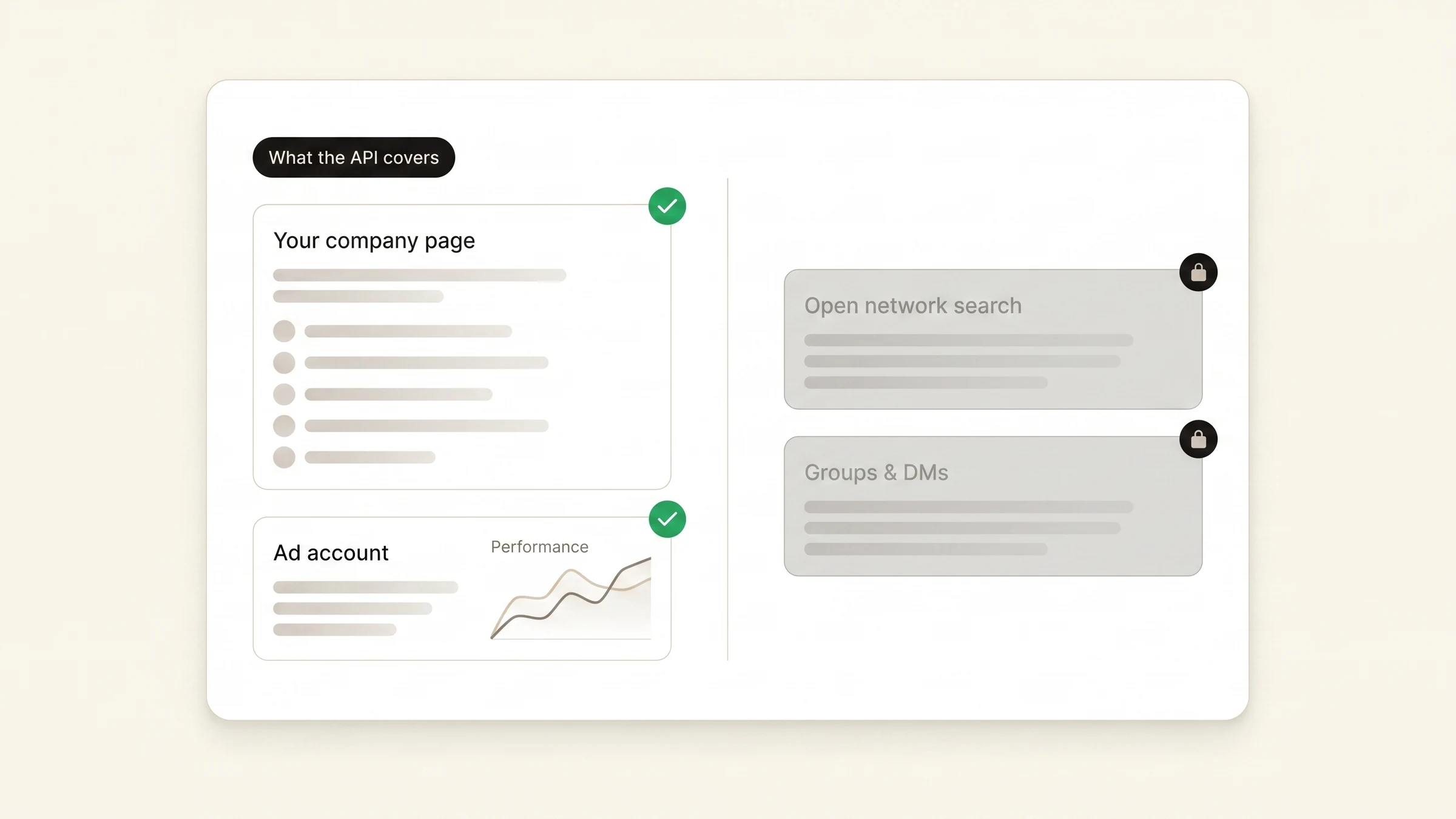
- Your own company page: mentions, comments, follower growth, post performance
- Your ad accounts: campaign engagement and conversion data
- Groups you don't control and personal profiles you don't own are out of reach. LinkedIn does not expose Groups content or private DMs to third parties, and it does not offer a way to pull someone else's public activity in bulk without their connection or without violating the User Agreement
That's a short list. It's also the reason most "LinkedIn social listening" vendors quietly pivot their pitch toward SSI tracking, sentiment on your own posts, or competitor page comparisons, categories the official API actually supports, rather than open-network monitoring.
What Do Most LinkedIn Monitoring Tools Actually Do Under the Hood?
Most tools that market "LinkedIn monitoring" alongside X, Reddit, and Instagram listening fall into one of two buckets:
- API-compliant tools that monitor pages and accounts you administer, and stop there
- Scraping-based tools that browse LinkedIn like a logged-in user (or many rotating users) to pull public posts and comments, which is unreliable, gets rate-limited or blocked, and puts your connected account at risk if you're the one authenticating it
| Approach | What it can see | Compliance risk | Reliability |
|---|---|---|---|
| Official API (page/ads) | Your own company page, ad data | None | High |
| Browser scraping | Public posts, comments, profiles | Violates LinkedIn ToS | Breaks on UI changes, rate limits |
| Manual tracking of a named list | Posts from people you follow/connect with | None (normal usage) | High, but doesn't scale past what a human can watch |
The third row is the one that actually matters for sales. It's also the least automated, and the least hyped, of the three.
What's Genuinely Possible for Sales Teams on LinkedIn?
Here's the honest version: you cannot listen to "the whole platform" for your ICP without breaking LinkedIn's terms. But you can absolutely track a defined list of prospects and customers, the accounts you already care about, and surface when they post, change jobs, get promoted, or engage with a topic relevant to your pitch. That's normal LinkedIn usage (viewing profiles and feeds you have access to as a logged-in user), not scraping the open network.
This is where buying signals actually come from in practice: a prospect posts about a problem your product solves, a champion changes companies, a target account's exec engages with a competitor's content. None of that requires violating LinkedIn's terms. It requires someone (or something) watching a specific, bounded list every day and flagging what matters.
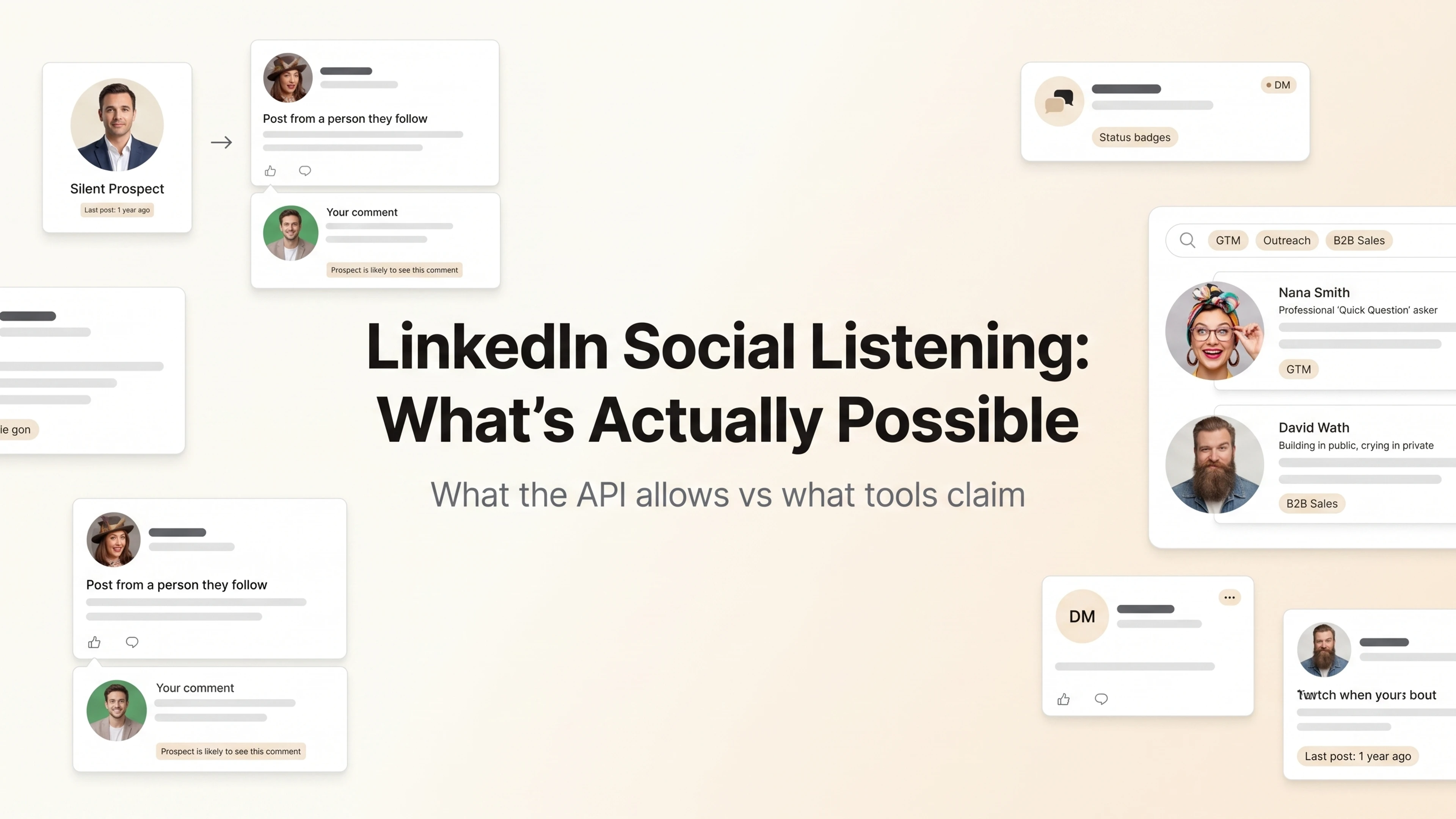
Extrovert tracks your prospects and topics, then suggests warm, on-brand comments and DMs from your playbook. You review and send.
See how it worksWhy Does Acting on the Signal Matter More Than Collecting It?
A dashboard that shows you a prospect posted three hours ago is only useful if you do something with it before the moment passes. Reps with high Social Selling Index scores generate 45% more opportunities and are 51% more likely to hit quota, and the pattern behind that stat isn't passive monitoring. It's consistent engagement: commenting on the right posts before you ever send a connection request or a pitch.
Response-rate data backs this up. LinkedIn response rates average 10.3%, more than double the rate of cold email, but that number collapses fast when the outreach is cold and unrecognized. Connection-note reply rates fell from 3.5% in May 2025 to 2.2% by April 2026, a 37% relative drop, largely because reps are sending more templated first-touches to people who've never seen their name before.
Warm outreach flips that: you show up in a prospect's comments for a week or two before you ever DM them, so by the time you reach out, you're a familiar name instead of a cold one.
Social listening on LinkedIn works when it's narrow: a defined list of prospects, watched consistently, acted on quickly. It breaks when vendors promise open-network monitoring the platform's own API doesn't support.
How Should SDRs and AEs Actually Use LinkedIn Social Listening?
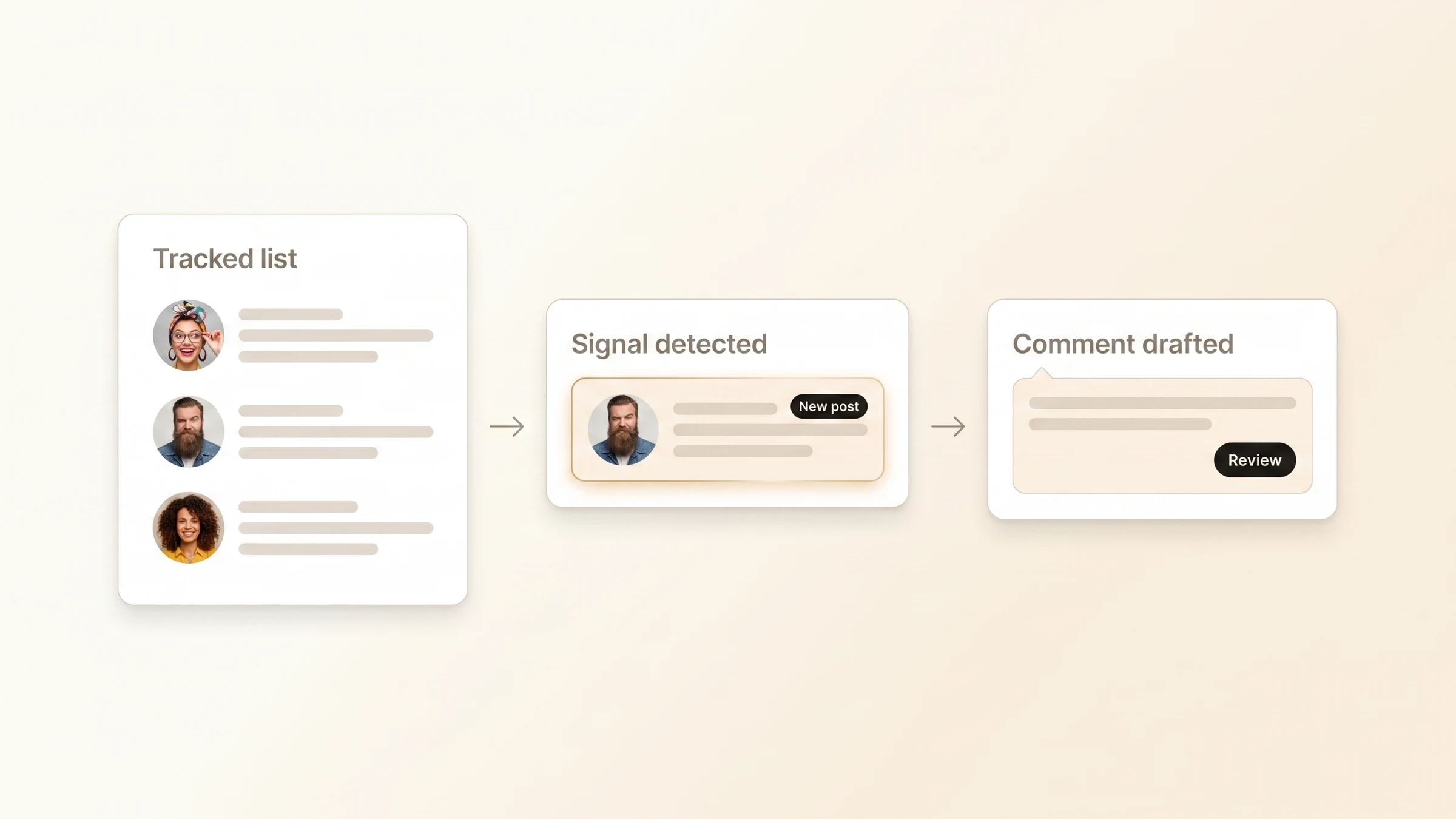
- Build a named list, not a keyword search. Import your target accounts and champions instead of trying to "listen" to the open platform.
- Track posts and job changes on that list daily. This is where real buying signals show up: a prospect posting about a problem, a champion moving to a new company, a target exec engaging with a competitor.
- Comment before you pitch. Reply genuinely to a post before sending a connection request or DM. It's the difference between a 2.2% cold reply rate and something closer to double-digit warm response rates.
- Keep a human in the loop. Every comment and DM should get reviewed before it sends. It keeps the account within normal usage patterns and keeps the message actually sounding like you.
- Feed what you learn into a longer cadence, not a one-shot sequence. A prospect who doesn't reply this week might reply after three more weeks of seeing you show up.
This is the practical version of engagement-led prospecting: fewer accounts, watched more closely, engaged more genuinely, over a longer window than a typical 2-week sequence gives up on.
What This Means for SDRs and AEs Specifically
SDRs running high account volumes benefit most from narrowing scope: a tracked list of 30-50 target accounts beats a vague "listen for anyone talking about X" search that LinkedIn's API can't support anyway. AEs managing existing pipeline get more value from tracking champions and economic buyers inside accounts already in play, watching for job changes, promotions, or posts that signal timing (a new budget cycle, a reorg, a stated pain point).
Both roles run into the same wall if they expect a tool to "listen" to the whole platform. The honest workflow is narrower, more manual in spirit, and more effective in practice than the pitch most social listening vendors lead with.
See how SDRs use Extrovert to warm up accounts and show up on prospects' posts before the first touch.
Extrovert for SDRsFAQ
What is LinkedIn social listening?
LinkedIn social listening is the practice of monitoring posts, comments, and activity on LinkedIn to surface mentions, sentiment, or buying signals. Unlike open-network listening on X or Instagram, LinkedIn's API restricts third-party access mostly to pages and accounts you control, so effective listening usually means tracking a defined list of people and companies rather than searching the whole platform.
Can you legally scrape LinkedIn for social listening?
Scraping public LinkedIn data isn't automatically a federal crime, based on the hiQ Labs v. LinkedIn ruling, but it still violates LinkedIn's User Agreement as a contractual matter. Tools that scrape risk account suspension and unreliable data collection when LinkedIn changes its site structure or blocks automated traffic.
What's the difference between LinkedIn social listening and sales intelligence tools?
Social listening tracks activity and sentiment (posts, comments, mentions), while sales intelligence tools like Sales Navigator or ZoomInfo focus on finding and enriching prospect data (titles, emails, firmographics). The two are complementary: intelligence tools help you build the list, and listening tells you when to act on it.
How do I track buying signals on LinkedIn without violating the terms of service?
Track a defined list of prospects and customers by following their public posts and profile activity as a normal logged-in user, which is standard LinkedIn usage. Watching for job changes, promotions, and posts about relevant pain points on accounts you've already identified, rather than scraping the open network, is what buying-signal tracking looks like in pipeline nurturing practice.
Does LinkedIn social listening apply to recruiters too?
Yes. Recruiters can track candidate and target-company activity the same way sales teams track prospects: watching for job changes, posts about frustration with a current role, or company news that signals hiring intent, all through normal profile and feed activity rather than scraping.
How much time does effective LinkedIn social listening take per day?
A focused list of prospects and topics, reviewed daily, takes roughly 15 minutes for a rep to scan and act on with the right workflow. That's a fraction of the time a broad, low-signal "monitor everything" approach demands, and it produces more usable signal because the list is already qualified.
Why did LinkedIn connection-note reply rates drop in 2026?
Connection-note reply rates fell from 3.5% in May 2025 to 2.2% by April 2026, a 37% relative decline, as more reps sent templated first-touch messages to cold, unrecognized names. Warming up a prospect through genuine comments before the connection request is one of the few levers reps have to counter that decline.
Can small teams or founders do LinkedIn social listening without a big tool budget?
Yes. A founder or small team can track a short list of prospects and customers manually, or use a lightweight tool built for narrow, prospect-level tracking rather than broad platform-wide monitoring, which is the only kind LinkedIn's API actually supports at scale anyway.
Sources: Mentionlytics: Social Listening on LinkedIn, connectsafely.ai: Is LinkedIn Automation Safe in 2026, Overloop: LinkedIn Outreach Benchmarks 2026, Yadulink: LinkedIn Outreach Benchmarks 2026