In March 2026, LinkedIn permanently removed HeyReach's company page (16,400 followers), banned the founder's personal profile, and pulled the accounts of its CEO and CMO. HeyReach had roughly 30,000 active users at the time. The trigger was not one bad actor: it was the tool's cloud-proxy architecture, the same architecture dozens of other automation vendors use to run LinkedIn actions from a server instead of your browser.
That case is the clearest signal yet of where LinkedIn's enforcement is heading in 2026. If you run outbound on LinkedIn, or you are a founder whose personal profile is your company's pipeline, understanding LinkedIn automation ban risk (why tools get flagged, and what still works) is not optional research. It is the difference between a growing feed presence and a suspended account with no backup.
This post covers what LinkedIn actually prohibits, how its detection systems catch automated behavior, what happened in the HeyReach case, and what a founder should do instead to keep building pipeline without gambling the account.
What counts as "automation" under LinkedIn's rules?
LinkedIn's own User Agreement, Section 8.2, bars "crawlers," bots, browser plug-ins, or extensions that scrape, modify, or automate activity on the platform. The prohibited list is broad: software that copies profile data, sends connection requests, sends or redirects messages, or accesses the service in ways a human would not.
In practice, three types of tools get caught. Cloud-based automation, the HeyReach category, runs outreach from a remote server using your session cookie, so LinkedIn sees activity happening without your browser open. Browser-extension automation injects scripts into your own Chrome session that click, scroll, and send on a schedule. Scraping tools pull profile data or search results in bulk, often paired with one of the outreach layers above.
Cold outreach tools built on any of these three layers are the ones LinkedIn is enforcing against hardest, because volume and velocity are the easiest automated behavior to spot.
How does LinkedIn actually detect automation?
LinkedIn does not rely on a single tripwire. It layers several detection methods together, and none of them require the platform to "catch" you mid-action.
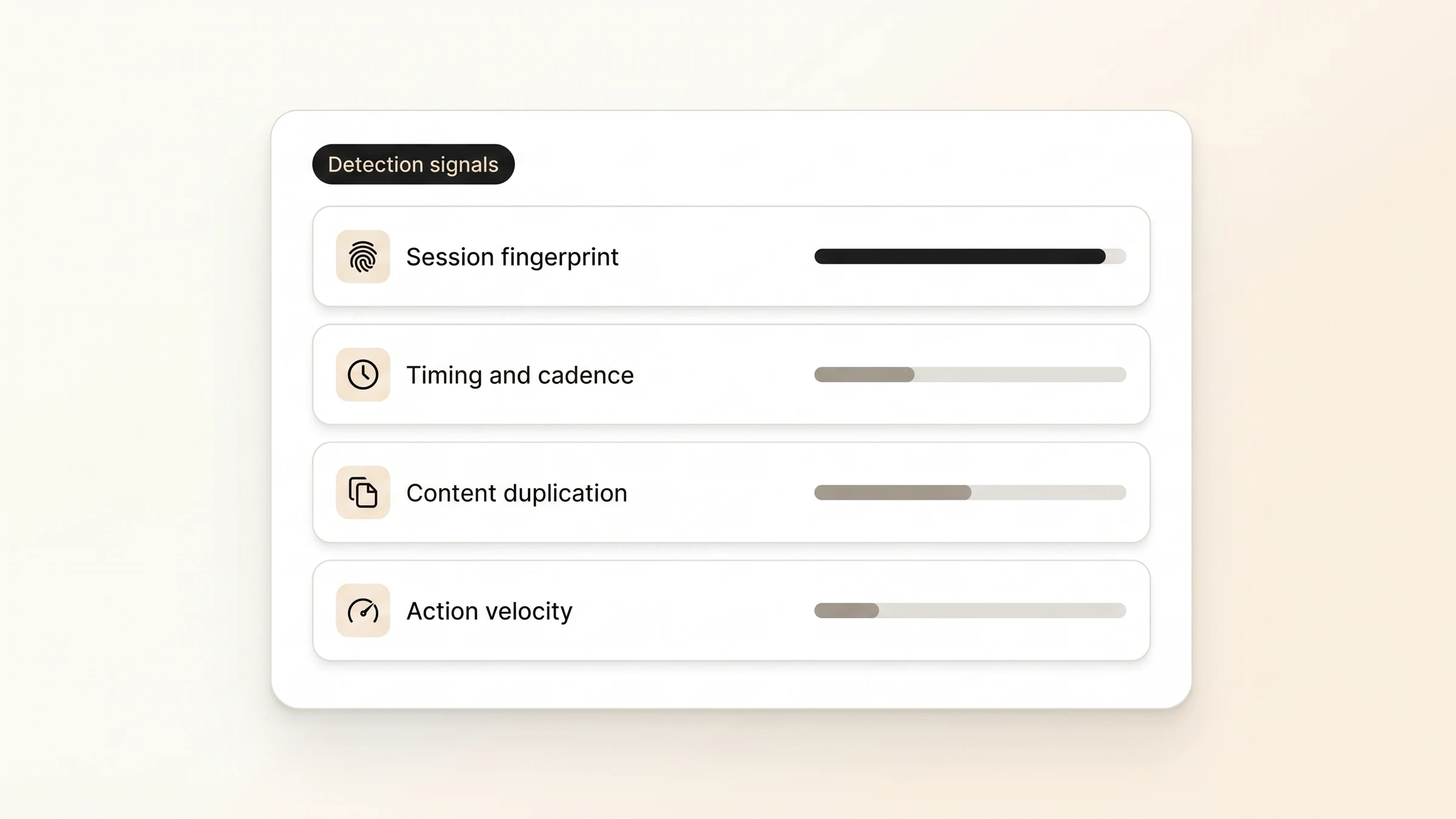
Automated sessions move differently than people do. Perfectly timed clicks, constant scroll speed, and connection requests sent at fixed intervals are the clearest behavioral signal LinkedIn checks for; a real user's session has natural variance, a script's does not.
LinkedIn also checks session and device fingerprinting: browser signature and IP consistency across logins. A sudden shift to a datacenter IP range, or a device signature that does not match your history, is one of the strongest single tells of a cloud-based tool.
Sending the identical opening line to fifty prospects creates a clear content-duplication cluster, even when each message goes out from a different account. LinkedIn runs this check across DMs and connection notes.
A well-documented velocity trigger sits around 100 to 200 connection requests a week. Cross that, or spike your profile views, and expect a temporary cap on outbound actions before a full restriction.
If your outreach tool runs from a server you cannot see, you cannot audit what "human-like" behavior it claims to simulate. That is the exact blind spot LinkedIn's 2026 enforcement is built to exploit.
What happened when LinkedIn banned HeyReach?
The HeyReach case is worth walking through because it shows enforcement has moved from individual accounts to the vendor level.
LinkedIn removed HeyReach's company page and banned its founder and two executives' personal profiles, while the underlying tool kept running for existing customers. That distinction matters: LinkedIn went after the vendor's presence on the platform, not (yet) every individual customer account, though industry reporting puts Q1 2026 restriction rates for cloud-proxy tools at roughly 4 in 10 accounts.
The lesson for a founder is not "avoid HeyReach specifically." It is that any tool built on a cloud-proxy or fake-browser-environment architecture is now a standing liability, regardless of which vendor sells it.
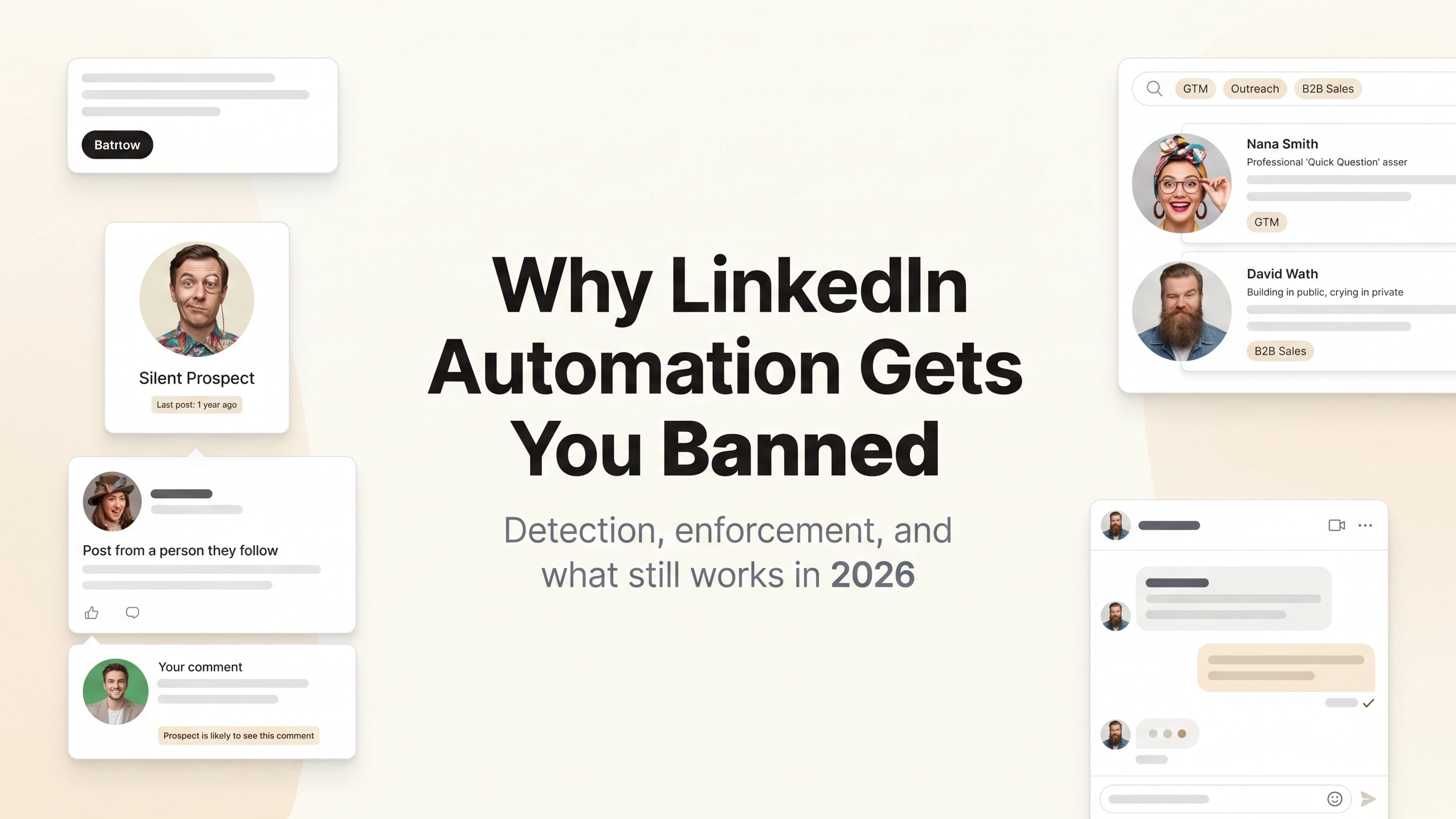
Extrovert tracks your prospects and topics, then suggests on-brand comments and DMs from your playbook. Every action is human-reviewed before it goes out.
See how it worksWhy does automation risk hit founders harder than SDRs?
An SDR whose account gets restricted is a bad week. A founder whose account gets restricted loses the channel that generates the company's pipeline, references, and often its hiring pipeline too, all at once. There is no backup rep to cover for a banned founder profile.
Founder-led sales runs on the founder being visible and recognizable, and a restricted or suspended profile erases both overnight while identity verification (LinkedIn now asks for a driver's license or passport upload on some restrictions) plays out over days or weeks.
That asymmetry is why the calculation is different for founder-led sales than it is for a 12-person SDR team spreading risk across a dozen accounts. One flagged tool, one shared login pattern, and the founder's own name goes dark on the platform where prospects actually look them up before a first call.
Automation vs. manual vs. engagement-led: what's the ban risk?
| Approach | Reply rate | Ban risk | Effort |
|---|---|---|---|
| Cloud-based automation (HeyReach-style) | Low to medium | High | Low |
| Browser-extension automation | Medium | High | Low to medium |
| Fully manual cold outreach | Medium | Low | High |
| Engagement-led warm outreach | High | Low | ~15 min/day |
Volume automation optimizes for one variable: how many touches you can send. LinkedIn's 2026 enforcement optimizes for the opposite variable: how obviously non-human those touches look in aggregate. The two goals cannot both win.
What's the difference between automation and AI-assisted outreach?
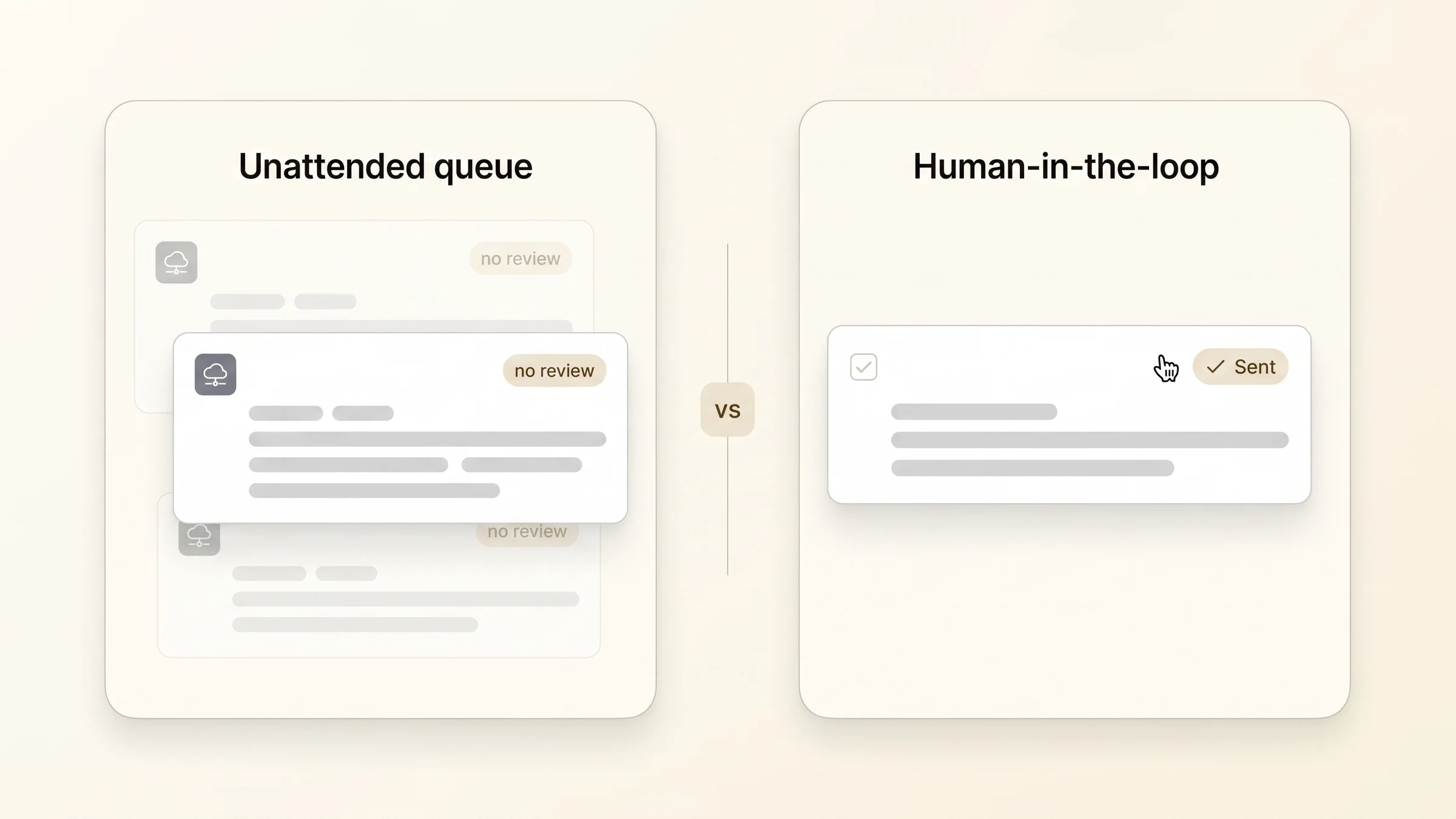
The distinction LinkedIn's detection systems actually care about is not "AI vs. no AI." It is whether a human is in the loop before anything sends.
An automation tool queues actions and executes them without a person reviewing each one, often from infrastructure LinkedIn can fingerprint as non-browser traffic. An AI-assisted workflow drafts a comment or DM suggestion from your own playbook, a person reads it, edits it if needed, and only then sends it from their own logged-in session.
That review step is not a compliance checkbox. It is what keeps the action pattern looking like what it is: a person, using their own browser, on their own schedule, occasionally slower and occasionally faster, the way real usage actually looks. Nothing posts or sends without approval, which avoids the unattended, server-driven activity LinkedIn's fingerprinting is built to catch. The human-in-the-loop workflow reduces account risk compared with fully automated sending; no tool, including a human-reviewed one, can promise an account is immune from LinkedIn's own enforcement decisions.
LinkedIn is not banning "outreach." It is banning unattended infrastructure. A person reviewing and sending every action from their own session is a fundamentally different signal than a server running your account while you sleep.
How does LinkedIn's detection stack actually score an account?
| Signal | What LinkedIn checks | Why it flags automation |
|---|---|---|
| Session fingerprint | Browser signature, IP range, device consistency | Cloud-proxy tools run from datacenter IPs, not your device |
| Timing and cadence | Interval between actions, active hours | Scripts hold rigid intervals; people don't |
| Content patterns | Duplicate DM or invite text across recipients | Templated blasts cluster identically |
| Action velocity | Connection requests, profile views per week | Bulk automation exceeds normal weekly caps fast |
Building genuine variety into a comment or DM, sourced from an actual playbook rather than one template copy-pasted at scale, is one of the few variables a person fully controls here. A free LinkedIn comment generator that drafts a fresh angle per post beats reusing the same three lines across fifty prospects, both for reply rate and for staying off the duplicate-content cluster LinkedIn is watching for.
How to recover if your account already got restricted
A first restriction usually shows up as limited feature access or a temporary cap on invites and messages. Escalation moves fast from there: a second flag typically forces identity verification, and a third can mean permanent loss of the account.
If you land in the first tier, stop all automated or scripted activity immediately, including any browser extension you forgot was still running. Slow your manual pace for one to two weeks: fewer connection requests, longer gaps between actions, and no copy-paste templates. LinkedIn's own appeal process is the only path back for a restricted account; there is no workaround that speeds it up.
Rebuilding trust after a restriction looks a lot like the engagement-led prospecting LinkedIn rewards anyway: commenting genuinely on posts before sending anything, spacing out connection requests, and varying your language prospect to prospect. It is slower than automation. It is also the version of the account LinkedIn does not flag.
Warm, human-reviewed LinkedIn engagement, from solo founders to whole revenue teams.
See pricingFAQ
What is LinkedIn automation, exactly?
LinkedIn automation is any third-party software, bot, script, or browser extension that performs actions on your account, such as sending connection requests, DMs, or profile views, without a person manually triggering each one. LinkedIn's User Agreement (Section 8.2) explicitly prohibits crawlers, bots, and browser add-ons that automate activity on the platform.
Does LinkedIn actually ban accounts for using automation tools?
Yes. LinkedIn moved from warnings to suspensions for first-time violations in 2025 and 2026, and in March 2026 it took action against the automation vendor HeyReach directly, removing the company's page and banning its founder's personal profile. Enforcement has extended beyond individual users to the vendors building the tools.
How does LinkedIn detect automation tools?
LinkedIn combines behavioral analysis (click and scroll patterns, timing consistency), session fingerprinting (browser signature, IP range), and content duplication checks (identical DM or invite text sent to many recipients) rather than relying on a single detection method. Bulk actions, like pulling thousands of profiles or sending hundreds of connection requests in a week, are the fastest way to trip these systems.
What happens after a first LinkedIn restriction?
A first restriction typically limits feature access, such as capping connection requests or messages, rather than suspending the account outright. Repeated violations escalate quickly: a second warning often requires identity verification, and a third can result in permanent account loss.
Is any LinkedIn automation safe to use?
No automation tool can guarantee an account will never be restricted, since LinkedIn's own enforcement decisions are outside any vendor's control. The lower-risk approach is a human-in-the-loop workflow, where a person reviews and sends every comment or DM from their own logged-in session instead of a script running unattended.
How does automation risk differ for founders versus SDRs?
A founder's personal profile is often the company's primary pipeline channel, so a restriction removes both individual reach and company credibility at once, while an SDR team can typically spread outbound across multiple accounts. That makes the cost of a banned account materially higher for founder-led sales than for a distributed SDR team.
What should I use instead of LinkedIn automation?
Engagement-led, human-reviewed outreach, commenting on a prospect's posts before sending a connection request or DM, builds familiarity without the unattended server activity LinkedIn's detection systems are built to catch. This is slower to start than mass automation but produces higher reply rates and does not carry the same account risk documented in LinkedIn's 2026 enforcement wave.
Sources: Prohibited software and extensions, LinkedIn Help, Northlight: Why LinkedIn Banned HeyReach, Marketing Experts Hub: LinkedIn Banned HeyReach.io